A subject state is a country that has agreed, or been forced, to answer to an overlord. It stays a country: it keeps its own government, land and armies. What changes is what it owes and what the overlord may ask. That is written down in a Subject Agreement made of clauses, and the clauses alone decide how heavy the relationship is. No clause, no power.
Where to find it
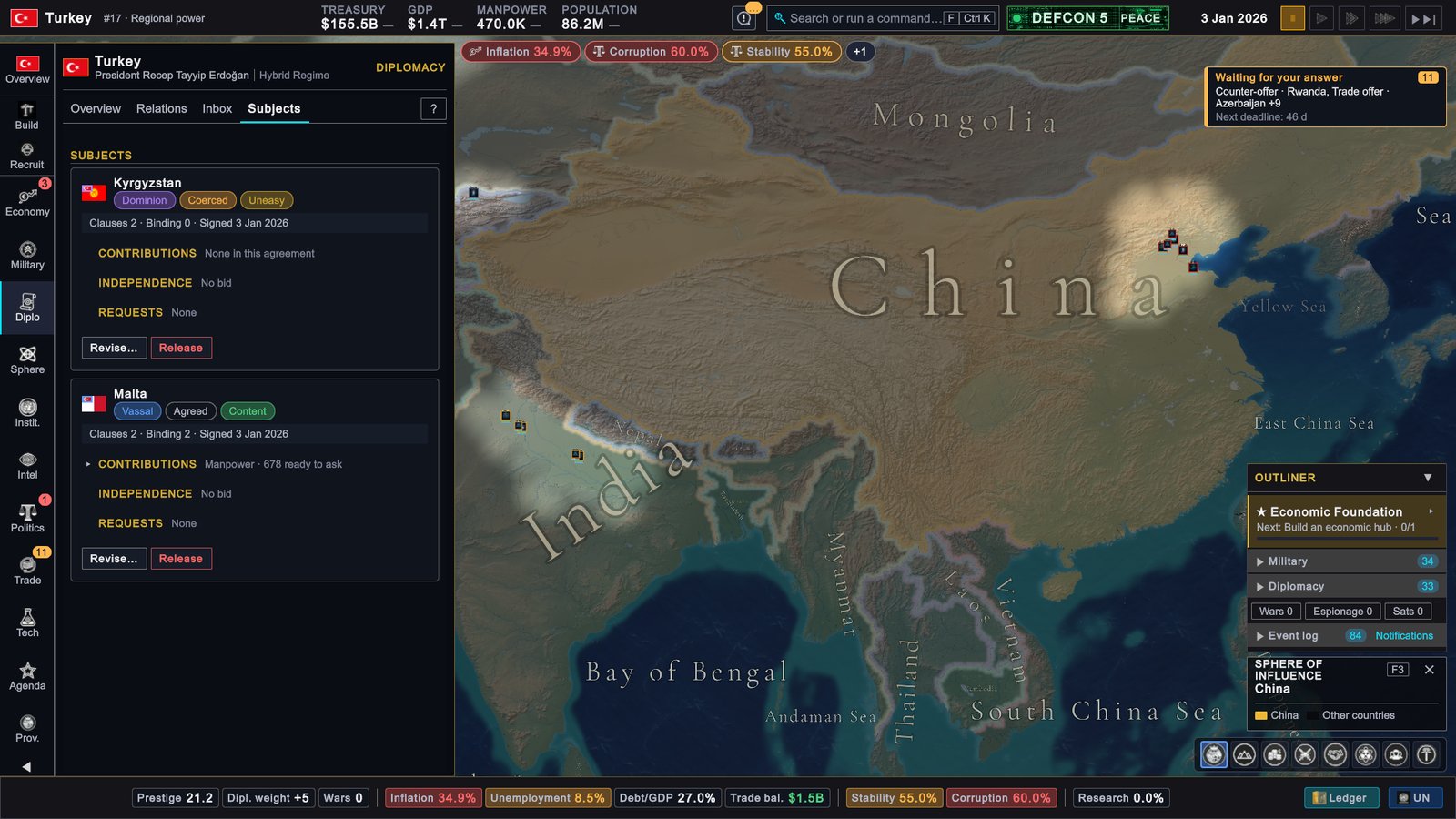
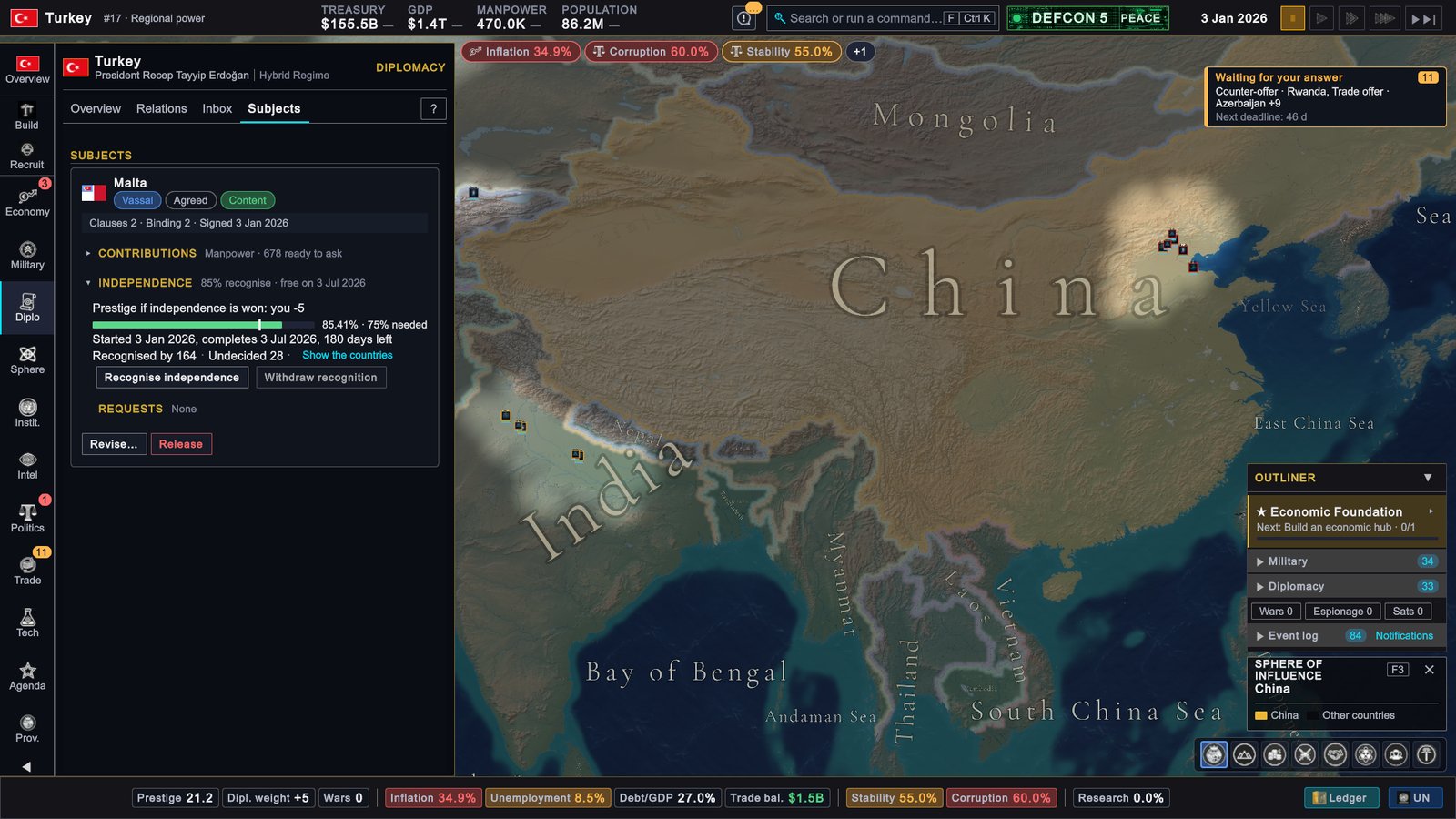
- Diplomacy › Subjects. Every agreement you are in: the subjects you hold, or the overlord you answer to. Each card shows the status, how it began, the subject’s mood, the clauses in words and the buttons that fit your role. Three fold-outs open on the card: Contributions, Independence and Requests (approvals, law directives and duties still waiting for an answer). A fold-out with nothing in it stays closed.
- Another country’s Diplomacy page › Subjects. To make an agreement, open that country’s Diplomacy page, choose Subjects and propose clauses there.
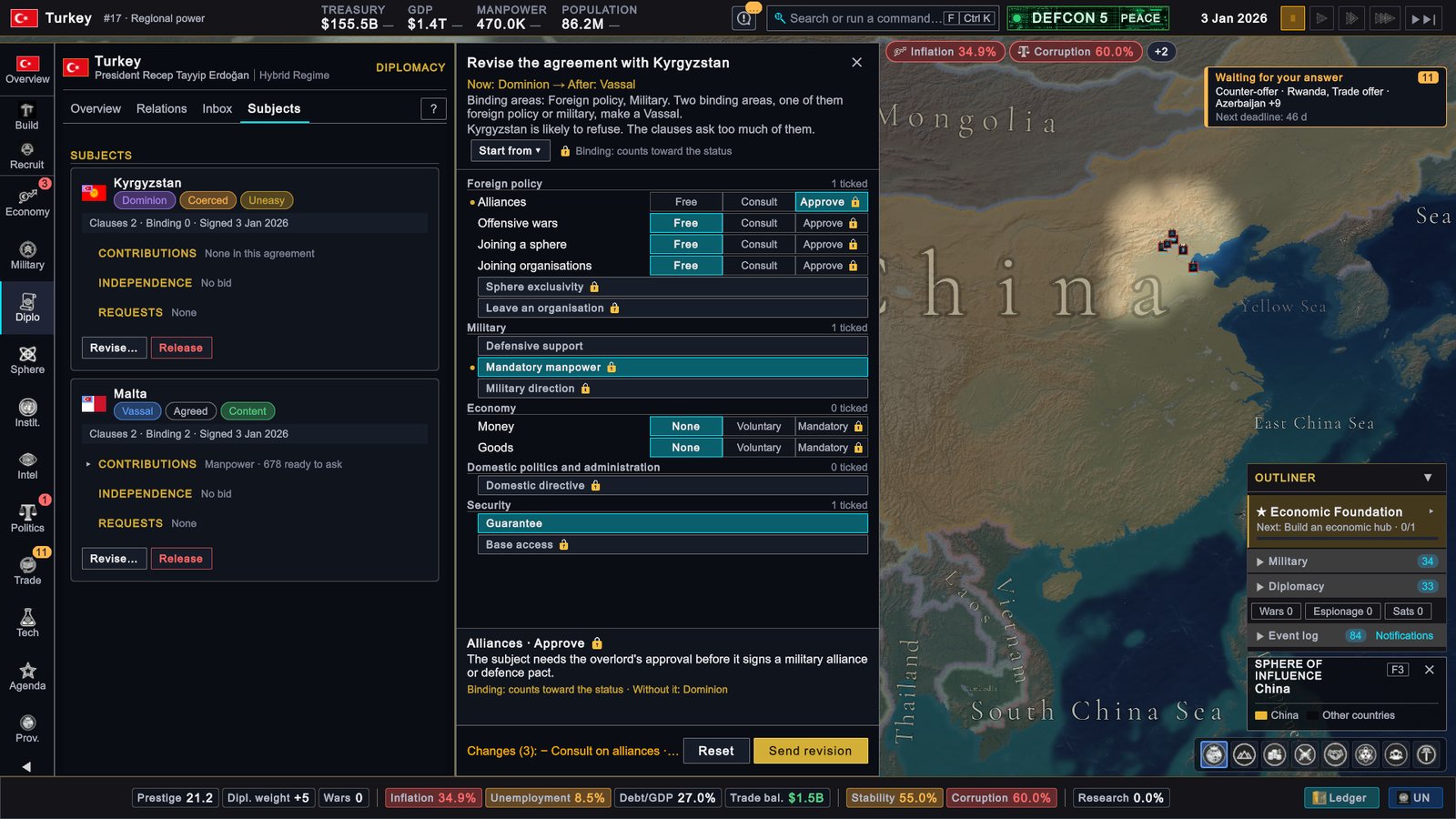
- The clause editor. Revise…, a proposal, Counter… and the peace view’s Change the clauses all open the same editor beside the sidebar: one line per clause, the resulting status and the likely answer (or, in a peace, the price) at the top, and the changes and the send button pinned at the bottom.
- Sphere of Influence › My sphere. A Subjects and overlord card shows how many subjects you hold, your status and their names, with Open Subjects.
- The flag. A subject’s flag carries its overlord’s flag in the top-left corner, framed by a border that shows the status: violet for a Dominion, blue for a Vassal, rose for a Comprehensive Central Authority. On the smallest flags only the coloured border shows.
- The country card and the map. A badge on a country’s card names its status, or reads Overlord. Click it to colour the overlord and its subjects on the map.
- Diplomacy › Inbox. Proposals, contribution requests, approval requests and law directives wait here. A notice titled Subject agreement reports every change.
How it works
Clauses in five areas
An agreement is a set of clauses in five areas. A clause is Binding when it gives the overlord real authority: a veto, a mandatory contribution or an order the subject must follow. Consulting and optional support never bind.
| Area | Clauses | Binding ones |
|---|---|---|
| Foreign policy | Consult on alliances, offensive wars, joining a sphere, joining organisations. Approve the same four. Sphere exclusivity. Leave an organisation | The four approvals, sphere exclusivity and leaving an organisation |
| Military | Defensive support. Mandatory manpower. Military direction | Mandatory manpower and military direction |
| Economy | Voluntary money, voluntary goods. Mandatory money, mandatory goods | The two mandatory ones |
| Domestic politics and administration | Domestic directive, for the law categories you name | The directive |
| Security | Guarantee. Base access | Base access. A guarantee is a real obligation, but gives no authority |
What each clause does:
- Consult means the subject tells the overlord before it acts. Nothing is blocked. You cannot both consult and require approval for the same act.
- Approve means the subject needs the overlord’s approval before it signs an alliance or defence pact, declares an offensive war, joins a sphere or applies to an organisation.
- Sphere exclusivity bars the subject from another leader’s sphere. It cannot be signed while the subject is in one.
- Leave an organisation lets the overlord require the subject to start leaving the organisations you name, within 30 days. Missing the deadline is a breach.
- Defensive support lets the overlord call the subject into a war in which the overlord is attacked. The subject may decline at no cost. Military direction lets it call the subject into any war it fights, and the subject must answer. It never joins on its own.
- Money and goods let the overlord ask for money from the treasury, or for each resource you name. A voluntary clause may be refused for free. A mandatory one must be met when the request is valid and the subject can pay. Mandatory manpower works the same way.
- Domestic directive lets the overlord direct the subject to adopt a law in the categories named. The subject adopts it only through its own law process, with its own cost, vote and cooldown. With no domestic clause, the subject keeps local autonomy.
- Guarantee means an attack on the subject calls the overlord in. Base access lets the overlord’s land armies enter and stay in the subject’s territory, in peace and war, one way only.
An agreement needs at least one real obligation: a guarantee, an approval, a mandatory contribution and so on. Consultation and voluntary clauses are not enough alone.
Three statuses, from the clauses
The game never stores a status. It works one out from the clauses, and the clause editor shows the result under Resulting status as you tick them, with a line that names the binding areas and the rule they meet. Each area counts once, however many binding clauses it holds. Selecting a clause shows its full effect, whether it binds, and the status it would make.
| Status | What the clauses must give |
|---|---|
| Dominion | At least one real obligation. No binding authority is needed. The subject keeps broad autonomy |
| Vassal | Binding authority in at least two areas, one of them foreign policy or military |
| Comprehensive Central Authority | Binding authority in at least four areas, one of them domestic politics and administration |
So approvals plus mandatory manpower make a Vassal. Mandatory money plus base access are two areas, but neither is foreign policy or military, so that stays a Dominion. Ticking another binding clause in a new area can raise the status; unticking one can lower it, and the editor says so before you do.
Making an agreement in peace time
Either side can propose. Press Make them your subject… on their Subjects page, or Become their subject… to offer yourself. Tick the clauses and press Send proposal. The other country answers; nothing changes until it does. A proposal nobody answers lapses after 30 days.
- A player decides for themselves. Only the country’s own player can accept an agreement. A counter-proposal, Counter…, returns different clauses and closes the first.
- An AI country weighs it. It looks at its relations and trust, your influence and strength, the threats it sees, and how heavy the clauses are against what it gains. The editor shows Likely answer, and a refusal gives a reason such as “Their relations with you are too cold” or “The clauses ask too much of them”.
- A Dominion must pass a check. To propose a Dominion in peace time you need a relevant sphere of influence over the country, and enough combined economic, trade and military weight over it. Strength in one makes up for weakness in another. The country’s Subjects page shows each part of the check against what is needed. The check is made once, when the Dominion is formed. It does not apply to a Vassal, to a peace term or to an agreement that already exists.
- Limits. A country has one overlord at most. A subject cannot hold subjects of its own, and cannot become an overlord.
Later, either side can propose new clauses with Revise… (the overlord) or Ask for different clauses… (the subject). The other side must agree. A revision can lighten an agreement, for example by dropping its binding clauses so that it becomes a Dominion, but it can never leave it without an obligation: that would not be an agreement.
Making one in a peace
Winning a war can make the loser a subject. In the peace view you demand a Subject Agreement and write the clauses. Your side must have held the loser’s capital and enough of its value to make it capitulate, without a break, for twelve months. It can be a Dominion or a Vassal, never a Comprehensive Central Authority: the editor greys every clause that would make one, and no province moves. Sphere exclusivity cannot be demanded from a loser that sits in another leader’s sphere. The price rises with the number of areas the clauses bind and with the size of the country, and again if the loser can still strike back with nuclear weapons. It adds aggressive expansion, far less than annexing the country. See Peace and occupation.
An agreement forced on a country is remembered: its card reads Imposed in a peace deal, and the subject’s mood suffers.
Contributions
Binding contribution clauses let the overlord draw money, goods or manpower from the subject. Draws run in an eight-year cycle with two stages.
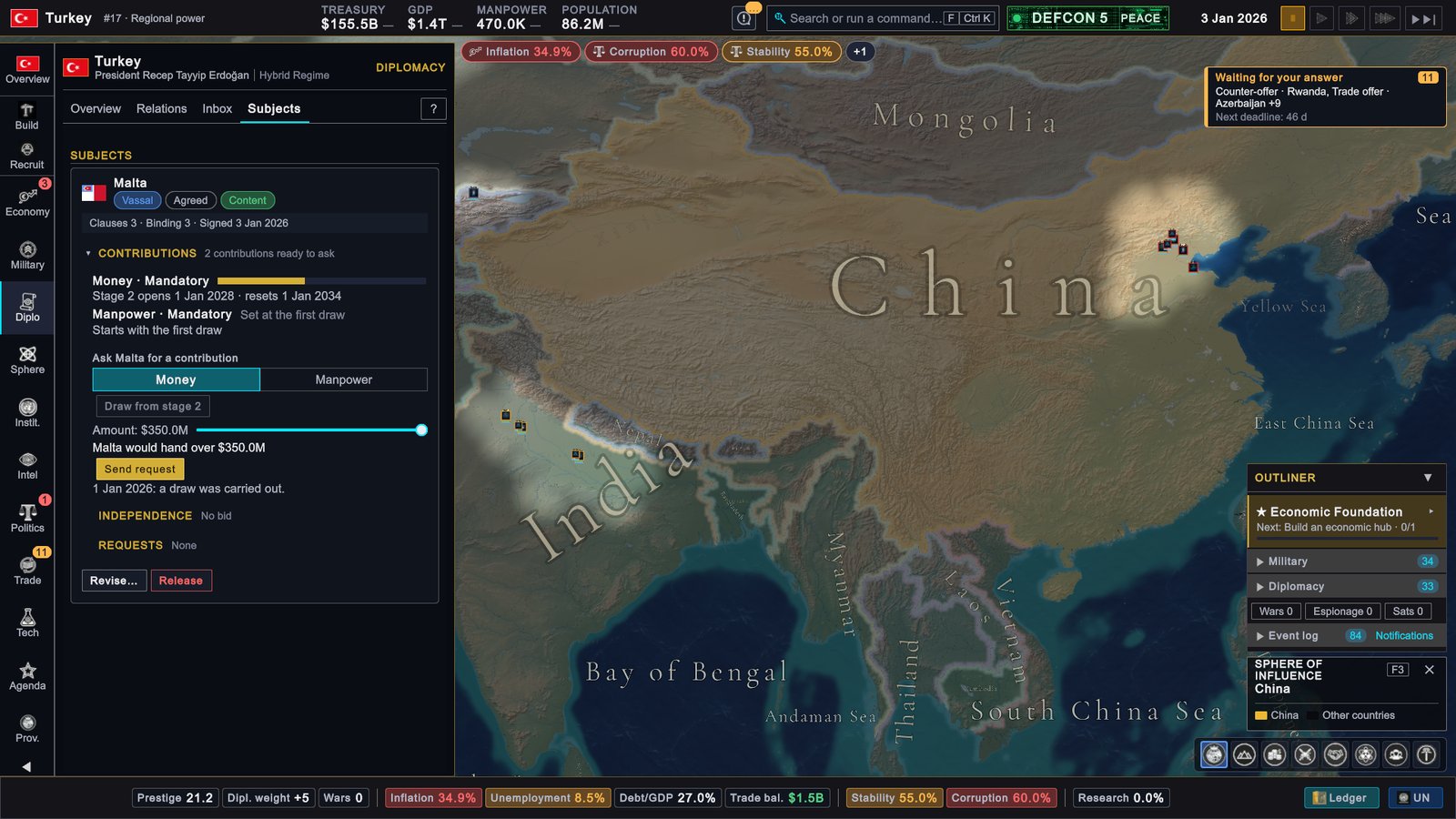
- The cycle starts with the first request that is carried out. Stage 1 allows up to 40% of what the subject can give at that moment.
- Stage 2 opens after two years. It allows up to 30% of what the subject can give when the first stage-2 draw is made.
- The first stage-2 draw closes the rest of stage 1 for good. The unused part is lost. The request screen warns you before you send it.
- When the cycle ends, unused entitlement retires. The next carried-out draw starts a new cycle.
To ask, press Contributions on the subject’s card, choose the kind and the stage, set the amount and press Send request. The subject answers within 30 days, counting only days its player is present. An accepted request is carried out once, at the next daily pass, and never takes more than three things allow: what the stage’s quota leaves, what the agreement allows and what the subject really has. That means money above its protected treasury floor, the exportable surplus of a resource, or its manpower pool, never its reserve or formed units. The panel shows Can give now, Stage 2 from, Cycle resets and the list of carried-out draws.
A request that runs out is never a breach. Refusing a mandatory request that the subject can meet is a breach. A breach costs 10 relations and 10 trust, and nothing more: the agreement stays.
Approvals, directives and calls
When a clause asks for approval, the acts it covers are greyed out for the subject, with the reason, until the overlord approves: an offensive war, an alliance or defence pact, a treaty, joining a sphere, an organisation or a trade bloc. The subject presses Ask for approval, picks the other party and sends the request. The overlord answers in its inbox, or at once if it is an AI. An approval allows one act with one party and lapses after a set number of days. Defensive wars and the war of independence never need approval. Refusing costs nothing, and a refusal shows its reason.
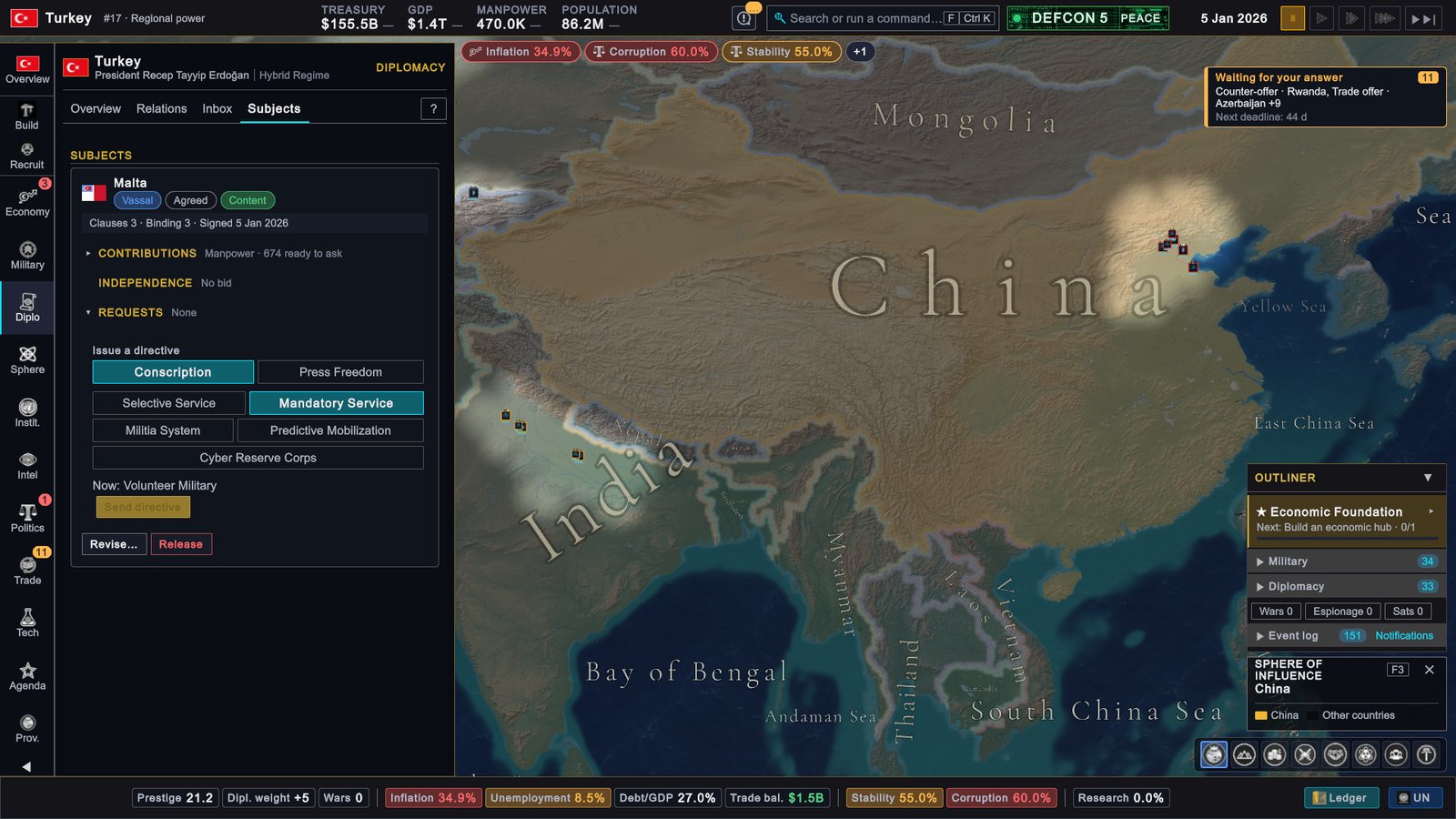
To give a directive, the overlord opens the Requests fold-out on the subject’s card and uses Issue a directive. It offers only the law categories the clause covers; pick the category and the law (your own by default), then Send directive. The overlord pays the cost of the law change: hover Send directive to see the cost, how the law passes in the subject (decree or vote) and its cooldown before you send. The button is greyed with the reason, and the numbers, when the change could not go through: the law is on its cooldown, a debate or law package is already running in the subject, the option is locked, you cannot pay, or the subject’s parliament would vote it down. It is also greyed while another directive in the same category waits for its answer.
The subject receives it as a Law directive in the inbox, naming the law and who pays. If it accepts, the change runs through its own law process: a decree takes effect at once, a parliament votes, and a debate can take months. The notices name the law and say what happened: adopted, debate started, voted down, or blocked with the reason. Refusing a directive outright is a breach. A change that cannot be carried out is never a breach. A call to arms under military direction works the same way: the subject must answer.
Prestige
An agreement weighs on both sides’ prestige for as long as it lasts.
| Dominion | Vassal | Comprehensive Central Authority | |
|---|---|---|---|
| The subject | −3 | −6 | −10 |
| The overlord, per subject | +1 | +2 | +3 |
An overlord gains at most +8 from all its subjects together. Making an agreement also books a one-off change that fades over about three years: −5 for the subject and +3 for the overlord when it is negotiated, −10 and +5 when it is imposed in a peace. A subject that wins its independence gains +8 and its former overlord loses 5, also fading. Agreements that exist when a game starts book no one-off change.
The status bar’s Prestige tooltip and the Ledger list each of these lines. The proposal card, the peace term, the agreement card, the independence bid and the war of independence each state what both sides’ prestige does. With no bid open, the No bid line on the Independence fold-out says what independence would bring.
What a war between the two does
If the overlord and its subject stand on opposite sides of a war, the whole agreement is suspended while it lasts. The subject owes nothing and the overlord may take nothing: no contributions, requests, approvals, directives or calls, and no breach for a suspended clause. The contribution cycle keeps counting in calendar time, with no catch-up. If the subject wins an independence war, the agreement ends. After any other peace it resumes as it was, unless a term of that peace changes it: an overlord that wins a war of independence may revise the clauses. Winning alone adds no authority.
The subject’s mood
Both sides can read the subject’s mood on the Subjects card. It is never a number. It is a word on the card, Content, Uneasy, Restless or Seeking to leave, and its tooltip names the causes.
- What pushes it away. Low stability, unrest, a risk of a coup, nationalist feeling, discontented interest groups, poor relations or little trust with the overlord, heavy clauses, an agreement that was forced on it, and contributions drawn.
- What holds it. Its economic dependence on the overlord, and the protection the overlord gives it against countries that threaten it.
- Its chances to leave. Support abroad: rivals of the overlord on good terms with the subject, and UN members that recognise its independence or would recognise it. Its strength next to the overlord, and an overlord busy with wars elsewhere.
An AI subject acts on this only when its real politics and its chances give it a reason. A restless one asks for lighter clauses. One that is looking for a way out declares a war of independence if its side is strong enough, and otherwise opens a bid for recognition when it has backers or enough UN members would recognise it. It needs no foreign backer for that. If nobody would recognise it, it asks for lighter clauses or for an agreed end. Nothing happens on a timer.
Ways out
An agreement ends in one of these ways.
- The overlord releases the subject. Press Release on the card. If the agreement has lasted at least five years, the freed country thinks better of its former overlord: relations rise by 20, with some trust.
- An agreed end. The subject presses Ask to end the agreement… and the overlord accepts. Only the subject can ask; an overlord that wants out releases its subject instead.
- Recognition. The subject presses Open bid in the Independence fold-out of its card. Any country can press Recognise independence, and take it back with Withdraw recognition. Only eligible members of the United Nations count, and the subject never counts itself. When at least 75% of them recognise it, a window starts. The share is tested at the end of every day, and if it stays at 75% or more for six calendar months, the agreement ends and no province changes hands. Any day that falls short restarts the count. The panel shows the share, a band from little to overwhelming support, who recognises, who has not decided and the window’s dates; Show the countries lists every country that recognises the bid and every undecided member, alphabetically. While the bid is open the agreement stays in force. The subject can close its bid at any time, and every recognition goes with it.
- A war of independence. A subject can declare a War of Independence on its own overlord and nobody else. It suspends the agreement. Winning it ends the agreement through the peace. There is no aggressive expansion price for declaring it.
- A third country’s peace. A country that beats the overlord can demand End Subject Agreement, naming the subject to free.
- The overlord ceases to exist. The subject is free. The same happens if the subject is gone.
A country that has left cannot be taken back cheaply for a while: a Subject Agreement in a peace costs up to three times as much in the first years after you released it, falling back to normal over ten, but never more than holding all of its land gives (100).
What the AI does
- As an overlord, it offers an agreement only to a country in its sphere that has a reason to say yes: a threat it fears or a dependence on the overlord. The offer is a Dominion with a guarantee and consultation on alliances, or, to a much weaker country under threat, a Vassal with approvals, mandatory money and a domestic directive over every law category. Its Vassal terms in a peace carry the same directive. It keeps at most two subjects and makes a new offer rarely. It issues at most one directive to a subject a year, only for a law where its own differs, only while it holds twice the cost, and never to a subject that is restless or seeking to leave. It asks for contributions only from a subject that is not restless, money when its treasury is short and manpower when it is at war, and never goods. It releases a subject that is looking to leave with strong outside support, after two breaches, or when the guarantee has pulled it into too many wars. In a war it sometimes aims to make a clearly weaker enemy a subject, not take its land. A human target always decides for itself.
- As a subject, it follows its mood, as above. It agrees to a voluntary request only when it is at ease and on decent terms with the overlord.
- As a third country, it recognises a bid when it is closer to the subject than to the overlord, closer in ideology, or a rival of the overlord, and more readily when the agreement was forced on the subject in a war or under pressure. It is less likely to if it holds subjects of its own. An ally of the overlord never recognises, and takes any recognition back.
What to do
- Start light. A Dominion with a guarantee and consultation is a real agreement and costs the subject little. Add binding clauses only where you need them.
- Read the status in the editor before you send. It tells you what you are asking for, and Likely answer tells you whether an AI will take it.
- Watch the mood. A subject that is restless will ask to loosen the agreement. One that is looking for a way out will seek recognition abroad. Heavy clauses, contributions and a weak overlord push it that way.
- Plan the contribution cycle. Stage 2 costs you the rest of stage 1. Use stage 1 first.
- Keep it voluntary when you can. A refusal of a voluntary request costs nothing for either side.
- Defend a subject you guarantee. A guarantee calls you into its wars.
- Count the prestige. A Vassal or a central authority costs the subject more prestige every day it lasts, and imposing one in a peace costs it more at once. The overlord’s gain is capped, so a fourth or fifth subject adds little.