Envoys are your agents abroad. The game’s screens call them specialists. Each one is a named person you place in a foreign country, where they run one operation month after month, give you a standing bonus that grows the longer they stay, and act as your operative for espionage missions there.
Where to find it
Open Intelligence › Operations (Y by default, or Intel on the rail). My specialists at the top lists your roster, one card per person. The scientists and engineers some mods add to the Knowledge Network are a different thing.
How it works
Roster, capacity and recruiting
Every country starts with a full roster. Capacity runs from 3 to 10 and grows with your GDP, prestige and diplomatic weight. The header shows it as a count, for example 3/3, with an At capacity chip when it is full.
Recruiting costs $1.0B. The Recruit button opens three candidates, each with a name and an archetype. Hire one, or pay a tenth of the recruit price to dismiss a candidate and draw another. Specialists draw no salary. To make room, open ⋯ on a card and choose Dismiss…, which removes that person for good.
Archetypes
The archetype decides which operations a specialist can run abroad, what their presence gives you, and which espionage mission is their specialty.
| Archetype | Operations abroad | Standing bonus while deployed | Specialty mission |
|---|---|---|---|
| Economic Hitman | Trade Port Leverage, Debt Diplomacy | Higher export earnings | Sabotage Economy |
| Political Architect | Relation Cultivation, Election Interference, Regime Change Setup | Relations with the host improve a little every month | Influence Government; also the only one who can run Fund Opposition |
| Shadow Operator | Covert Sabotage, Election Interference | Your missions in the host succeed more often and are detected less | Sabotage Infrastructure |
| Tech Scout | Tech Acquisition, Research Acceleration | Faster research at home, and better mission odds in the host | Steal Technology |
Every deployed specialist can also run Gather Intelligence. The missions are described on the Intelligence and espionage page.
Deploying
-
Pick an idle specialist. On their card, press Deploy abroad…. A drawer opens beside the sidebar.
-
Choose the target. The list is sorted by relation, most hostile first, and shows your intel on each country and how many of your specialists are already there. Type to filter, press Show all countries for the full list, or use Pick on map.
-
Choose the operation. Each row shows the chance of success in each of the three phases and the exposure it adds per day. Hover a row for its effects and risks, then press Choose ›.
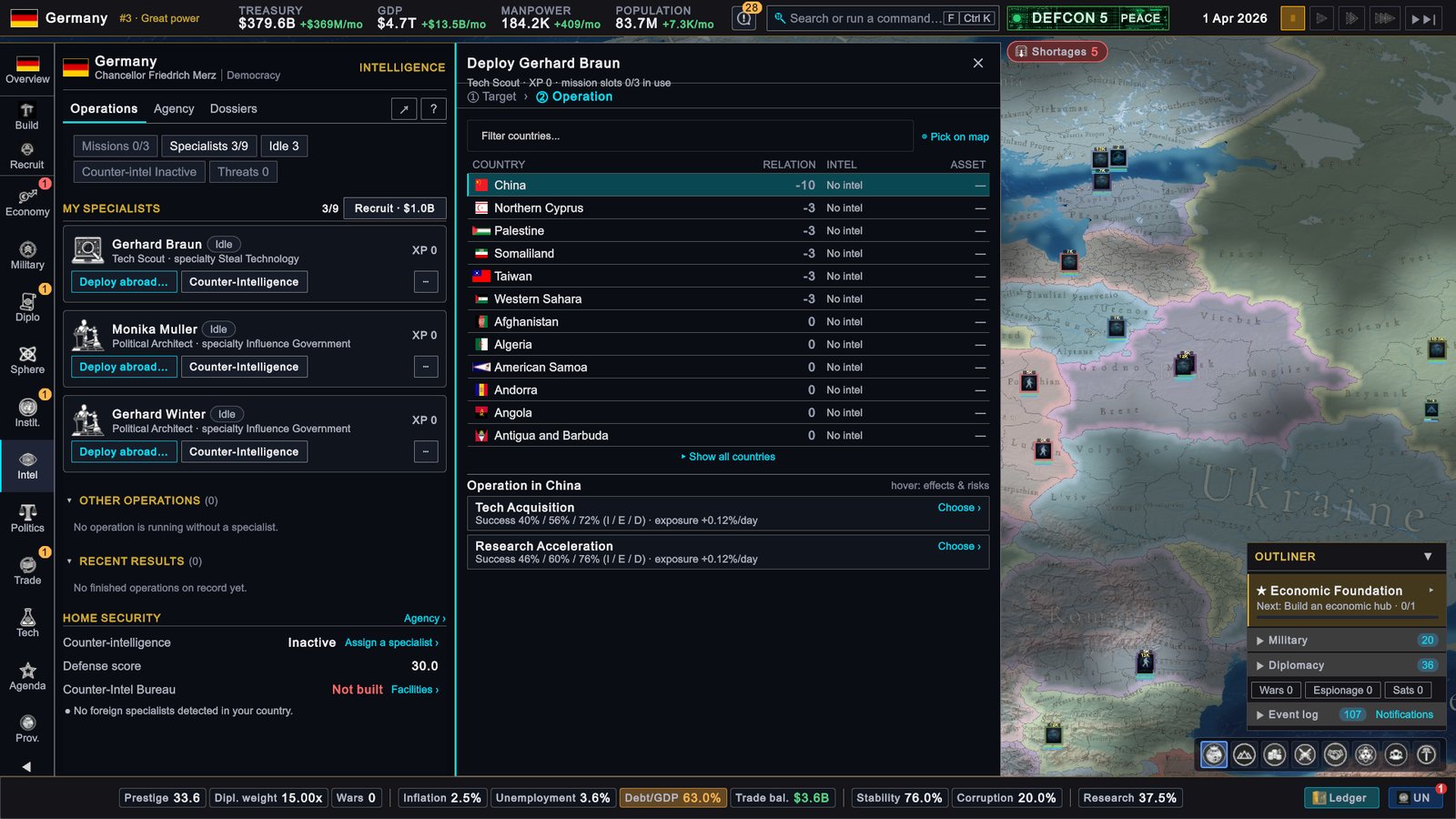
Germany, 1 April 2026: deploying a specialist. Step 1 is the target, step 2 the operation.
Deploying is free and takes effect at once. You cannot deploy to a country that has declared you persona non grata.
Three phases
A deployment grows through three phases, shown as a ladder on the card:
| Phase | When | What changes |
|---|---|---|
| Infiltration | The first 90 days | Lowest success chances, smallest bonus, slowest exposure |
| Established | From day 90 | Better chances and a larger bonus, faster exposure |
| Deep State | After 365 days, and only if you have completed Intelligence tier 3 in the Knowledge Network | Best chances and bonus, fastest exposure, and the signature |
Without Intelligence tier 3 a specialist stays Established however long they serve.
The monthly operation
Once a month the operation you chose is rolled against its success chance for the current phase.
- On success you gain money, and with most operations GDP as well. The target loses money and GDP, and relations with the target dip.
- On failure you usually lose money, relations fall further, and the specialist’s exposure jumps.
Relation Cultivation is the friendly exception: success raises relations and brings a small gain to both sides. Whatever the operation is called, its result is paid in treasury, GDP, relations and exposure. The hover on each operation lists the exact amounts.
A toast reports each result. The target of an operation that takes its money is told that a foreign operation hit it and which country ran it.
Exposure
Exposure measures how close a deployed specialist is to being caught, from 0 to 100%. It rises every day at a rate set by the archetype and phase, and jumps after a failed operation. While you are at peace a small daily decay is taken off that rise; while you are at war there is no decay, so exposure builds faster. The card shows the meter with an amber mark and the burn line.
At 95% the specialist is burned:
- They are lost. The card stays on your roster marked Burned and keeps its place until you dismiss it.
- Relations with the host drop by 50.
- You are persona non grata there for a year and cannot deploy to that country.
Other ways a deployment ends
- Recall. You bring the specialist home. They rest for 90 days and the position they built is gone: a new deployment starts again at Infiltration.
- Expelled by the host. The host has a monthly chance to detect a foreign specialist, higher in the later phases. If it expels yours, the effect is a recall plus a year as persona non grata.
- Caught on a mission. A specialist whose espionage mission is exposed is sent home for 90 days.
Signature
At Deep State the card gains Activate Signature, the specialist’s special operation against the host. Each use adds a large burst of exposure (20 to 30 points, by archetype) and starts a 180-day cooldown. A Shadow Operator’s signature removes the host’s province defence bonus when you attack it, for 60 days.
Experience
Each monthly result adds XP, shown on the card: 10 for a success, 3 for a failure. At 5, 15, 30 and 50 XP the specialist gains a trait that shifts their exposure rate or their chances. The card shows XP but does not list traits.
Limits and costs at a glance
| Roster size | 3 to 10, by GDP, prestige and diplomatic weight |
| Recruit | $1.0B; a new candidate for a tenth of that |
| Salary | None |
| Espionage missions | Three at a time across the whole roster, each with a monthly fee |
| Rest after recall or expulsion | 90 days |
| Signature cooldown | 180 days |
What to do
- Deploy early. The bonus and the success chances need 90 days to step up, and a year for Deep State. An idle specialist earns nothing.
- Match the archetype to the aim. Send a Political Architect with Relation Cultivation to a country you are courting, a Tech Scout to speed research, an Economic Hitman to a rival whose money you want.
- Watch the exposure meter. Recalling costs 90 days. Burning costs the specialist, 50 relations and a year locked out of the country.
- Expect more risk in wartime. Exposure has no decay while you are at war, so long deployments burn sooner.
- Research Intelligence tier 3 if you plan to keep specialists in place for more than a year.
- Keep one specialist where you want missions. Espionage missions against a country need someone deployed there.