Aircraft in Global Protocol are grouped into air wings. A wing does not march across the map like an army: it sits at an airfield or on a carrier and flies missions to targets within range of that base. Wings stop enemy bombers, tip land battles, wear down provinces and fleets, and lift the fog of war over a front.
Where to find it
- Military › Forces lists your wings under the Air filter. Military opens with M by default.
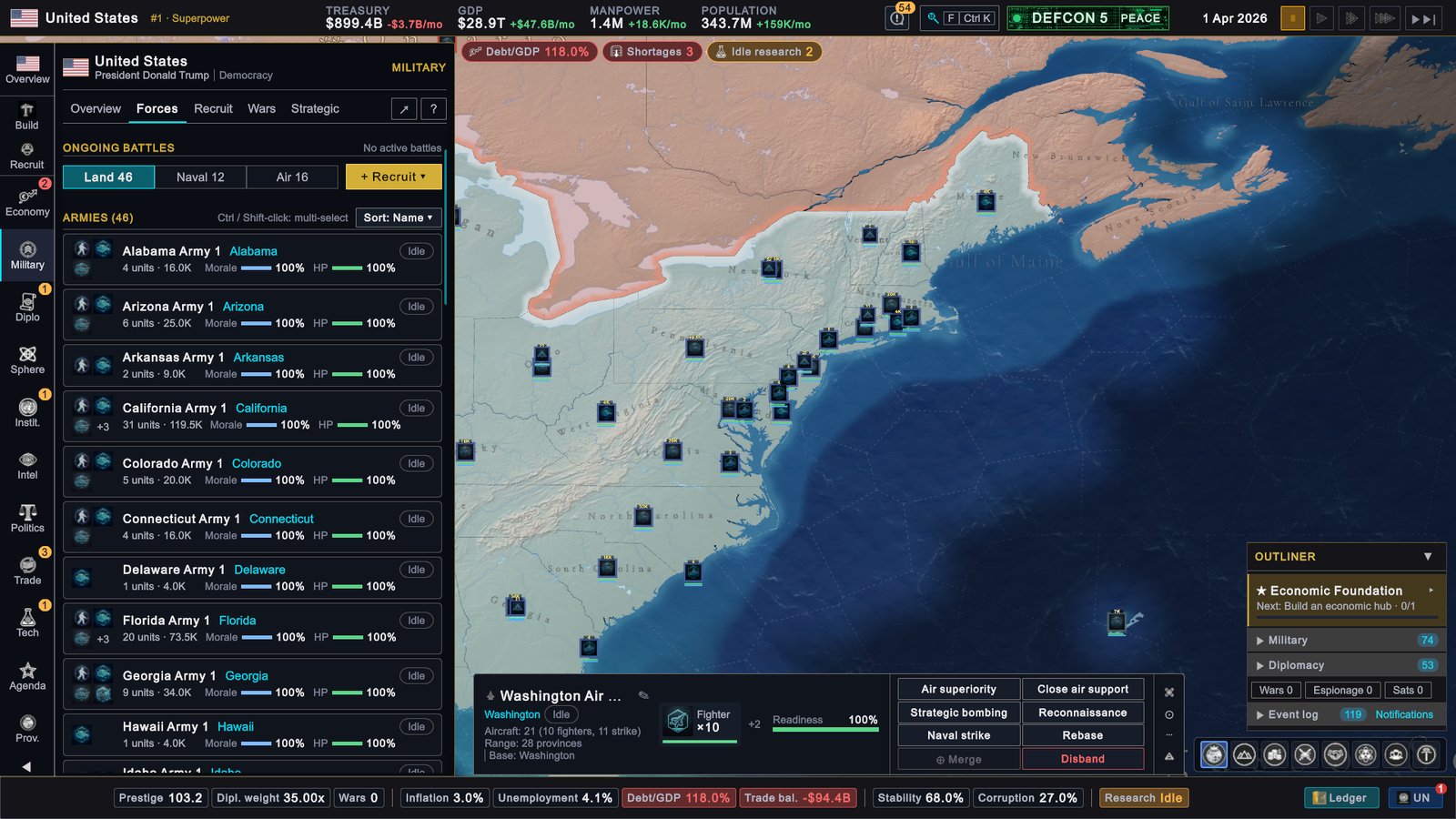
- Click a wing’s marker on the map, or its row in the list, to select it. The unit bar at the bottom of the screen then shows the wing and its orders. Wings are selected and commanded on the flat map, not on the globe view.
- New aircraft are ordered on Military › Recruit, in a province that has an Airfield.
How it works
Aircraft and the missions they fly
A wing can fly a mission when it holds at least one aircraft of the right kind. The unit bar shows the mix, for example “Aircraft: 6 (2 fighters, 4 strike)”.
| Aircraft | Counts as | Missions |
|---|---|---|
| Fighter | Fighter | Air superiority, Reconnaissance |
| Bomber | Strike | Close air support, Strategic bombing, Naval strike, Reconnaissance |
| Helicopter | Strike | Close air support, Strategic bombing, Naval strike, Reconnaissance |
| Drone | Neither | Reconnaissance |
A mission’s range is the longest range among the wing’s aircraft that can fly it. Helicopters reach the least; bombers and drones reach the furthest. The numbers are in the Units reference. While a wing is selected, the map draws its range as a circle around its base.
Bases and slots
- Airfields. A wing needs a province with an Airfield, both to be recruited and to be based. An Airfield hosts two wings at level 1, three at level 2 and four at level 3. Wings still being built there, and wings flying in, count against the slots.
- Carriers. Each Aircraft Carrier in a fleet adds four wing slots. Wings aboard fly their missions from wherever the fleet is.
- Losing the base. If an enemy occupies the base province, the province changes owner, or the Airfield is gone, the wing breaks off its mission and neither flies nor recovers there. A toast tells you to rebase it to another Airfield of yours. A wing on a carrier is lost with it if the fleet is destroyed.
The five missions
Every mission is flown at a province (or sea zone) you pick, within range of the base. The wing flies out, does its work, returns and goes again until you cancel the mission or it ends by itself.
| Mission | Needs | What it does |
|---|---|---|
| Air superiority | Fighters | Patrols the province you pick and intercepts enemy wings flying any other mission at a target within the wing’s fighter range of that province. |
| Close air support | Strike aircraft | While the mission runs, your armies fighting in the target province gain combat power: more as the wing gets stronger, up to 30%. |
| Strategic bombing | Strike aircraft | Each time the wing arrives over the target, the province gains devastation and loses infrastructure, and enemy armies standing there take damage. |
| Naval strike | Strike aircraft | Each time the wing arrives, enemy fleets in the target sea zone take damage. Ships can be sunk. |
| Reconnaissance | Any aircraft | Lifts the fog of war around the target province, out to three provinces. |
Two details matter when you bomb armies. A raid concentrates on the weakest stack in the army, so it can destroy regiments outright instead of scratching every stack a little. And an army that was bombed stops recovering health for 30 days.
Readiness and fuel
Each wing has a Readiness bar. Readiness falls every day the wing is on a mission and recovers while it rests at base. A wing strikes at half strength once it is under 30% readiness, and breaks off the mission by itself when readiness gets too low: a toast reports it, and the wing’s status reads Recovering until it can fly again.
Wings on missions also burn oil. If your country is short of oil, readiness drains faster, and a severe shortage cancels missions.
Interception and losses
- In the air. Only wings on air superiority intercept. When an enemy wing’s target lies inside a patrol’s reach, the two fight that day and both sides can lose aircraft. The share of fighters on each side decides who takes more: fighters escorting a strike wing blunt the interception. Readiness and morale scale each side’s damage.
- From the ground. Enemy armies in the target province shoot back at wings flying close air support or strategic bombing. What counts is how much anti-air the armies carry per regiment, so Air Defense regiments are what make a force dangerous to fly over. Ground fire can take up to a quarter of a wing’s aircraft in a day.
- Air Defense System. This building does not shoot aircraft down. It reduces the damage bombing does to its province and to the armies standing in it.
A wing with no aircraft left is destroyed.
Rebasing
Rebase moves a wing to another Airfield of yours or onto one of your carriers. The new base must have a free slot, must not be occupied by an enemy, and an Airfield must be within the wing’s longest range of its current base. The move takes three days and cancels the wing’s mission. A wing in air combat cannot rebase.
Giving a wing a mission
-
Select the wing. Click its marker on the map or its row under Military › Forces. With several wings selected, one order goes to every wing that can fly the mission.
-
Pick the mission on the unit bar. The buttons are Air superiority, Close air support, Strategic bombing, Naval strike and Reconnaissance. A greyed-out button tells you why when you hover it, for example that no aircraft in the wing can fly that mission.
-
Click the target. A pill at the top of the map names the mission and reads “Click the province to fly the mission over.” Left-click a province inside the range circle. Cancel (Esc) leaves the mode without giving the order.
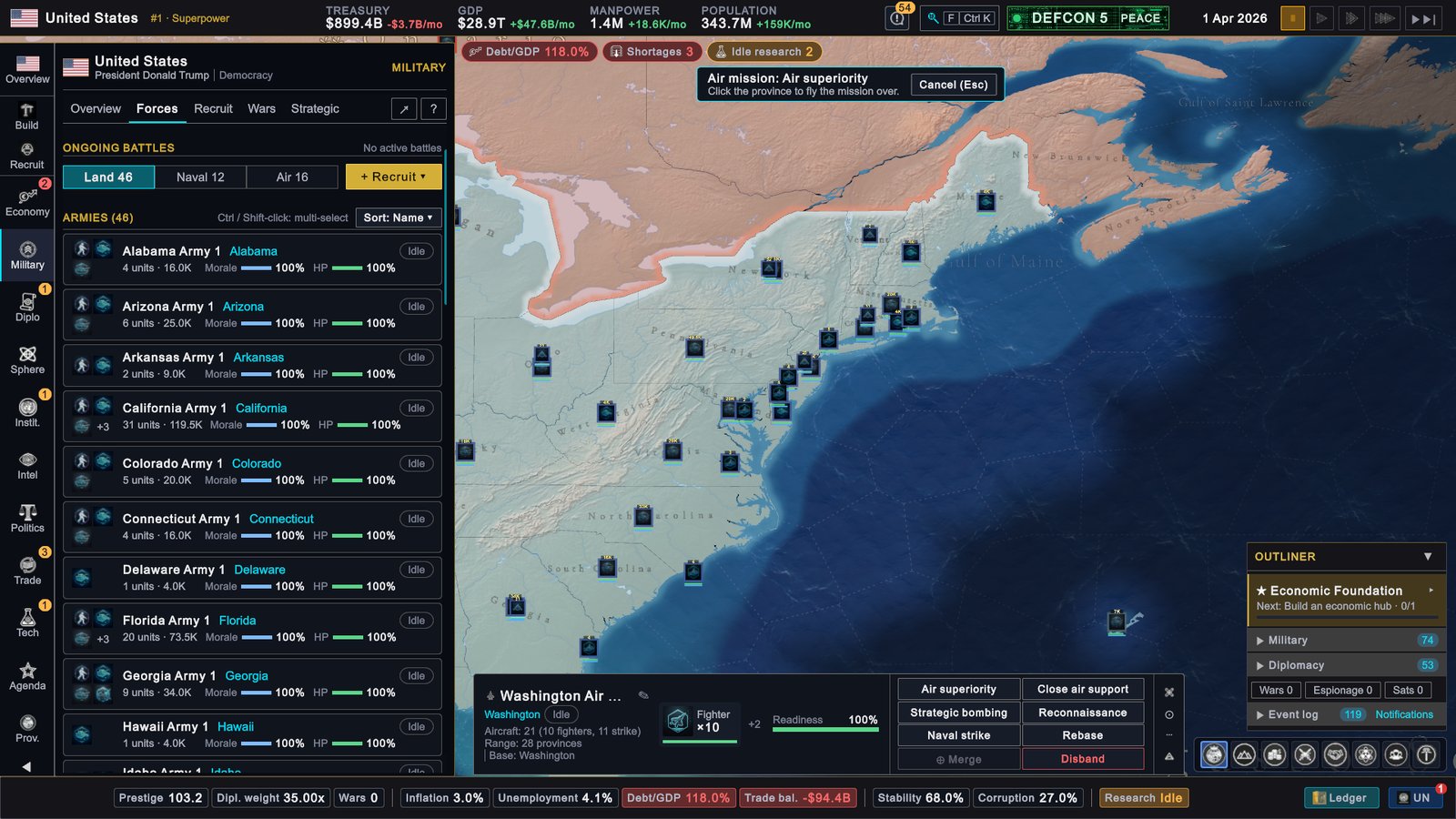
United States, 1 April 2026: choosing the target for an air mission. The pill at the top names the mission. -
Watch the status. The wing’s status changes to Outbound, Over target, Returning or On patrol. Cancel mission recalls it to base.
You can also right-click a province with a wing selected: a small menu lists the missions and the rebase order that are possible there.
What to do
- Cover your own front first. Put fighter wings on air superiority over the province where your armies are fighting, or over the province the enemy keeps bombing. A patrol protects everything within its fighters’ range of that province.
- Escort your bombers. A wing that mixes fighters with strike aircraft loses fewer aircraft to an enemy patrol than strike aircraft flying alone.
- Bomb before you attack. Strategic bombing on the province you are about to assault thins the defenders and stops them healing. Check for Air Defense regiments first: flying over them is how wings melt away.
- Rotate wings. One wing flying without rest ends up at low readiness and half strength. Two wings taking turns keep the pressure constant.
- Move the base, not the target. Range is measured from the base. Upgrade an Airfield near the front for more slots, or bring a carrier, then rebase forward.
- Scout before a war. A reconnaissance mission over a border province shows you what is waiting there. For a standing view of a region, see Satellites.
- Keep oil in stock. An air campaign on top of an oil shortage ends itself.