Every country you do not play is run by the AI. It builds, researches, trades, signs treaties, votes, spies and fights with the same kinds of orders you have. Knowing what moves it helps you read a neighbour before it acts, and helps you pick the two settings that shape it.
Where to find it
There is no AI screen. You meet the AI through what it does and through two settings.
- The settings. DIFFICULTY and AI AGGRESSIVENESS are on the country select screen once you have picked a country. In multiplayer the host sets both in the lobby.
- What it does. Toasts, the event log and the Diplomacy › Inbox tab report its moves. A country’s card shows its budget, relations and wars.
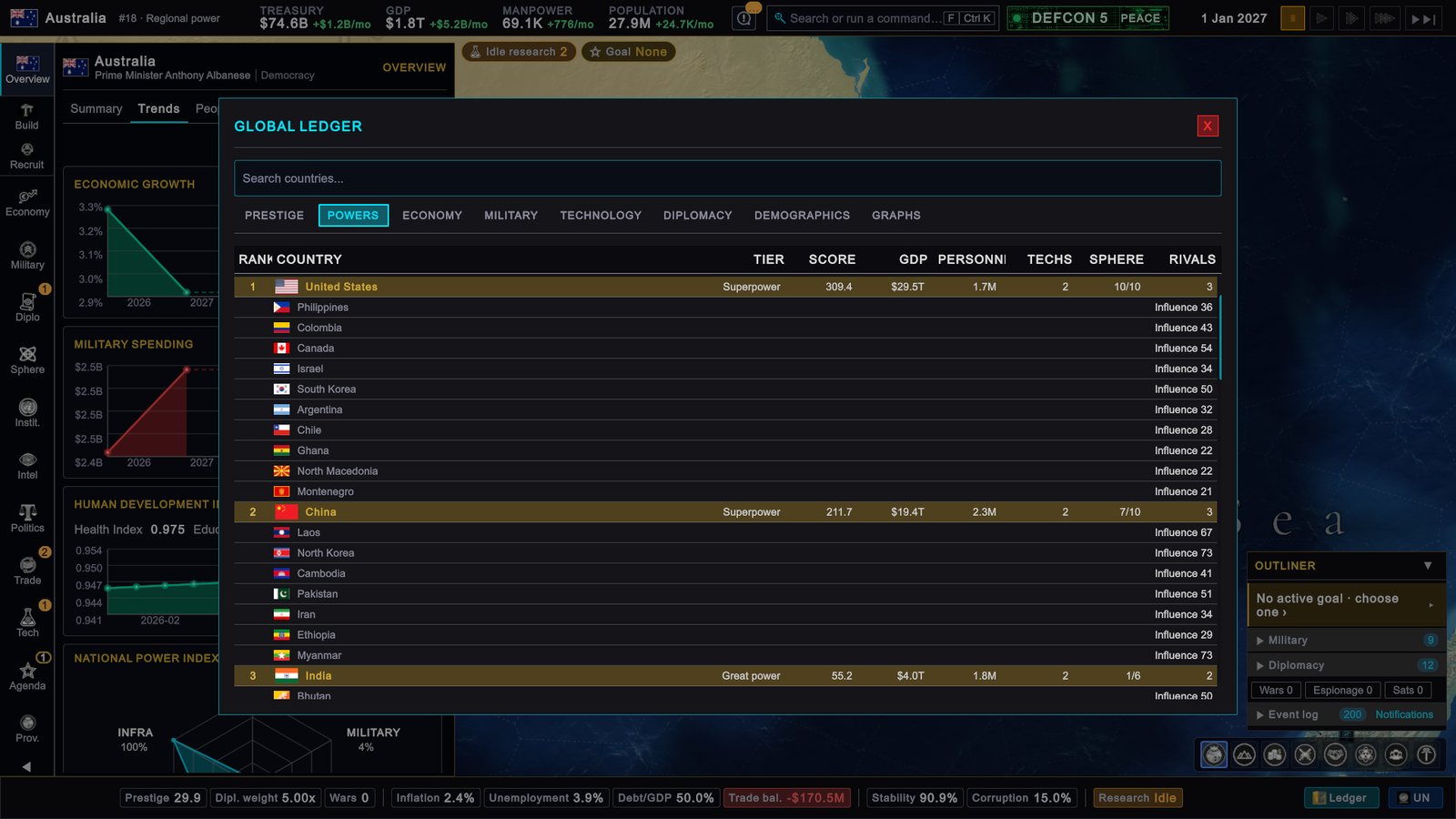
- Who is strong. The POWERS tab of the Global Ledger, G by default.
How it works
Temperament and long-term strategy
Each country has a temperament of its own: how aggressive it is, how much it values diplomacy, trade and alliances, how much it wants to expand, and how readily it reaches for nuclear weapons. Some countries lean towards trade, some towards expansion, and some keep to themselves.
On top of that, each AI country follows a long-term strategy and reviews it once a year, in January. It may aim to dominate its region, to become an economic power, to rely on a nuclear deterrent, to lead alliances, to redraw borders, to spread its ideology, to wall itself off, or to lead in technology. A country in crisis, with heavy war exhaustion, several wars or a shrinking economy, switches to plain survival. The AI tends to keep the strategy it has, so a country’s character is fairly stable over a campaign.
The strategy shows in the budget. A technology-led country spends more on research, and a country seeking regional dominance spends more on its military. A country that is preparing a war shifts money to the military and its reserves and raises taxes.
AI countries decide most things once a month, each on its own day of the month, so the world does not move all at once.
What the two settings change
DIFFICULTY changes four numbers. Three apply to countries played by a human, and one applies to the AI when its target is a human.
| EASY | NORMAL | DIFFICULT | EXPERT | |
|---|---|---|---|---|
| Your GDP growth, while it is positive | 25% faster | unchanged | 13% slower | 23% slower |
| Your research speed | 30% faster | unchanged | 20% slower | 30% slower |
| How fast your war exhaustion builds | 30% slower | unchanged | 25% faster | 50% faster |
| The AI’s appetite for a war against a human player | halved | unchanged | 25% higher | 50% higher |
Difficulty does not change how AI countries treat each other. It is also not the difficulty group a country is listed under on the country select screen, which describes the country you pick.
AI AGGRESSIVENESS applies to every AI country and every target. It multiplies how much an AI wants any war it is weighing.
| Setting | Effect on the AI’s appetite for war |
|---|---|
| PEACEFUL | AI countries do not plan or declare wars of their own. You can still attack them. |
| LESS AGGRESSIVE | Less than half of normal |
| NORMAL | The standard level |
| ARMAGEDDON | Two and a half times normal |
Both are chosen before the campaign starts and are stored with it. A multiplayer game continued from a save keeps the values it started with.
How an AI country decides on war
An AI country weighs each possible target and goes ahead only when the result clears a fixed bar.
What pushes it towards war: a reason for war (a casus belli) against the target, valuable territory, a past war to avenge, a distant ideology and distrust of the target. Without a reason for war, all but the most aggressive countries stay out.
What holds it back:
- being weaker than the target, or having its forces tied up elsewhere
- the target’s nuclear weapons, which deter all but the most aggressive countries
- the target’s allies and the countries that guarantee it, whose strength it adds to the target’s own
- wars it is already fighting. Few countries open a second front, and an AI country fighting two wars starts no more
- its own war exhaustion and a weak economy
- its own aggressive expansion, because a country that has grabbed a lot fears a coalition
- the measures it expects from the UN
- a shared ideology, ethnicity or religion with the target, unless the reason for war is strong
- trade. A major trade partner or a partner in the same trade arrangement is a costly enemy, however good the reason
- trust. Attacking a country that trusts it counts as a betrayal
An AI war usually arrives in steps that you can see. The country first tries to isolate its target: it files a condemnation at the UN, denounces the target, imposes sanctions and courts other countries. Then comes economic pressure, such as a trade war. Then it builds up its forces. The last step before war is an ultimatum. If the target accepts, the plan is dropped. If the target refuses or lets the ultimatum expire, war follows.
AI countries hold back from declaring war during the first month of a campaign.
In war and at peace
At war, an AI country moves its budget to the military, recruits, and runs its armies, fleets, air wings and missiles itself.
Asking for peace is a decision of its own. An AI country rarely asks during the first six months of a war, and it waits longer if no battle has been fought. It holds out while it is clearly winning or still holds ground it wants. It becomes more willing as the war drags on and its exhaustion climbs.
When you are the one proposing, the game tells you the likely answer first.
- Peace. The peace view shows Their answer: “Will accept”, or “Will refuse” with the reason, and the pressures behind it. See Peace and occupation.
- Treaties and alliances. The tooltip of a proposal carries a verdict such as LIKELY, POSSIBLE or UNLIKELY. For an alliance, their opinion of you, their trust, a shared rival and their own willingness to ally count, not your size. See Diplomatic actions and treaties.
- Trade offers. The AI can accept, refuse or answer with a counter-offer. See Trade.
AI countries also answer their own events. The choice is weighted by temperament and strategy, and for a flashpoint that belongs to it, an AI country usually takes the first answer on the list.
What to do
- Make yourself expensive to attack. Military strength, allies, a guarantee from a stronger country and nuclear weapons all lower an AI’s appetite for a war against you.
- Trade with the neighbour you fear. Being a major trade partner dampens its wish for war, and so does trust between the two of you.
- Read the ladder. A UN condemnation, a denouncement and new sanctions from the same country are the first steps of a war plan. Open its card and see whether the military share of its budget is climbing. You still have the ultimatum as a last exit.
- Mind your own expansion. Aggressive expansion restrains the AI, and it also restrains how other countries see you.
- Pick the settings for the campaign you want. For a quiet economic game, lower AI AGGRESSIVENESS. To be pressed harder while the world stays the same, raise DIFFICULTY instead.
- Ask it why. The console can list recent AI decisions with their reasons. See Console and admin panel.