A navy does three jobs in Global Protocol: it fights other fleets for control of the sea, it blockades enemy coasts and straits, and it carries your armies overseas. Fleets also host air wings and submarine-launched missiles, which have their own pages.
Where to find it
- Military › Forces, then Naval, lists your fleets (M opens Military by default).
- Military › Recruit, then Naval, builds ships.
- The unit bar opens when you select a fleet on the map or in the list. Blockade orders are there.
- SETTINGS › GRAPHICS › Sea zone borders draws thin lines between sea zones. They are shown whenever an order asks you to pick a zone.
How it works
Ships
| Ship | Role |
|---|---|
| Aircraft Carrier | Hosts air wings, four per carrier, and carries the most troops. Very tough, modest in a gun fight, and the slowest ship to build |
| Destroyer | The strongest escort, with the best anti-submarine rating |
| Frigate | A cheaper escort with good anti-air and anti-submarine ratings |
| Submarine | The highest attack and little protection. Carries up to four missiles |
| Patrol Boat | The cheapest and quickest ship to build; weak in battle |
| Amphibious Assault Ship | Carries twice the troops of an escort |
Every ship is built in a coastal province of yours that has a Naval Base, and one base builds up to three ships at a time. Finished ships form a fleet in the sea zone beside the base, named after the province. Costs and stats are in the units reference.
Fleets, sea zones and harbours
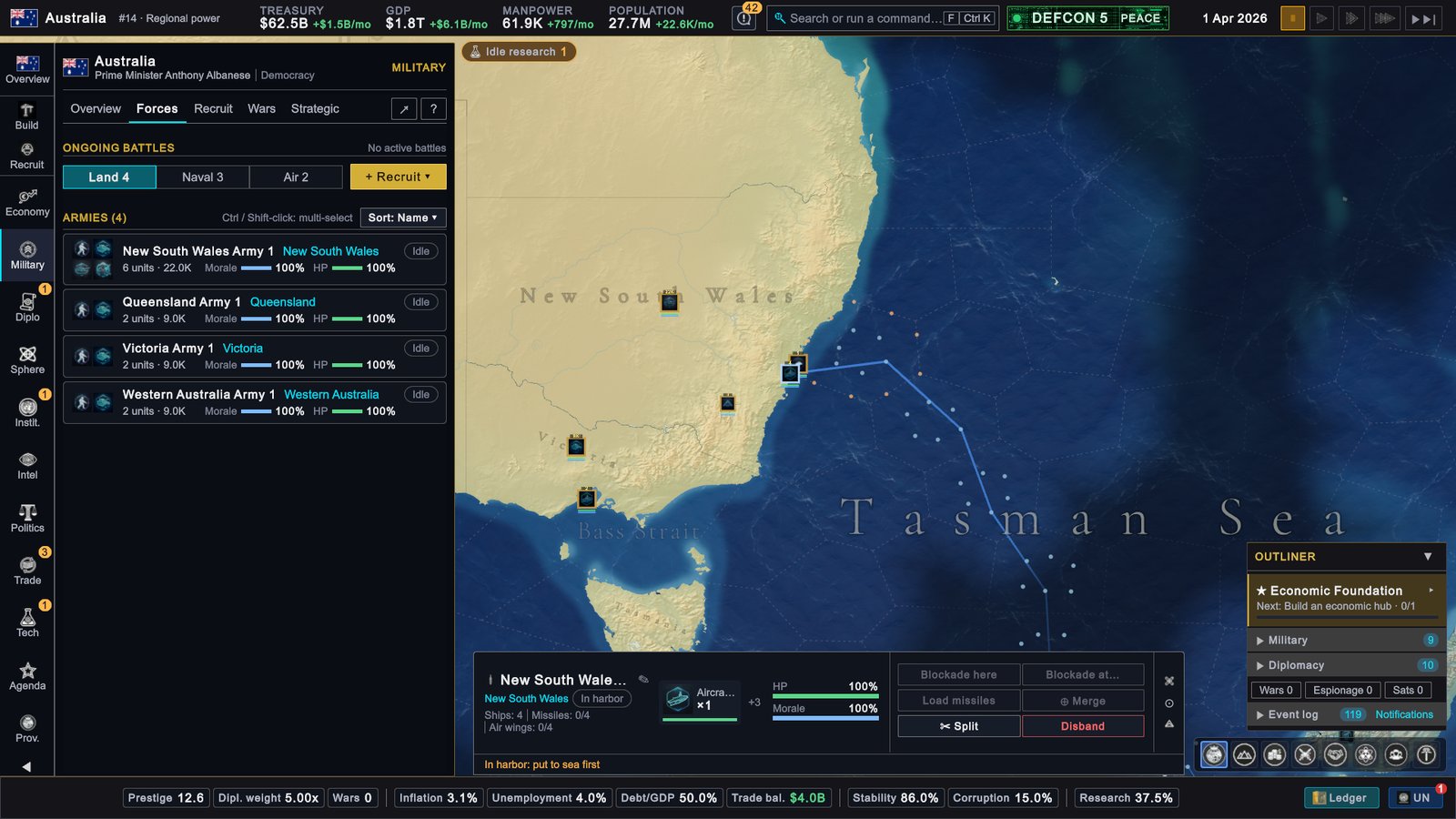
The sea is divided into sea zones. A fleet is a group of ships that occupies one zone and moves from zone to zone at the speed of its slowest ship.
- Move. Select a fleet and right-click a sea zone. The route is found for you.
- Dock. Right-click a coastal province of yours and the fleet sails there and enters its harbour. Its status reads In harbor.
- Pursue. Right-click an enemy fleet and yours follows it.
- Organise. Split, Merge all, renaming and control groups work as they do for armies.
A fleet in harbour takes no part in naval battles, does not count toward sea control and cannot blockade. It has to put to sea first.
The unit bar shows Ships, Missiles (carried out of the tubes available, four per submarine) and Air wings (in use out of the slots on the fleet’s carriers).
Naval combat
Hostile fleets in the same sea zone fight in daily rounds, much as armies do. Strength comes from the ships’ attack and defence values, their remaining HP, morale and research. About ten ships’ worth of strength counts per side each round, and each round’s damage varies by up to 20% either way.
Submarines are the exception to plain strength. The larger the share of submarines in your fleet, and the better the enemy’s anti-submarine ratings, the more damage your fleet takes. Destroyers and frigates are the answer to a submarine fleet.
A fleet whose morale falls to 20% breaks off and retreats to the zone it came from. A fleet that loses all its ships is gone. Either way the winner is credited with a battle won, which counts toward war score. A fleet cannot move while it is fighting. Air wings can also strike fleets within their range; see Air power.
Sea control and blockades
A blockade is an order you give a fleet at war. It has three forms on the unit bar:
- Blockade here blockades the enemy coasts next to the sea zone the fleet is in.
- Blockade at… lists the nearest enemy coasts and lets you pick a sea zone on the map, with enemy coasts highlighted in red. Every selected fleet sails there and starts the blockade on arrival.
- Lift blockade ends the blockade, or the order to start one.
The rule. A blockade holds only with sea control: your side must have at least twice the hostile naval power in the zone. Your allies’ fleets count for you. Fleets in harbour and neutral fleets count for nobody. The game checks this every day. A battle in the zone does not lift the blockade; losing control does, and the fleet’s status changes to Blockade contested. The order ends by itself when nothing is left to blockade.
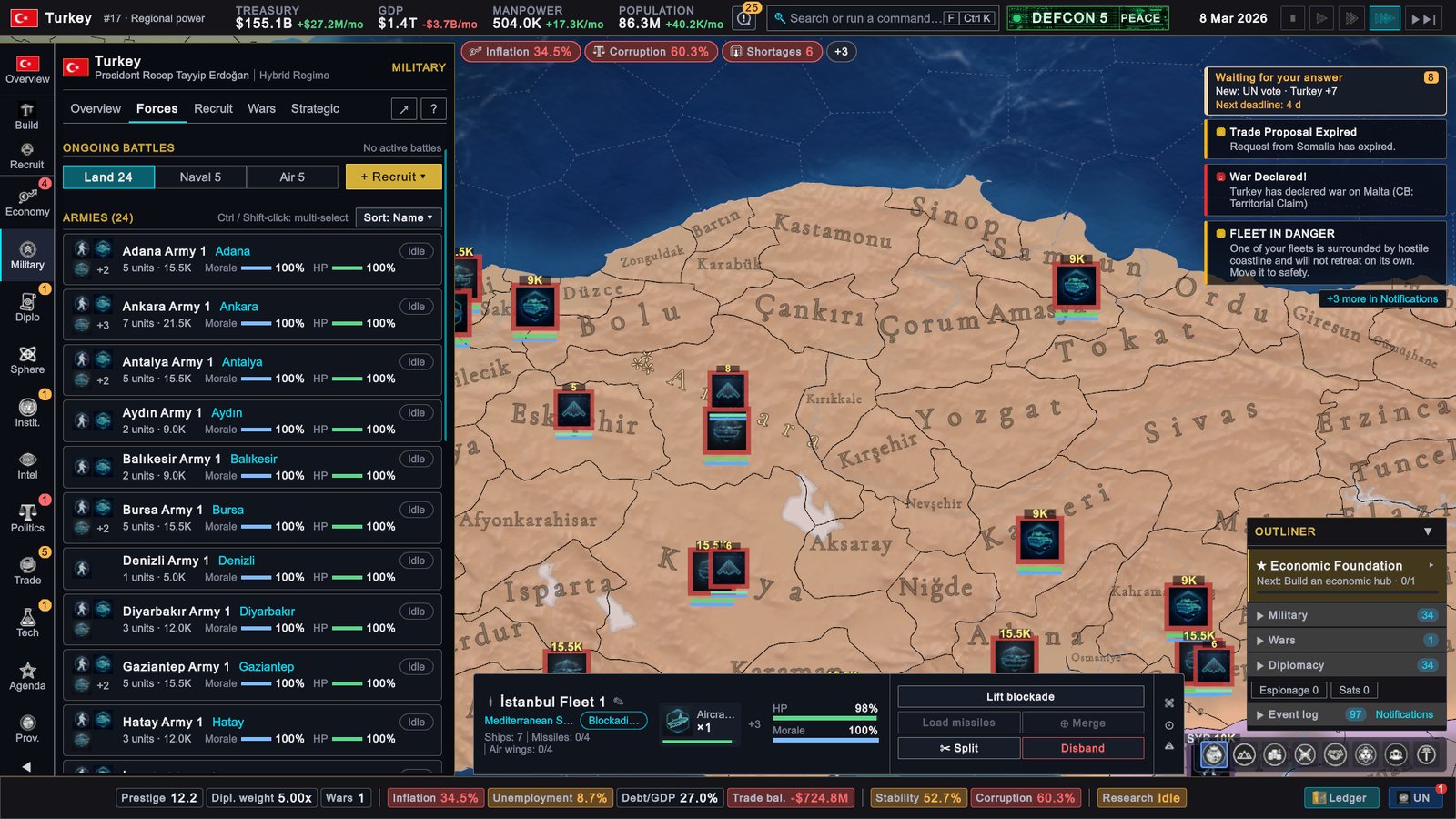
While the blockade holds, the unit bar shows Sea control (your power against the hostile power, and the ratio needed), Enemy ports and Coasts cut.
What a blockade does to the country that holds those ports:
| Effect | Size |
|---|---|
| Output of each blockaded port province | Reduced by a quarter |
| Its trade by sea | Shrinks with the share of its coast under blockade, counted by coastal population. Trade over land is spared |
| Its supply contracts by sea | Stop once half its coast is blockaded |
| Its war exhaustion | Up to 1 extra point a month at a fully blockaded coast |
| Its armies in a blockaded port with no land route to their capital | Do not recover, and fight at 70% |
The share of each side’s coast under blockade appears on the war card in Military › Wars and as Coast blockaded on the war page.
Straits. A fleet that blockades one of the trade network’s chokepoints closes it to your enemies: the unit bar shows Strait as Closed to your enemies. Their trade with other countries then needs a route that avoids it, and stops where there is none. See Trade network, chokepoints and blocs.
A fleet that is carrying or collecting troops cannot blockade.
Moving armies by sea
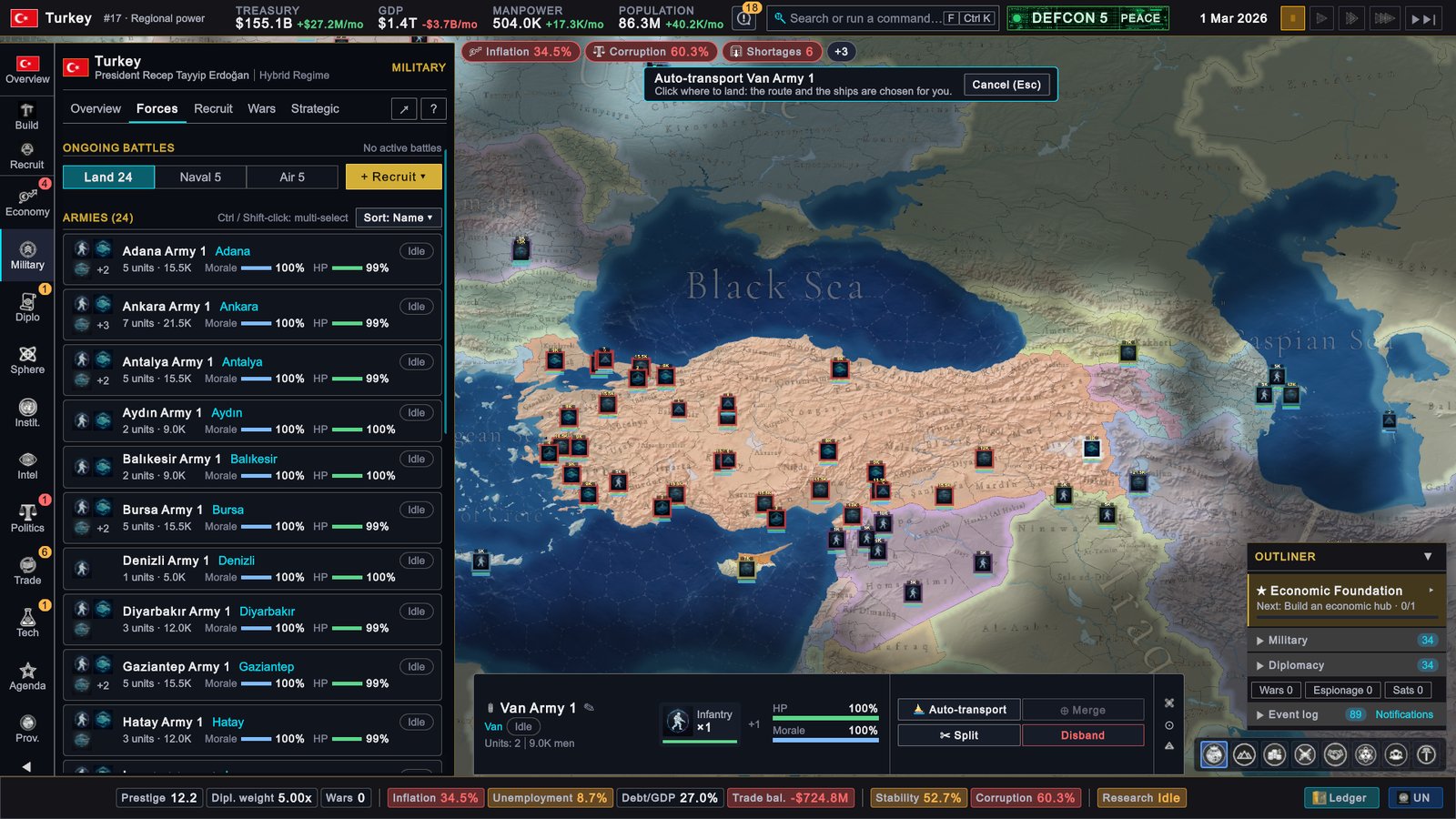
You do not load armies onto ships by hand. Select an army and right-click a destination across the sea, or press Auto-transport on its unit bar and click where to land. The game chooses the boarding port, the route and the ships, and a SEA TRANSPORT window asks you to confirm. It names the fleets, the number of trips, the estimated days at sea, and any fleet whose current orders would be replaced.
- Ships. Any warship carries troops: 5,000 soldiers a ship, 10,000 for an Amphibious Assault Ship and 20,000 for an Aircraft Carrier. Up to eight fleets can share one lift, and if they cannot carry the army at once they make several trips.
- Boarding. The army marches to a port on a friendly coast and the ships meet it there. Its status reads Embarking, then At sea. If the two have not met within 30 days, the transport is cancelled.
- Landing. You can land on any coast your army may enter, including an enemy coast. For three days after coming ashore an army can fight at reduced strength, as the Land forces battle table shows.
- Short hops. If the destination can be reached overland within eight provinces, the army marches instead.
A transport fleet that meets a hostile fleet has to fight it, and ships it loses reduce what it can carry.
Repair
Damaged fleets repair only when idle, and not for 30 days after they last took damage. Where the fleet waits decides the speed:
| Where | Repair each day |
|---|---|
| In harbour, on a coast of yours with a Naval Base beside that sea zone | 1% of full HP |
| In harbour on a coast of yours without a base, or at sea beside your Naval Base | 0.4% |
| Anywhere else | None |
Morale returns by a point a day wherever the fleet rests, after the same 30-day wait.
What to do
- Check the ratio before you blockade. A blockade under the two-to-one line cuts nothing. Bring a second fleet or call an ally’s.
- Blockade where the people are. Coverage is counted by coastal population, so the big port provinces matter most.
- Escort your landings. A transport fleet fights whatever it meets, so clear the route or send warships ahead.
- Mix escorts into submarine fleets, and hunt enemy submarines with destroyers and frigates.
- Send damaged fleets home. Only a harbour beside a Naval Base repairs at full speed, and nothing repairs at sea away from your bases.
- Build amphibious ships or carriers before an overseas war. They cut the number of trips a landing needs.