A province is the smallest piece of land on the map. People live in provinces, deposits lie under them, buildings stand in them and armies fight over them. Your country’s economy is the sum of what its provinces produce, so knowing how to read one, and how to raise its infrastructure, pays off in every other part of the game.
Where to find it
- Click any province on the map. Its panel opens on the right, and the arrows in its header step through the other provinces of the same owner.
- Provinces on the rail (the button reads Prov.; P by default) lists every province you own, on three tabs: Overview, Construction and Inventory.
- H or Home by default brings the camera back to your country.
How it works
What a province holds
Every province has a terrain, an area, a population, resource deposits, an infrastructure level and a number of building slots. Its output starts from a base production and is multiplied by infrastructure, terrain and the buildings that stand there. Three things cut it:
| Condition | Largest cut to output |
|---|---|
| Unrest | 80% at unrest 100 |
| Devastation | 80% at devastation 100 |
| Radiation | All of it at radiation 100 |
A blockaded port province also loses a quarter of its output while the blockade holds.
The province panel
The header shows the owner, the terrain and the deposits. Under it are five tiles: Pop, GDP, Infra (with the level that unlocks the next building slot), Unrest and Dev. A banner appears when something is wrong: a battle in progress, a siege, an occupation or devastation.
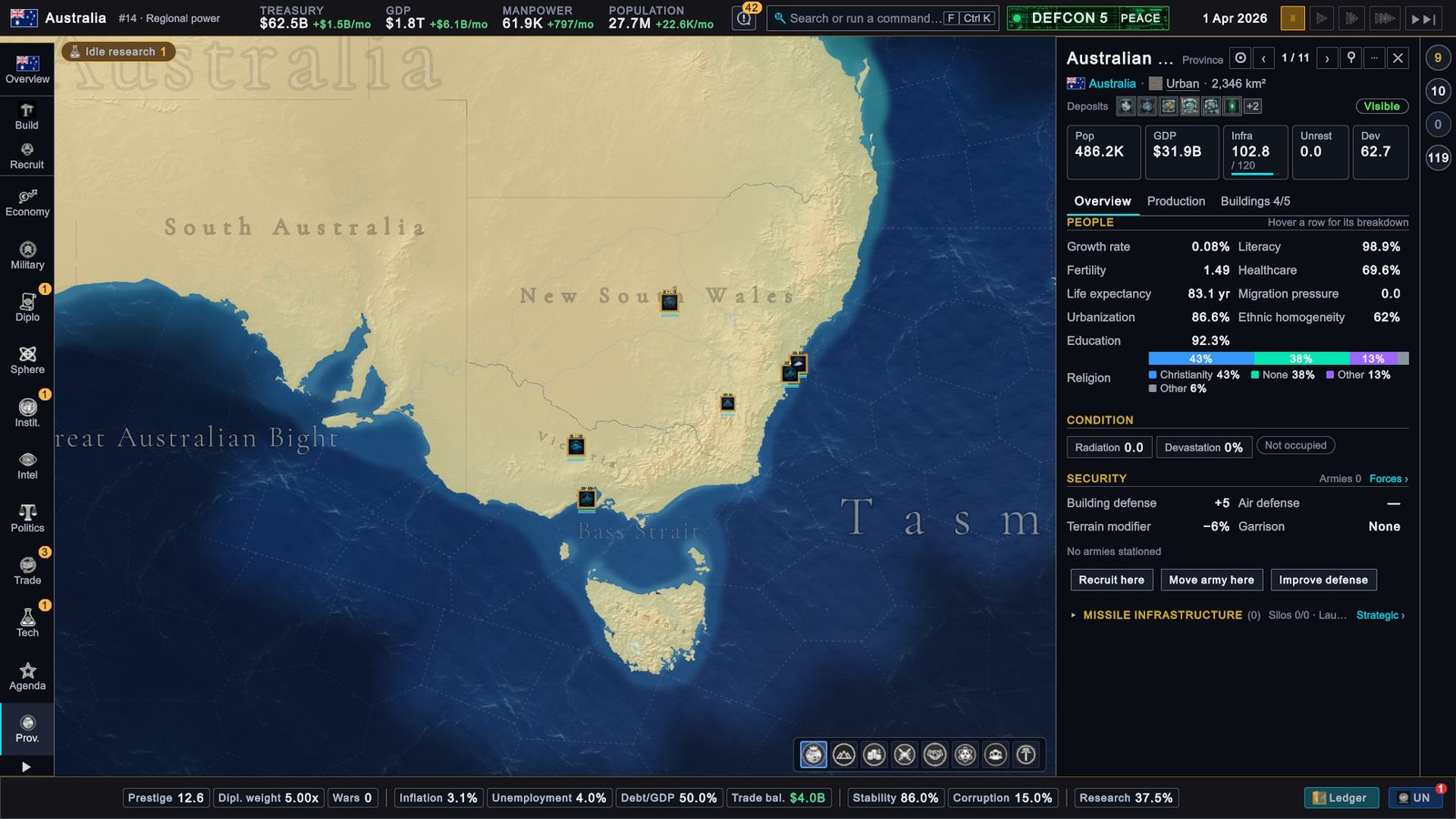
The panel has three tabs.
- Overview. People lists growth rate, literacy, fertility, healthcare, life expectancy, migration pressure, urbanization, ethnic homogeneity, education and religion; hover a row for its breakdown. Condition shows radiation, devastation and whether the province is occupied. Security shows the defence its buildings give, air defence, the terrain modifier and the garrison, with Recruit here, Move army here and Improve defense.
- Production. Output shows base production and Supply efficiency, the share of the inputs for the province’s main product that your country can supply. Resources lists each deposit with its richness and whether an extraction building works it. BUILDING EFFECTS adds up what the buildings here give.
- Buildings. Slots, what is built, what is under construction and the build picker. See Buildings and construction.
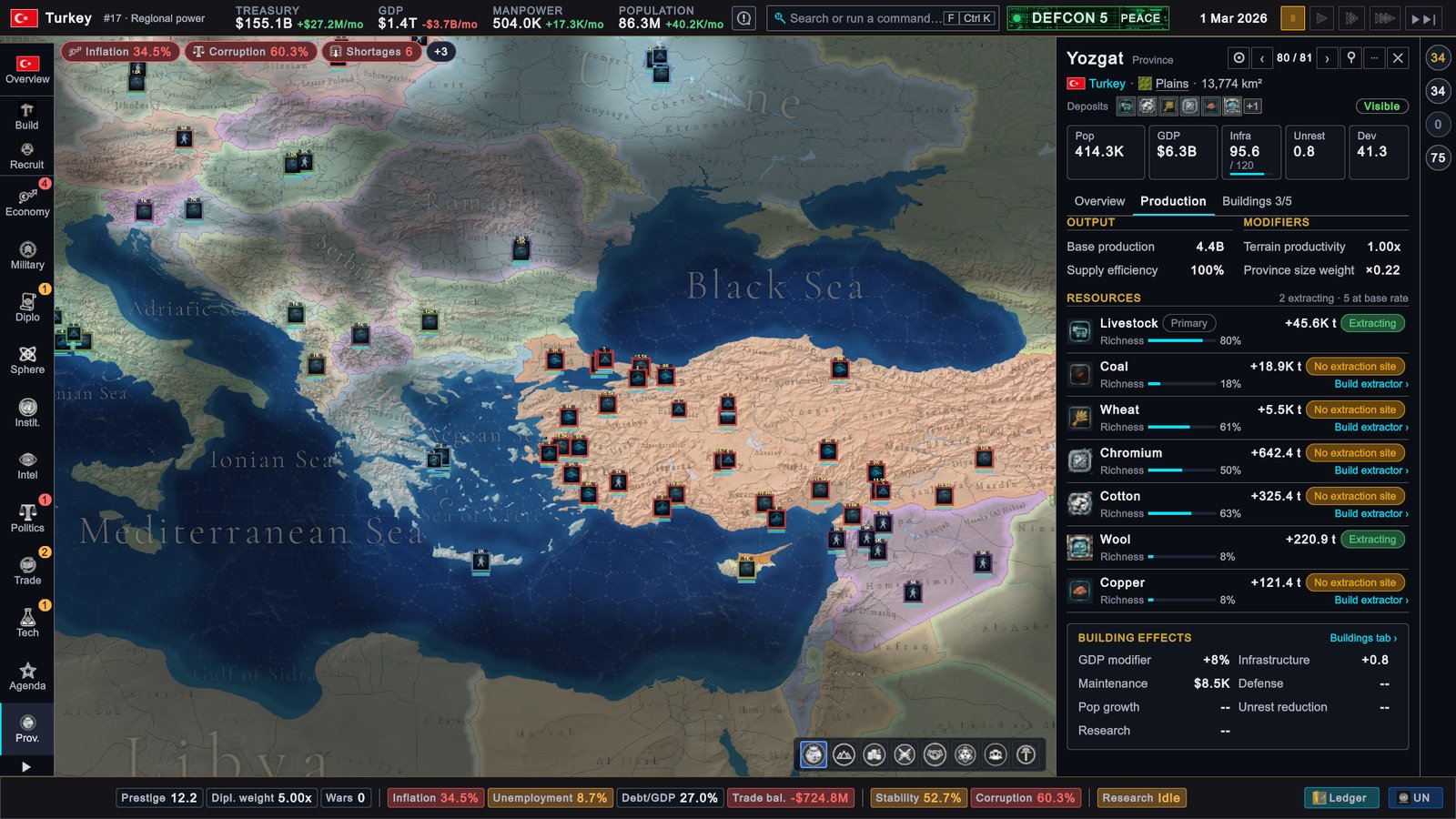
The Provinces page
Three chips at the top count the provinces with free slots, with upgradeable buildings and with high unrest. Click one to jump to that list. The search box filters by name.
- Overview has one row per province: name, population, GDP, infrastructure, unrest and main resource. Dots on the resource mark construction under way, occupation and radiation. The bottom row gives sums and averages. Filters keep the provinces with high unrest, the occupied ones, those that are building and those with low infrastructure. Clicking a row selects the province, centres the map on it and opens its panel.
- Construction has a View switch. Provinces lists slots, queue, upgradeable buildings, months to the next completion and upkeep; select a row to build, upgrade or cancel there. Recommendations suggests where to build. Queue lists every project under way in the country, with its progress and a cancel button.
- Inventory has one row per building type and level across the whole country: how many you own, where they stand and what they cost in upkeep. It opens sorted by upkeep, which makes it the place to see where your maintenance money goes.
Infrastructure
Infrastructure runs from 0 to 200. It changes five things in a province:
- Output. Each point adds half a percent to base output.
- Building slots. A province gains a slot for every 40 points, and above 150 another for every 25.
- Construction speed. Each point makes construction half a percent faster.
- What can be built. Every building sets a minimum infrastructure.
- Movement. Armies march faster through provinces with better infrastructure.
It grows in two ways. The Infrastructure share of your budget raises your provinces by a few points a year on average, more when you spend a larger share of GDP, and favours the provinces that are furthest behind. Budget spending stops at 150. Above that, only infrastructure buildings add more: at level 1 a Power Plant adds 6 points a year, a Highway Network 4, a Telecom Network 3 and a Water Treatment plant 2. Demolishing one takes back what it delivered.
Development (Dev, 0 to 100) follows behind. It grows every month with the number of buildings and with infrastructure, and it cannot pass the province’s infrastructure. People migrate towards more developed provinces.
Devastation and recovery
Devastation is war damage, from 0 to 100. It rises while armies fight in the province and when the province is bombed. Air defence buildings reduce what air strikes do. While devastation lasts:
- output is cut, by up to 80%;
- above 10, infrastructure is worn down every day, faster the higher the devastation;
- people leave every month, up to 5% of the population at full devastation.
Once the fighting stops, devastation heals by one point a day. The infrastructure that was lost does not come back with it: it has to regrow through the budget or through buildings.
The capital
Your capital is one of your provinces. To move it, open the panel of another province you own, click ⋯ in its header and choose Move capital here. The entry states a stability cost, and the game asks you to confirm before the capital moves.
Occupation
A province held by an enemy army is occupied: the panel shows Occupied by and a resistance level. Its output goes to the occupier at half efficiency, and its unrest jumps when the occupation begins. Occupation is not ownership; who keeps the province is settled in the peace deal. See Peace and occupation.
What to do
- Read the Infra tile first. It shows how far the province is from its next building slot.
- Fund infrastructure early. It raises output, slots and construction speed together, and it takes years to build up.
- Put infrastructure buildings in your best provinces. Budget spending carries a province to 150; a Power Plant and a Highway Network take it further.
- Use the attention chips. Free slots and upgradeable buildings are the cheapest growth you have, and a province with high unrest is losing output every month.
- After a war, check Condition. A devastated province has lost infrastructure, and with it perhaps a building slot.