Goods in Global Protocol travel along a network of trade centres joined by sea and land lanes. The route decides what freight costs, a closed strait can send a cargo around a continent, and the country that owns a busy centre is paid for the trade that passes through. On top of the network sit tariffs and trade blocs, which decide who trades cheaply with whom.
Where to find it
- The map. Trade centres, lanes and flows are drawn in the Economy map mode (F3 by default). Opening the Trade page switches to it for you.
- Trade › Overview, the Trade centres card: your centres and the world’s busiest. Clicking a centre on the map opens the same card with that centre selected.
- A country’s card, Relations tab: the TRADE ARRANGEMENTS… button holds every bloc move you can make with that country, and the TRADE ARRANGEMENTS section lists the blocs it belongs to.
- Institutions › Agenda, the Trade arrangements chip: invitations, your applications and the admissions you vote on.
How it works
Trade centres
There are three kinds of centre: 26 global hubs, 30 regional centres, and a national centre for every country. Goods between two countries leave through the seller’s national centre, cross the hubs and regional centres on the cheapest route, and arrive at the buyer’s national centre.
On the map, a centre that carries more trade is drawn bigger and brighter. Your own trade and your own centres are gold.
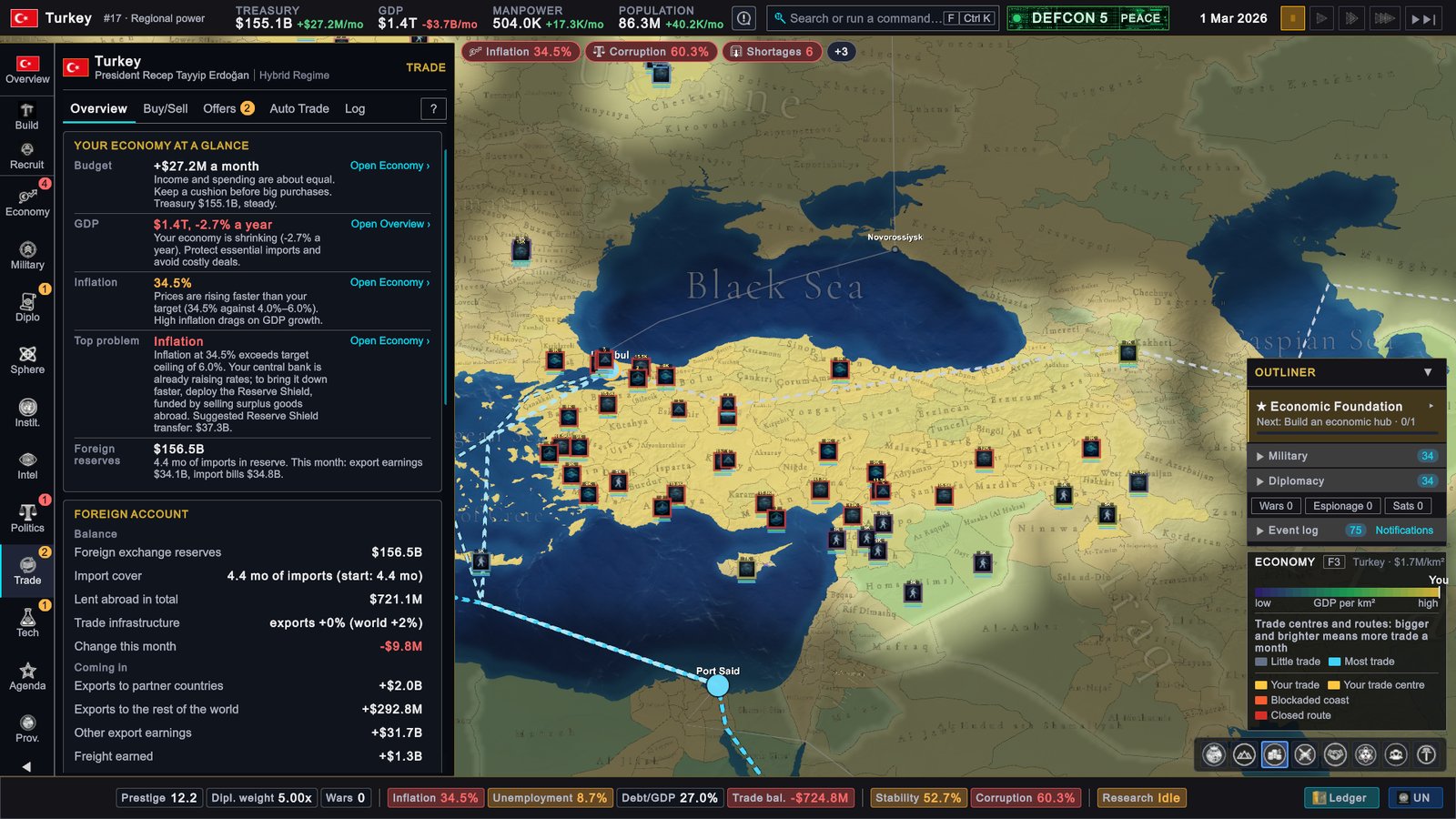
The card for a centre shows its Kind, its Owner, the Value per month that passes through it (an average over recent months) and Fees last month. Buy and sell in this region opens Buy/Sell limited to the countries that trade through that hub. A region only groups countries: it holds no stock and sets no price.
A centre belongs to whoever owns its province, and it changes hands with the province. Owning one pays in three ways:
- Handling fees. Part of the freight on every cargo routed through the centre goes to its owner’s treasury the month after, up to a small share of the owner’s GDP. A hub earns a larger share of each cargo than a regional centre, and a regional centre more than a national one.
- A trade bonus that grows with how busy the centre is: a larger share of world export sales and extra commercial revenue.
- Cheaper freight. A buyer that owns a hub at either end of the route pays 20% less freight on it.
Lanes and freight
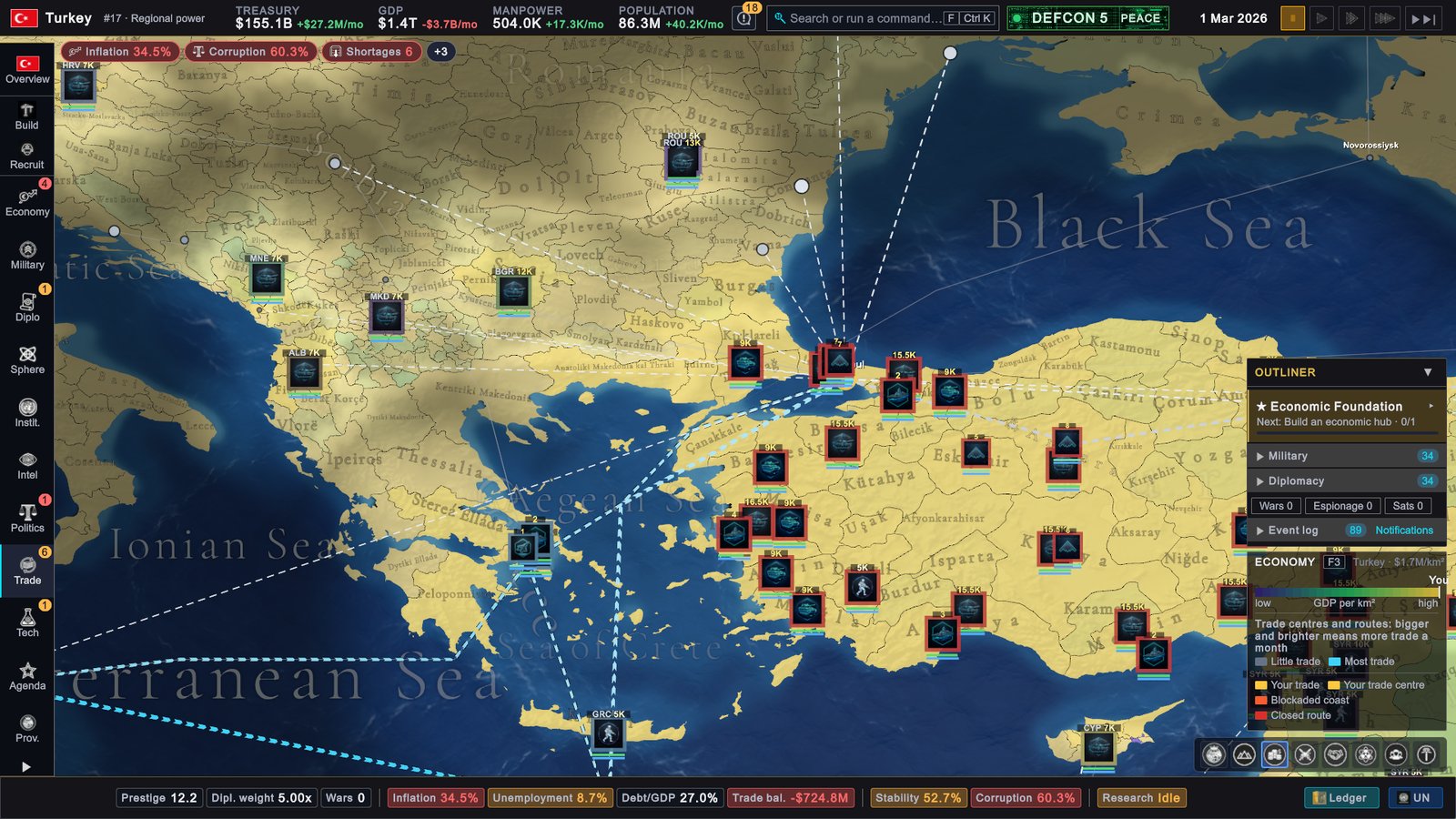
Lanes run by sea or over land, and a route can combine both. Freight depends on the distance, the weight of the goods and the kind of cargo. A tonne costs nine times as much to move a kilometre by land as by sea. Only very light goods travel by air.
The buyer pays freight on top of the goods for supply contracts, orders with one country and deliveries under a trade agreement. On the world market the spread covers it.
Chokepoints and closures
Fourteen chokepoints sit on the sea lanes, among them Suez, Hormuz, Malacca, Panama, the Bosphorus and Gibraltar. A chokepoint can close in two ways.
- A world event. Crises can close Suez, Hormuz, Malacca or the Taiwan Strait to everyone for two to six months.
- A blockading fleet. In a war, a fleet that holds a chokepoint closes it to its owner’s enemies only. See Navy.
A closed lane is drawn in red. Trade that used it takes the next cheapest route, at a higher freight cost. Trade between two countries stops only when no route is left at all.
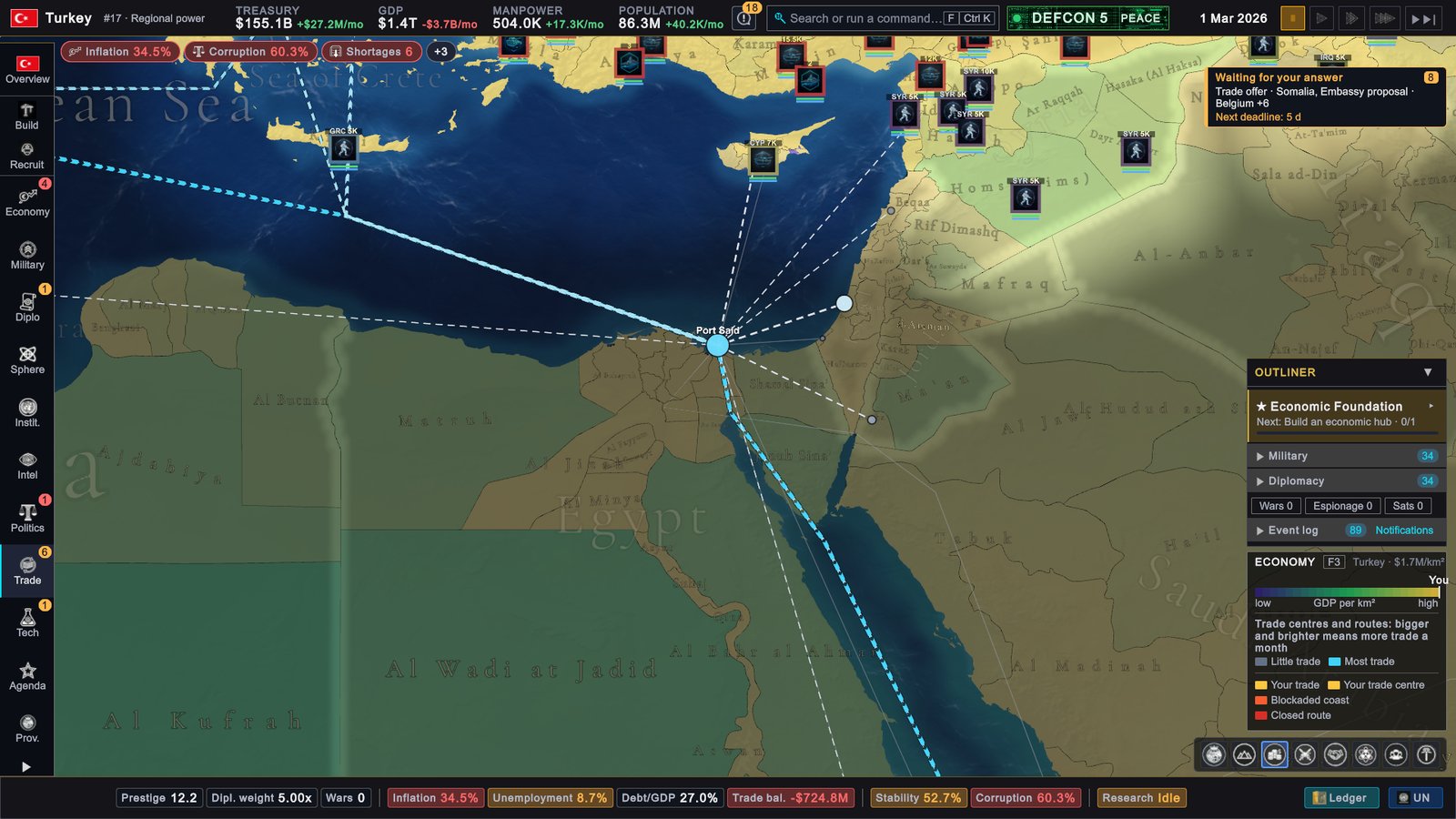
A blockade of a coast is a separate thing. It cuts that country’s sea trade in step with the share of the coast that is blockaded, the blockaded ports lose output, and from half the coast it stops contracts and orders that travel by sea.
Tariffs
A tariff is a duty on imports, paid to the importing country’s treasury. Private importers pay it; supply contracts carry none. Every country has a normal rate, and you do not set yours by hand. What changes is the rate between two particular countries:
- a trade agreement lowers it between the two;
- a trade bloc lowers it, usually to nothing, on the goods the bloc covers;
- a customs union replaces its members’ rates towards outsiders with one common external tariff.
Lower tariffs also move trade: private firms buy more from partners whose goods arrive cheaper.
Sanctions and trade restrictions
Some measures stop trade outright. A national sanction or a trade war stops all trade between two countries, supply contracts included. A trade restriction decided in an institution stops trade in the goods it names with one country, for every member that enforces it. A multilateral embargo leaves only a trickle of private trade. See Sanctions, economic warfare and ultimatums and International institutions.
Trade blocs
The game calls them trade arrangements. There are three kinds.
| Kind | What members share |
|---|---|
| Free trade area | Low or no tariffs between members on the goods it covers. Each member keeps its own trade policy. |
| Customs union | The same, plus a common external tariff. Most unions also negotiate trade agreements for all members. |
| Single market | The deepest kind: goods and services, a common tariff, and trade agreements and trade sanctions decided together. |
The game starts with the main blocs of 2026 in place, and with agreements that link a bloc to outside countries. The full list is in the Trade blocs and chokepoints reference table.
TRADE ARRANGEMENTS… on a country’s card offers the moves that are possible with that country, and says why the others are not:
- Apply to join a bloc it belongs to. The members decide within 15 days by the bloc’s own rule: every member must agree, or no member may object. Some blocs admit only countries of their region, and some take no new members.
- Join through an organization. Where a bloc’s members are those of an organization, as with the EU single market, you join the organization instead, on the Institutions page.
- Found a free trade area with it. The two of you trade all goods at no tariff. An AI country agrees if it gains enough from the tariffs saved and relations are not hostile; a human player gets an invitation. A country can belong to at most three blocs founded during play.
- Invite it into a bloc of yours. The members decide, then the country chooses.
- Leave. You give notice, and your preferences end when the notice runs out: 180 days for a bloc founded during play, and from 180 days to five years for the blocs the game starts with.
After a refusal you wait 180 days before asking again.
Membership lowers tariffs with the other members on the covered goods, and private trade shifts towards them. AI countries also weigh a shared bloc against going to war with a fellow member. A customs union limits you in return: a country bound by a union’s common tariff can neither found nor join a bloc of its own, and where the union negotiates for its members it signs no trade agreements either. For the EU’s own trade and sanction decisions, see International institutions.
What to do
- Look at the route before you sign. A supplier whose cargo crosses a chokepoint is one crisis away from costing more.
- Build trade infrastructure. A Trade Port and Commercial Districts raise your share of world export sales and cut the freight your importers pay.
- Found a free trade area with your largest partners. The gain is the tariff both sides stop paying, so it is largest where trade is already heavy.
- Check a union’s rules before you join. A customs union decides your tariffs and, in most cases, your trade agreements.