A reconnaissance satellite gives you a standing view of one region of the world. It keeps the provinces under it out of the fog of war for as long as you leave it there, and you can send it anywhere on the globe at any time. Satellites do nothing else: they carry no weapons and they do not affect missiles.
Where to find it
- Military › Strategic has a Satellites section with Capacity used, In production, the launch cost, upkeep and build time, and either what is still missing or “Ready to launch from Satellite Command.” Military opens with M by default.
- Satellite Command › in that section opens Satellite Command, where you launch and manage them.
- The Outliner lists your satellites under Satellites.
- Satellites themselves are drawn on the globe view, not on the flat map. See Map modes and the globe.
How it works
What a satellite reveals
A satellite sits over one province and makes every province within three provinces of it visible to you. Visible means you see what is there at this moment: foreign armies and fleets are drawn only in provinces you can currently see. The fog of war itself is explained on Map modes and the globe.
Research can widen the view. Picks in the Knowledge Network that add surveillance range extend every satellite’s radius, along with the vision of your provinces, armies and fleets.
What you need to launch one
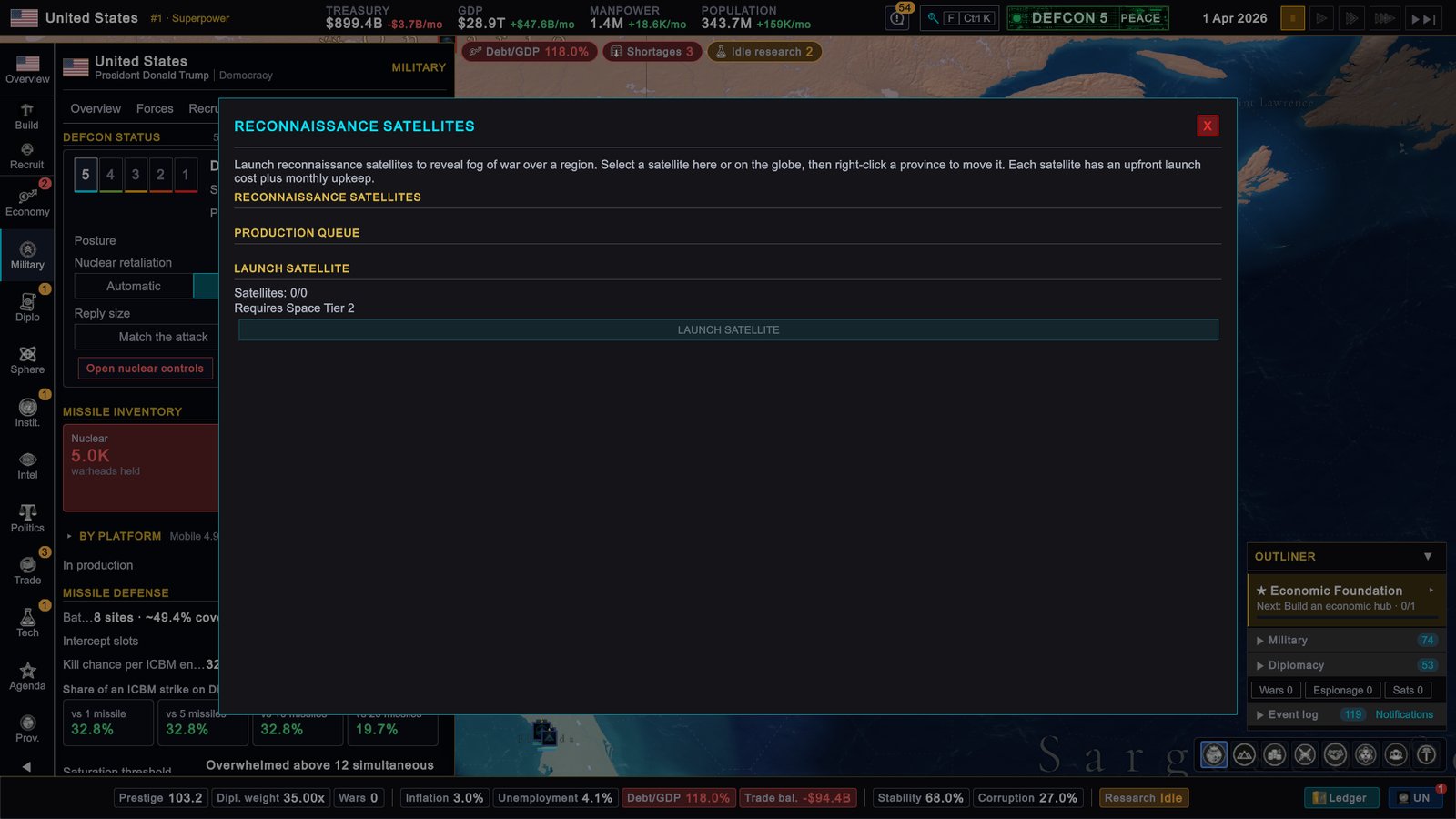
- Space Tier 2 in the Knowledge Network. Until you have it, the Strategic tab reads “Requires Space Tier 2”.
- A Satellite Launch Facility. This building needs the same research tier and a province with high infrastructure and a large population; the build picker shows the exact requirements.
- Free capacity. See below.
- The launch cost in your treasury.
With all four, LAUNCH SATELLITE in Satellite Command queues one. The cost is paid at once and the satellite takes six months to build; the PRODUCTION QUEUE section shows the months remaining. It then appears in orbit above the launch facility’s province and joins the Outliner list.
Capacity and upkeep
Each completed Satellite Launch Facility in a province you own supports three satellites. Satellites in orbit and satellites still in production both count, and Satellite Command shows the total as Satellites: used/capacity. A province holds one facility, so more capacity means a facility in another province.
Every satellite in orbit costs upkeep each month, taken from the treasury with your building maintenance. The Strategic tab and the launch button’s tooltip show the launch cost and the monthly upkeep.
Moving a satellite
-
Select the satellite. Click its entry in the Outliner, its card in Satellite Command, or the satellite itself on the globe. From the Outliner or the card, the camera switches to the globe and centres on it.
-
Read the pill. A pill at the top of the map reads “Move Satellite” with its number, and a small panel shows the satellite’s position, vision range and monthly upkeep.
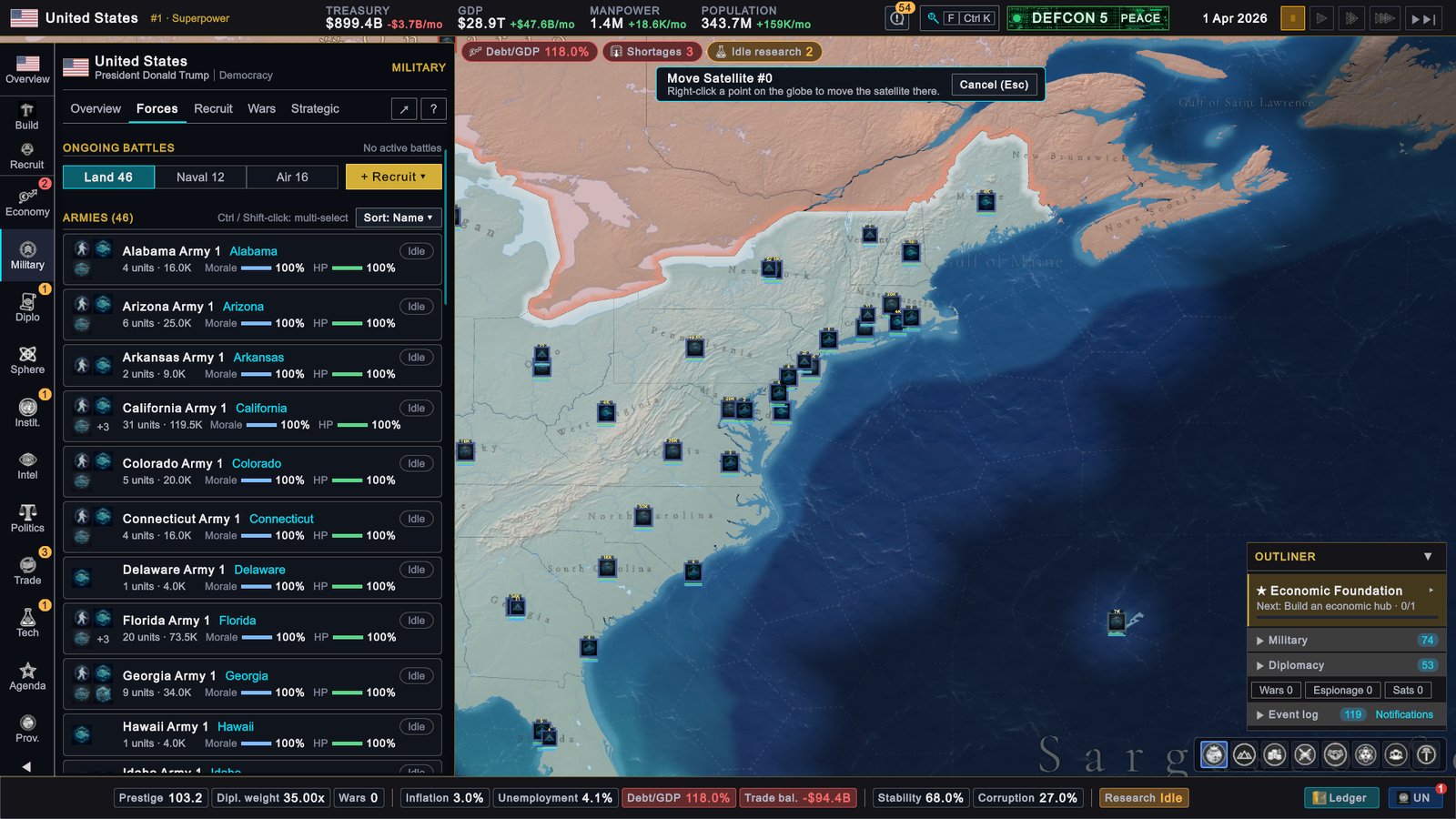
United States, 1 April 2026: a selected satellite. The pill asks for a right-click on the globe. -
Right-click the new position. Right-click any point on the globe. The satellite takes up station over the province nearest to that point and its view moves with it at once; the marker then glides to the new spot.
-
Carry on or deselect. The satellite stays selected, so another right-click moves it again. Esc or a left-click on empty space deselects it.
Moving costs nothing and there is no limit on distance or on how often you do it. REPOSITION on a satellite’s card in Satellite Command starts the same mode.
Satellite Command
| Section | What it shows |
|---|---|
| RECONNAISSANCE SATELLITES | One card per satellite in orbit: Position, Vision Range, Monthly Upkeep and the REPOSITION button. Clicking a card selects that satellite on the globe. |
| PRODUCTION QUEUE | Satellites being built, with the months remaining. |
| LAUNCH SATELLITE | Your used and total capacity, the one requirement you are still missing if there is one, and the launch button. |
What to do
- Watch the country you expect to fight. A satellite over a rival’s border provinces shows you its armies arriving before a war starts, not after.
- Move it with the war. Because moving is free and immediate, one satellite can cover the landing area before an invasion, the front during it, and a second rival afterwards.
- Pair it with reconnaissance flights. An air wing on a reconnaissance mission needs a base in range and uses up readiness. A satellite needs neither, which makes it the better choice far from home.
- Plan the facility early. The launch facility is the slow part: it needs research, a strong province and its own construction time before the six months of the first satellite begin.
- Remember the upkeep. A satellite you no longer look at still costs money every month.