Between a cold relation and a war there is a range of pressure: stopping trade, attacking a currency, raising tariffs, and the formal demand of an ultimatum. Each one costs you something too. This page explains what each tool does in the game, who pays, and how the steps lead toward war or away from it.
Where to find it
- Country card › Relations. The SANCTIONS group holds IMPOSE SANCTIONS (or LIFT SANCTIONS), Seek a UN measure and ISSUE ULTIMATUM. The ECONOMIC WARFARE group holds CURRENCY MANIPULATION, START TRADE WAR, SEND AID PACKAGE and DEBT TRAP LOAN.
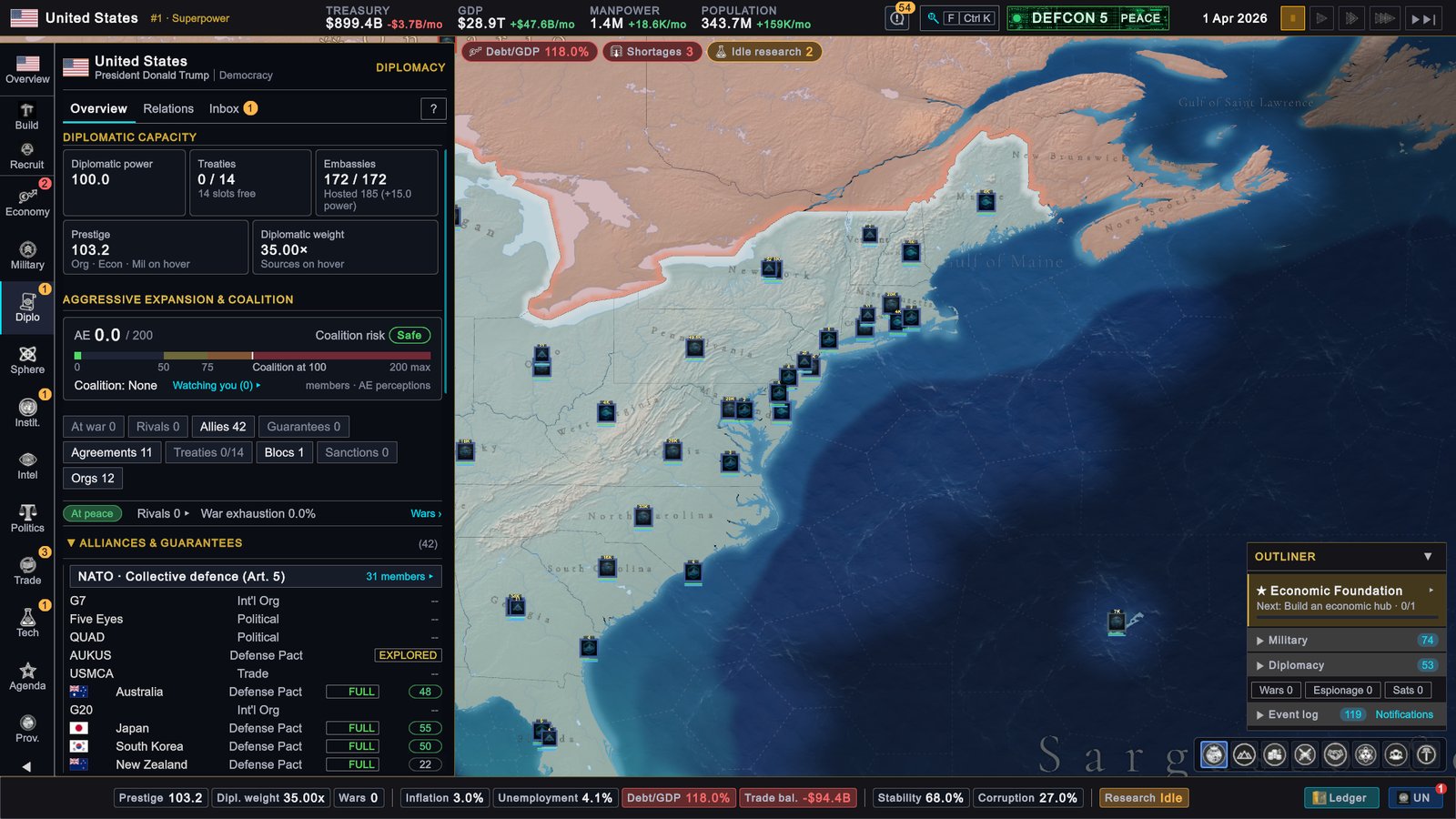
- Diplomacy › Overview. The PRESSURE & SANCTIONS block shows the pressure on the country you are viewing.
- Institutions page. Measures decided by the UN or the EU are proposed and voted there; see International institutions.
- Ultimatums sent to you open as a window and wait in Diplomacy › Inbox.
How it works
Sanctions: who decides and who enforces
A sanction in the game is a trade measure: it stops trade between the countries that enforce it and the target. What differs is who decides it and how many countries stop trading.
| Measure | Who decides | Who stops trading with the target | What gets through |
|---|---|---|---|
| National sanction | You, at once | Your country alone | Nothing |
| EU measure | The Council of the EU, in two votes | Every EU member | A tenth of private trade |
| General Assembly recommendation | Two thirds of the Assembly, after a vetoed Council draft | The members that voted yes | A tenth of private trade |
| Security Council trade restriction | 9 of 15 Council members, with no permanent member against | Every UN member | A tenth of private trade |
There are no separate asset freezes or arms embargoes. An institution measure names its scope instead: all goods except humanitarian ones, a category or one good; purchases, sales or both; and what happens to supply contracts already signed.
A national sanction
IMPOSE SANCTIONS stops all trade between you and the target in both directions, private trade and supply contracts included. The confirmation shows what you lose: the monthly value of your trade with that country and its share of your GDP. It is not available while you are at war with the target.
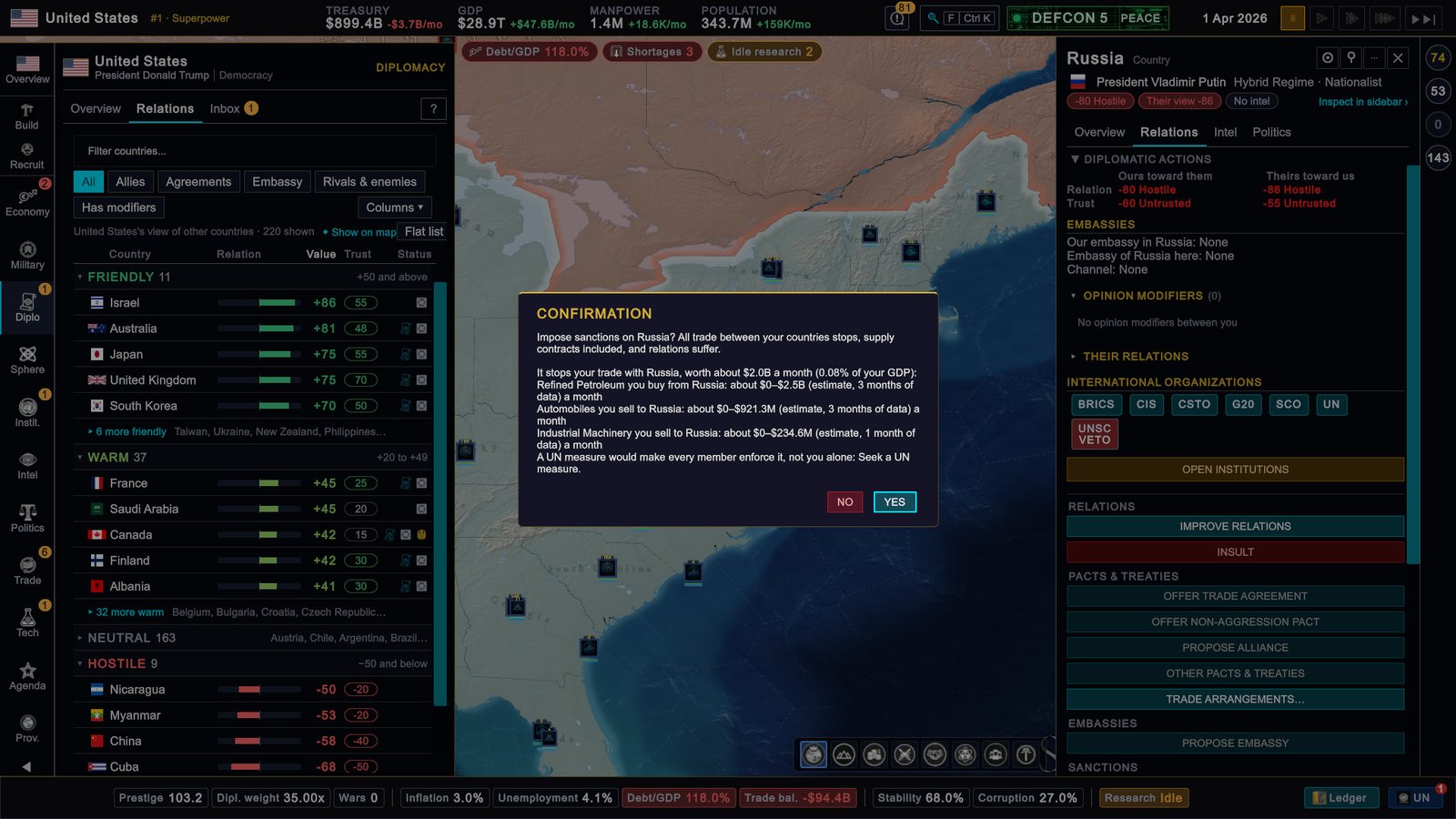
While the sanction stands:
- relations fall 2 points every month;
- an Improve Relations mission with that country gains nothing;
- no trade agreement can be signed between you.
LIFT SANCTIONS ends it and trade resumes. A national sanction costs you exactly the trade it denies the target, and you carry it alone. Seek a UN measure opens the proposal window of the Institutions page with the country filled in, so that other members share the cut. Proposing a trade restriction there needs a seat on the Security Council; without one you can table a condemnation in the General Assembly.
EU members cannot cut trade alone. If you play an EU member, IMPOSE SANCTIONS is a diplomatic statement only: relations suffer and trade goes on. The button beside it reads Seek an EU or UN measure.
Economic warfare
| Tool | What you pay | What it does | How long |
|---|---|---|---|
| CURRENCY MANIPULATION | 1% of your GDP; the treasury must still cover two months of expenses | Raises the target’s inflation by half a point | 12 months; a 12-month cooldown runs from the launch |
| START TRADE WAR | No fee; your own trade shrinks by a share of what the target loses | Each step cuts the target’s trade by a further 5%, up to 50%, and lowers relations by 5 times the new level | 12 months after the last step, then the level falls by one a month |
| SEND AID PACKAGE | 0.5% of your GDP | Relations +15 on both sides at once, Aid Received +15 for two years, a little trust | One payment |
| DEBT TRAP LOAN | 5% of the target’s GDP, paid from your treasury into theirs | The target pays you interest every month at 8% a year, and you become its main creditor | No end date; five loans at most per country |
Rules that apply across the group:
- Currency manipulation and trade wars cannot be used against an ally or a defence pact partner, or during a war with the target.
- A currency manipulation has a 40% chance of being exposed. If it is, the target’s trust in you drops by 20 for two years.
- The inflation a country suffers from all manipulators together is capped slightly above one attack’s worth, so piling on adds little.
- At most three countries can run hostile economic operations against the same target at once.
- The share of a trade war you pay yourself is between 5% and 50% of the target’s cut. It grows with the size of the target’s economy and is higher when the target is one of your main trade partners. A trade war on a large partner hurts you; one on a small economy barely does.
- An AI country takes a loan only if it needs the money (a thin treasury or a monthly deficit) and your relation with it is -10 or better. Being its main creditor raises your sphere influence there.
The PRESSURE & SANCTIONS block on a country’s Overview shows the result: inflation impact, trade war level, aid received and debt outstanding.
The escalation ladder
An AI country that plans a war does not usually open with it. Its plan moves through stages. The steps named in bold are written to the event log, and you get a toast when you are one of the two countries:
- UN Condemnation and Public Denouncement. It tables a condemnation of the target at the UN and insults it. A national sanction can come in the same stage.
- Trade War Escalated. Economic pressure.
- A military build-up.
- Ultimatum Issued. The last step before war.
The plan has an exit. If the planner’s relation toward its target recovers to +25 before the war starts, the plan is dropped and the news reads Tensions Eased. You can use the same steps yourself, in any order.
Ultimatums
ISSUE ULTIMATUM sends a formal demand. It is unavailable during a war or a truce with the target. An ultimatum you send demands that the target Stand down. An AI country may attach a harsher demand that matches its reason for war: Cede contested territory, Change of government or Public humiliation.
An AI target weighs the military balance between you, the strength of its allies, its war exhaustion, its relation with you, how harsh the demand is and how aggressive its government is. A much weaker, isolated country is the likeliest to yield.
- If the target yields, a truce of 24 months is signed and the issuer’s war plan is dropped. The issuer thinks better of the target for a while (Tensions Eased); the target resents it (Backed Down, larger for a harsher demand). The demand itself is not carried out: no land or money changes hands.
- If the target refuses, nothing is signed. For the next 180 days the issuer’s declaration of war on that target is treated as justified: it adds half the usual aggressive expansion and costs half the usual relations with third countries. An AI issuer then moves on to the war itself.
When an ultimatum reaches you, a window titled Ultimatum names the demand and the deadline, 21 days, with the buttons Yield and Refuse. No answer counts as a refusal.
What to do
- Price a sanction before you impose it. If the confirmation shows a large share of your GDP, a UN or EU measure spreads the cost, though it takes weeks and can fail.
- Use aid as the quick friendly lever. It moves relations more in one day than a mission does in a month, and it feeds sphere influence.
- Watch the news for the ladder. A condemnation and a denouncement from the same country mean a plan is running. Raising that country’s relation toward you to +25 ends it.
- An ultimatum is worth sending before a war you intend anyway. A refusal halves the diplomatic cost of the declaration; a yield gives you two quiet years.
- Yielding to an ultimatum is cheap. You lose some opinion and gain a truce. Refuse when you are ready to fight.