Stability measures how firmly your government holds the country, from 0 to 100. Corruption measures how much of the state leaks away. Both drift each month toward a target, and your job is to move the target. Let them slide and the game answers with unrest, lost taxes, coups and revolution.
Where to find it
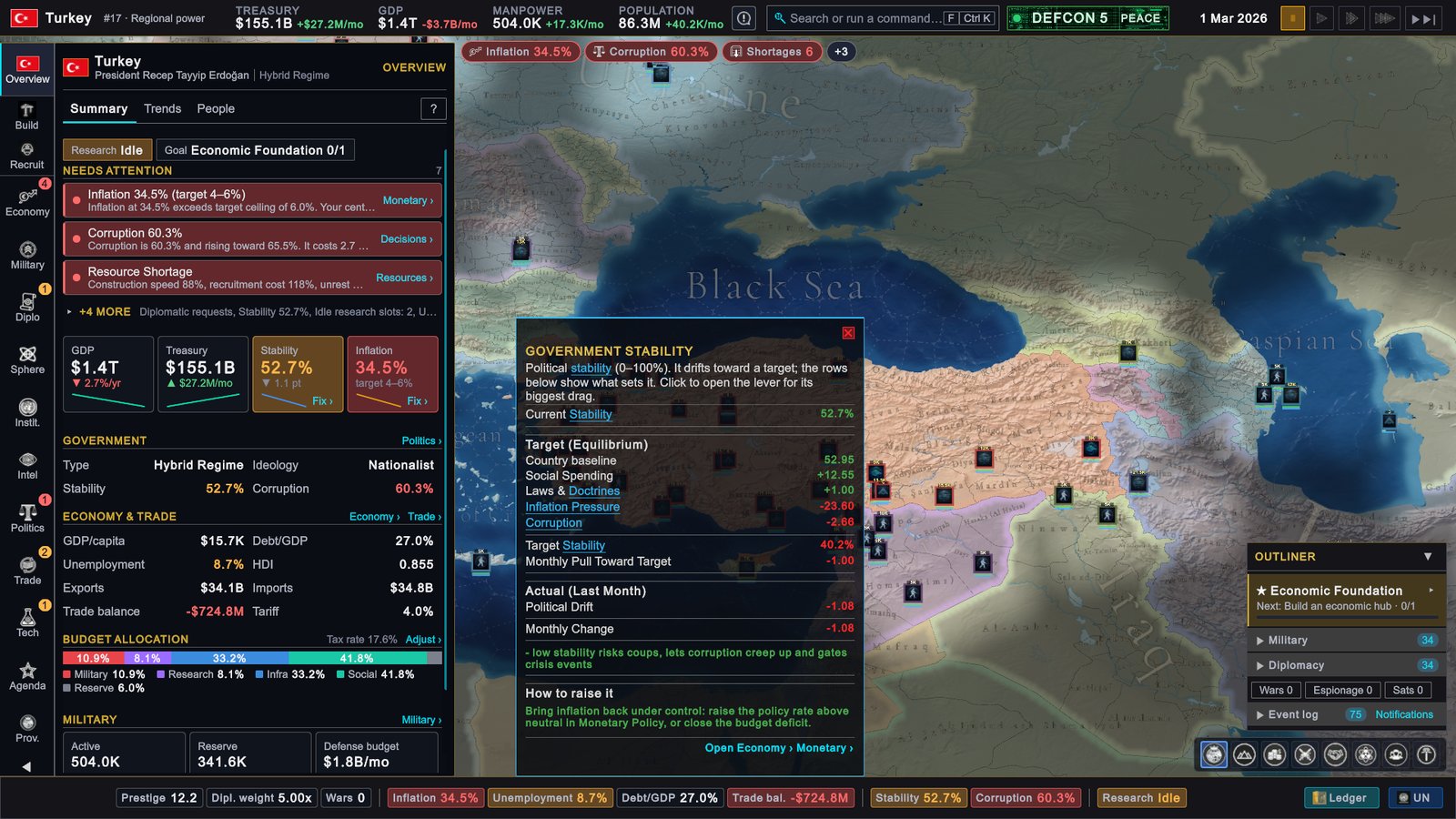
- Status bar (bottom of the screen): Stability and Corruption. Hover either for its full breakdown; click it to open the page that fixes its biggest problem.
- Priority strip (top of the map): both appear here when they need attention.
- Politics › Decisions (K opens Politics by default): coup risk, resentment and the tools on this page.
How it works
Stability moves toward a target
Each month stability closes part of the gap to its target. It climbs by 1.25 a month at most, and by less than half of that while you are at war. The drift downward is capped at 2 a month. Recovery is slow by design.
| What sets the target | Rule |
|---|---|
| Country baseline | Each country’s own starting level |
| Social Spending | A larger Social share of the budget raises it |
| Laws & Doctrines | Those marked Stability target, up to 10 in total |
| Inflation Pressure | Lowers it above 5% inflation |
| Excess Unemployment | Lowers it once unemployment is 2 points above the country’s natural rate |
| Average Unrest | Lowers it when average province unrest is above 10 |
| War Exhaustion | Every point lowers it |
| Excess Debt | Lowers it above 90% of GDP, or above your country’s usual level if that is higher |
| Corruption | Lowers it above 55 corruption and raises it below 55 |
A member of a sphere of influence with a political charter can have one more positive row, Sphere charter. The target never goes above 92, so no country rests at 100.
One-off changes work differently. An election win (+8), a coup (-25), a revolution (-40), an event or a goal reward moves stability at once, and then it drifts back toward the target. One tenth of each shock stays on your baseline for good.
Unrest
Unrest is counted per province, from 0 to 100.
- It rises with poverty in the province, laws that add Unrest (monthly), shortages of strategic resources, hidden resentment, and high unemployment in a young population.
- It falls with the Social share of your budget (more so where education is high), with a Hospital, Public School or Public Library in the province, and with laws that reduce it.
High unrest cuts the province’s GDP and resource output, drives people away, and sends refugees abroad above 60. Country-wide, average unrest above 50 turns voters against the government, and above 70 it makes revolution possible.
Clandestine resentment
Clandestine resentment is hidden anger, from 0 to 100. The stability number does not show it. You build it by decreeing laws your people oppose, by running Smear campaigns, by banning a bloc, and by an anti-corruption campaign in a government that rules by decree.
Every point of it costs you each month: a little stability, a little unrest in every province, and half a percentage point of coup risk before the protections described below. It fades by only 0.2 a month, and not at all while a smear is running or a bloc is banned.
Corruption
Corruption also moves toward a target, by half a point a month at most.
- Lowers the target: laws such as Free Press and Expansive Liberties, anti-corruption doctrines, an Anti-corruption campaign, and institutional resilience above 50.
- Raises the target: laws such as State-Controlled Press and Surveillance State, stability below 40, inflation above 10%, war exhaustion, and institutional resilience below 50.
- Events move your baseline: a quarter of each scandal or reform stays for good.
Corruption costs you three ways. Above 20 it leaks tax revenue, 2% for every 10 points, which comes to about a sixth of the total at the highest corruption. Above 55 it lowers the stability target. And it makes a coup likelier once stability is low.
Coup risk
Coup risk on the Decisions tab is the chance per month that the military takes over. It has two parts.
- Low stability. Below 30 stability a small risk appears. It grows as stability falls and with corruption.
- Resentment. This part applies at any stability, and it is the one that makes a coup likely.
Then the protections apply. A democracy keeps 15% of the risk and a hybrid regime 45%. Every point of institutional resilience above 50 removes 1% of what is left.
A coup installs a new leader and costs 25 stability. A democracy or hybrid regime becomes a military junta: elections stop and laws are decreed. A revolution needs average unrest above 70. A third collapse, shown as Government Reform, can happen while stability is below 40 and corruption above 60. Government and leaders lists what each one changes.
The tools on Decisions
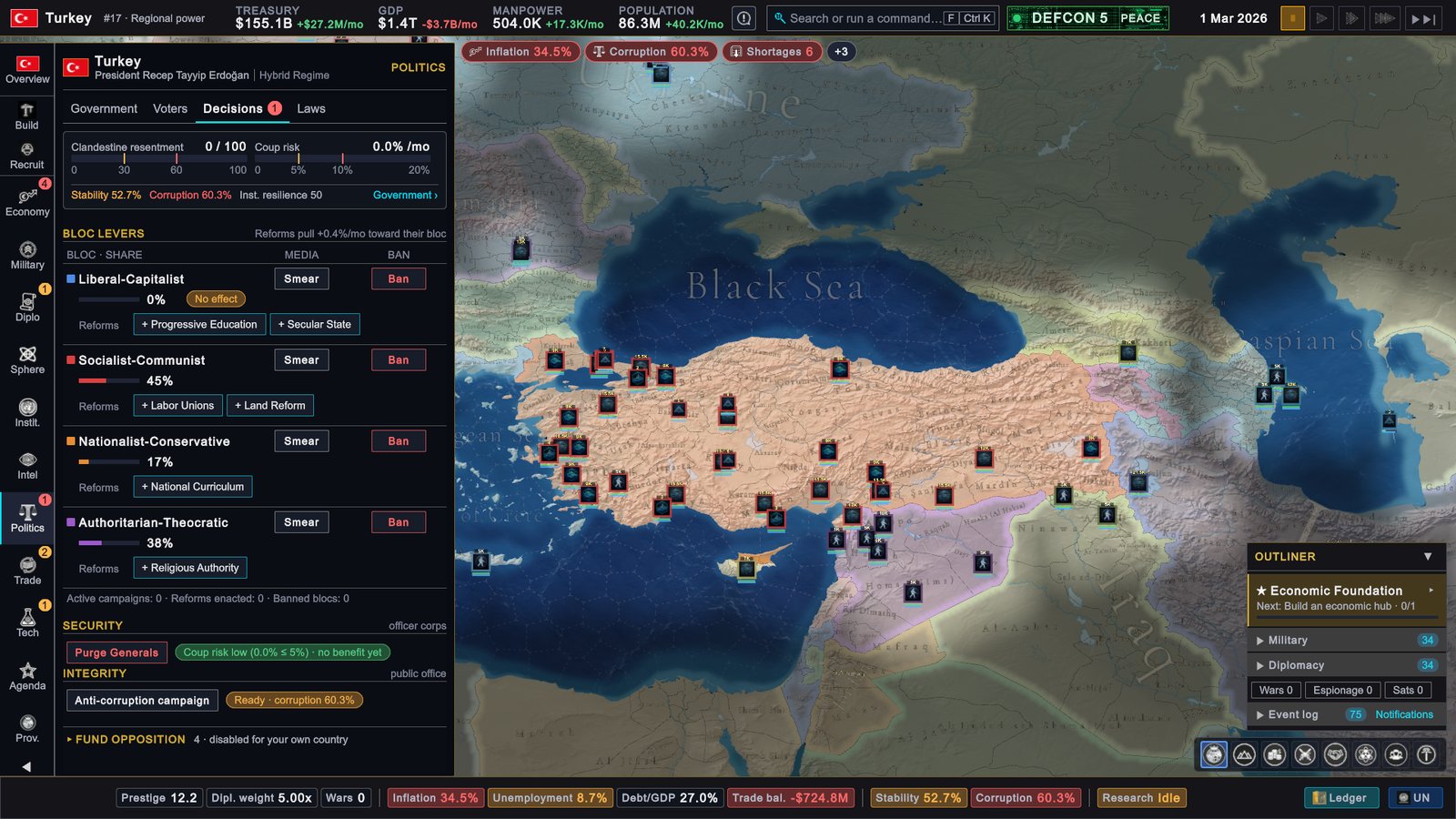
| Tool | What it does | What it costs |
|---|---|---|
| Smear (a button per bloc) | For 12 months the bloc loses 1.5 points of the electorate a month to the others | $2 billion, and resentment every month it runs |
| Ban / Lift ban | The bloc’s vote drops to zero and stays there. After Lift ban its support regrows | 25 resentment at once and 2 more every month of the ban |
| Reforms (six) | Each pulls 0.4 points of the electorate a month toward its bloc until you repeal it | $10 billion each |
| Purge Generals | Adds 20 institutional resilience, which cuts coup risk and lowers the corruption target | $5 billion and 8 stability |
| Anti-corruption campaign | Cuts the corruption target by 8. A small part is permanent; the rest fades over 24 months | About 0.1% of GDP, more where corruption is high; 3 stability; resentment if you rule by decree; then 36 months before the next |
| Fund opposition | Works on other countries only | See Envoys |
The reforms are Progressive Education and Secular State (Liberal-Capitalist), Labor Unions and Land Reform (Socialist-Communist), National Curriculum (Nationalist-Conservative) and Religious Authority (Authoritarian-Theocratic).
A campaign can fail. The chance is 15% while corruption is 40 or lower and grows with every point above that, up to 60%. A failed campaign still takes the money and the stability and starts the 36 months of waiting. The button’s tooltip shows your chance. The campaign is refused at 15 corruption or below.
Moving the capital is not on this tab: open the panel of another province you own, click ⋯ in its header and choose Move capital here. The entry states a stability cost, and the game asks you to confirm.
What to do
In normal times:
- Keep the Social share up. It raises the stability target and calms unrest in every province.
- Hold inflation under 5%. It is often the largest negative row. See Inflation and monetary policy.
- Treat resentment as debt. It builds fast and fades slowly. A ban adds 25 at once, and at 0.2 a month that takes about ten years to clear after you lift it.
When stability is falling:
-
Find the cause. Hover Stability on the status bar and read the rows under Target (Equilibrium). Click to go to the lever for the biggest one.
-
Stop adding resentment. No new decrees against the electorate, no new smears. Lift bans you can live without, so that resentment starts to fade.
-
Raise the target. Raise the Social share, bring inflation down, and pass laws marked Stability target.
-
Deal with coup risk. If the chip beside Purge Generals says a purge lowers the risk, use it. It costs 8 stability at once, so do it before you are close to 30, not after.
-
Then clean up. Run the Anti-corruption campaign when it shows Ready, and pass laws that lower the corruption target.
-
Give it time. Stability climbs by 1.25 a month at best, and more slowly at war. Ending a war lets war exhaustion fade and restores the full climb.