The game models international organizations as bodies that put items on an agenda and vote. A decision can condemn a country, stop its trade with every member, or send allied forces to defend one. Everything on this page is the game’s own rules: they borrow names and procedures from real institutions and simplify them.
Where to find it
- Institutions page. Click Institutions on the rail (J by default). The tabs are Agenda, Organizations, Commitments and Representatives.
- Status bar. The UN button opens the Agenda; its badge counts the items that need you.
- Diplomacy page. Open Institutions on Overview leads to the same place.
- Reference. The Organizations table lists every organization and its members.
How it works
The Agenda tab
Agenda has three sections: Needs you, Open and Decided. Each item is a card with its kind, its stage (Drafting, Voting, Adopted, Failed, Vetoed or Lapsed), the deadline, the sponsor, and an If adopted… box that says what it would do. Ballots are secret until an item is decided, and you can change yours until the vote closes.
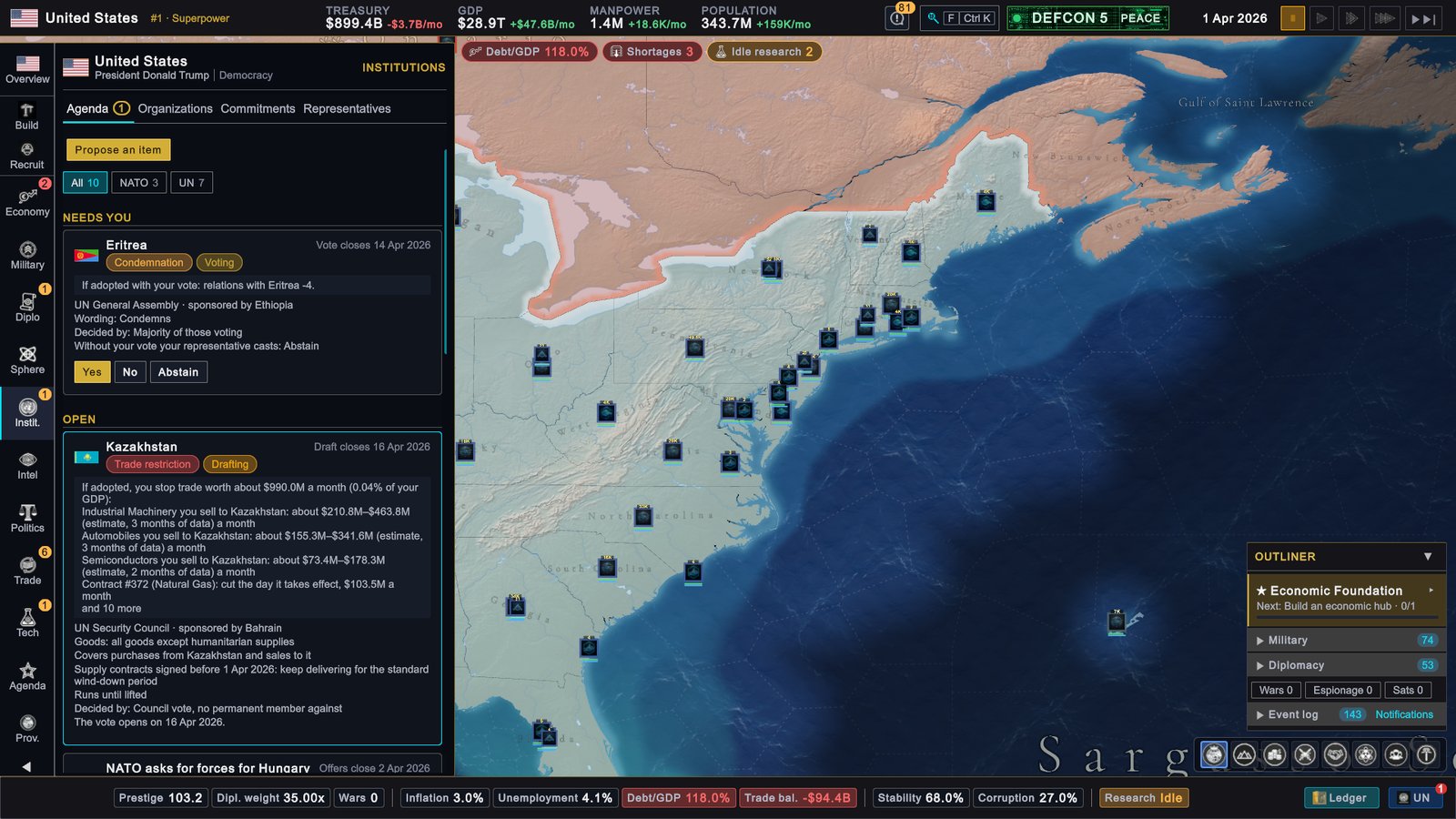
Tabling and voting
Propose an item opens a window where you pick the body, the kind and the country concerned. What you can table depends on where you are a full member:
| Body | Kinds you can table |
|---|---|
| UN General Assembly | Condemnation, Ceasefire call, Call for mediation |
| UN Security Council (you need a seat) | Trade restriction, Condemnation, Call for mediation |
| Council of the EU | Decision on a trade restriction, Trade negotiation mandate |
A body holds at most three open items, and you wait 60 days before tabling the same kind against the same country again.
An ordinary item spends 15 days in drafting and 15 in voting; an urgent one 5 and 5. During drafting, members state positions in public, and a condemnation that would fail can be softened to milder wording. During voting the buttons are Yes, No and Abstain.
| Decision | How it passes |
|---|---|
| Assembly condemnation or call for mediation | More Yes than No; abstentions do not count |
| Assembly ceasefire call or recommended measures | Two thirds of those voting |
| Security Council decision | 9 Yes of 15 and no permanent member voting No |
| EU decision on a trade restriction | Unanimity: one No blocks, an abstention does not |
| EU regulation or trade mandate | 55% of members holding 65% of the members’ population |
| NATO, CSTO, BRICS and most regional bodies | Consensus: any No blocks |
AI members vote on their relations, wars, pacts and trade agreements with the sponsor and the target, and on what a trade measure would cost them. A target that wages an offensive war or carries high aggressive expansion draws more votes against it.
The General Assembly and the Security Council
The Security Council has five permanent members and ten elected for two years. The Assembly holds the elections each year, and Stand for a seat appears on the item for your regional group.
- The veto. A permanent member vetoes by voting No; there is no separate button. With nine or more Yes votes, that No makes the item Vetoed. An abstention is not a veto.
- A vetoed draft. The sponsor of a vetoed trade restriction gets Send to the Assembly for 30 days. The Council votes on the referral with nine votes needed and no veto; if it passes, the Assembly votes on the same text as Recommended measures. A recommendation binds only the members that voted Yes.
- Condemnation. The condemned country’s relation falls by 15 toward the sponsor and by 4 toward each Yes voter, and it loses 3 prestige.
- Trade restriction. Every UN member stops the named trade with the target. A tenth of private trade still gets through.
- Calls. A ceasefire call adds 4 war exhaustion to both parties and does not stop the war. A call for mediation raises the parties’ relations by 8 each way.
The game tables urgent UN items by itself after an offensive declaration of war on a member, a nuclear strike, a country fighting four or more others, or a blockade outside a war. A UN decision does not forbid or authorise a war: the UN reacts after the fact, and the Declare War window forecasts how it is likely to react.
The EU
EU trade measures take two votes. Stage 1 is the Decision on a trade restriction, by unanimity. During drafting, Support with an exemption… asks to keep trading some goods; exemptions go to at most two members, and only where they make the text pass. Stage 2 follows at once: a regulation voted by qualified majority that binds every member, including those that voted No. The measure runs 365 days and is put up for renewal before it lapses.
Under the common trade policy an EU member cannot act alone on trade:
- its national sanction is a diplomatic statement with no trade effect;
- it cannot sign a trade agreement of its own. The Union negotiates through a Trade negotiation mandate.
NATO and the CSTO
You cannot table the items of these two alliances yourself; they come from AI members, from events and from the game.
- Consultations and reinforcement plans. When members adopt consultations about a threatened ally, a reinforcement plan goes to a vote. If it passes, a defence mission takes offers for 30 days and a card asks you for forces: Offer forces…, Political support or Decline. The card shows what is expected of you, and members’ trust in you follows your answer.
- Forces under allied command. In the offer window you pick units and their rules of engagement: Defend if attacked or Withdraw if fighting starts. The units stay yours and you pay for them, but only the mission commander orders them. They fight on the host’s side while your country stays out of the war. Recall before their service ends costs up to 8 trust with the host and the other members.
- Collective defence. When a member is attacked from outside, the alliance votes by consensus on invoking collective defence. If it is invoked, each ally has 10 days to choose: Join the war, Offer forces…, Political support or Decline. Nobody is pulled into the war automatically. Each ally is judged against the share expected of it, for up to 15 trust either way.
In both cases, no answer by the deadline counts as political support.
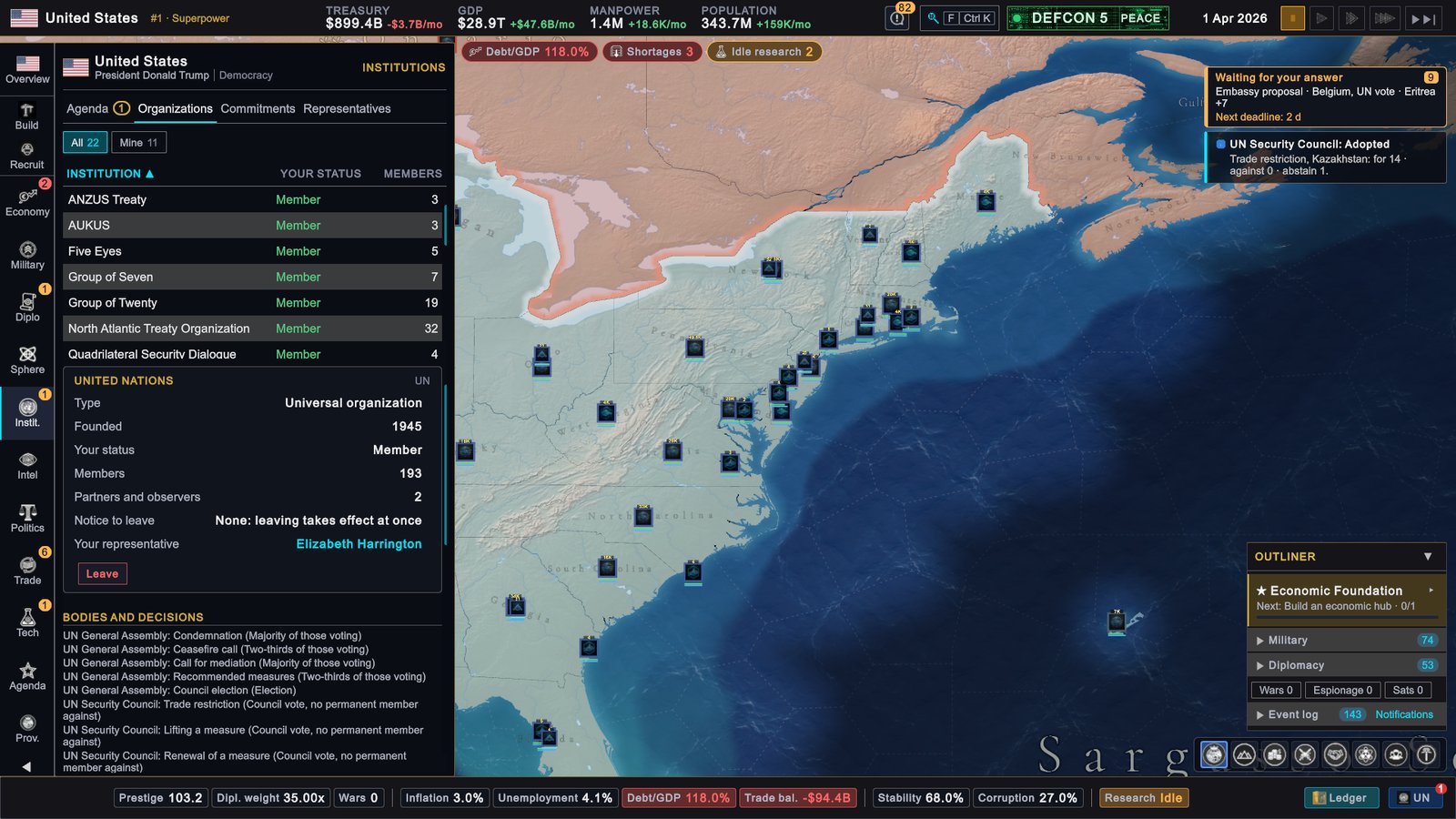
The Organizations tab
The table lists every organization with Your status and Members. Selecting one shows its bodies and what each decides, council seats, measures in force and recent decisions. Ten organizations take decisions; the others are membership only.
Apply to join puts your application on the agenda of an organization that accepts applications; several take only countries of their region, and NATO admits by invitation. Give notice to leave starts the notice period (365 days for NATO, 730 for the EU), during which its decisions still bind you. Notice cannot be withdrawn.
The Commitments tab
Commitments lists what binds you: your forces on defence missions (with Recall), allied forces in your country, notices to leave, invitations, items you sponsor, measures you enforce, measures on your country and your council seats.
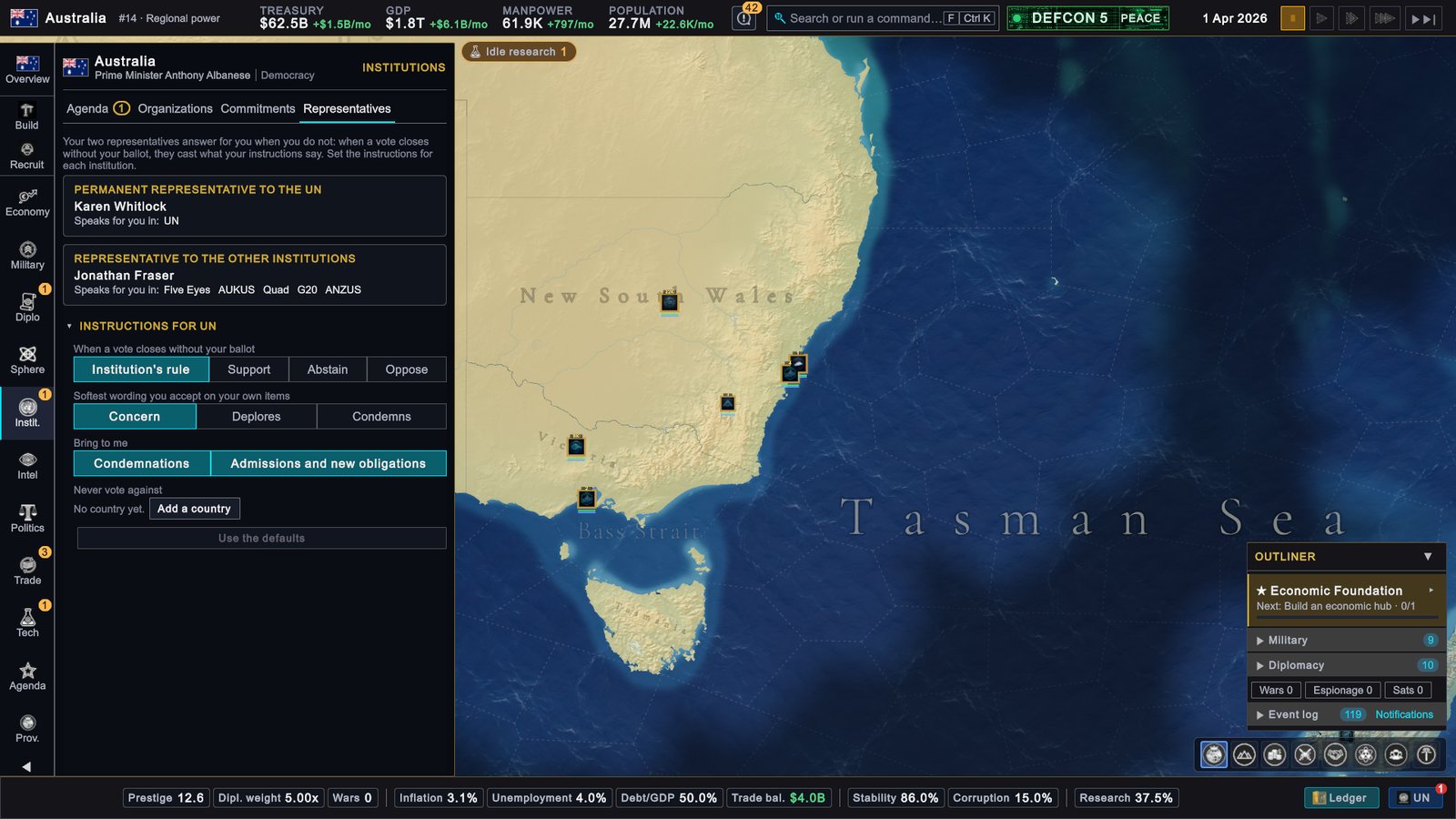
The Representatives tab
Every country has two fixed posts: a Permanent representative to the UN and a Representative to the other institutions. They vote for you when a vote closes without your ballot. You set their instructions per institution:
- When a vote closes without your ballot: Institution’s rule, Support, Abstain or Oppose.
- Bring to me: which kinds of item appear under Needs you. The rest are left to the representative.
- When allies ask for forces: Decide for me, Political support only or Ask me.
- Never vote against: up to four protected partners per institution. Your representative votes No on a condemnation or trade restriction against them. It does not override a vote you cast yourself.
What to do
- Set instructions early. Protect your closest partners and decide how force requests are answered, so that deadlines you miss still go your way.
- Count the votes before you table. A Security Council draft against a permanent member’s friend is likely to be vetoed, and a trade restriction stops your own trade with the target too.