Inflation is the yearly rate at which prices rise in your country. High inflation slows growth, weakens stability and feeds corruption, and it does not fall back by itself: in the game it drifts toward what people expect it to be. Your main tool against it is the central bank’s policy rate.
Where to find it
- Economy › Monetary. Click Economy on the rail (E by default), then the Monetary tab.
- Overview › Summary. The Inflation tile shows the rate and your target band. When inflation is a problem it carries a Fix › link to the Monetary tab.
- Status bar. The Inflation chip at the bottom of the screen.
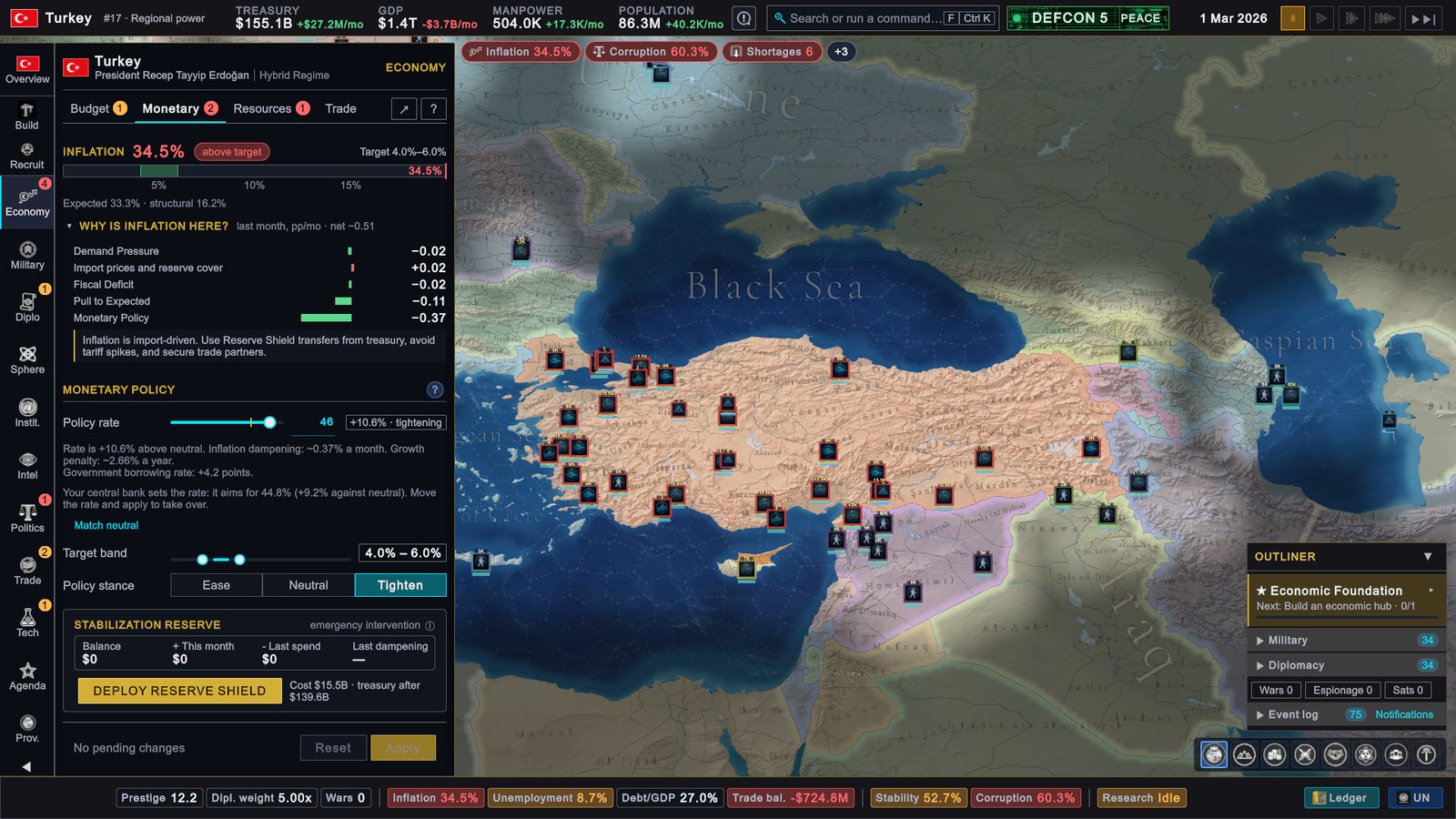
How it works
What moves inflation each month
The top of the tab shows the rate, a chip reading above target, within target or below target, and a gauge with your band marked on it. Below it, Why is inflation here? lists what moved inflation last month, in percentage points per month. It needs one closed month.
| Row | What it is | What changes it |
|---|---|---|
| Pull to Expected | Each month inflation closes about an eighth of the gap to expected inflation | Expectations, which move slowly |
| Monetary Policy | The policy rate against the neutral rate | You, or your central bank |
| Fiscal Deficit | The gap between what the budget collects and what its spending shares pay out | Tax rate and spending split |
| Import prices and reserve cover | Rising import prices, weighted by how much you import, plus a premium when import cover is low | Trade agreements soften it; so does energy resilience above its starting level, which some event choices raise |
| Demand Pressure | A small share of your growth rate | Faster growth adds more |
| Economic warfare | Currency manipulation by other countries | See Sanctions, economic warfare and ultimatums |
| Reserve Stabilization | The stabilization reserve spending itself | The reserve shield |
Rows that did not move inflation are left out. A one-line diagnosis appears under the list once inflation is 6% or more. Inflation cannot leave the range from −5% to 200%; at the top a chip reads at ceiling.
Expected and structural inflation
Under the gauge is a line such as “Expected 34.1% · structural 16.3%”. These two figures decide where inflation settles.
- Expected inflation follows actual inflation and the structural level, a few percent of the gap each month.
- Structural inflation is your country’s underlying level. Only the policy rate moves it: a rate 10 points above neutral lowers it by about one point a year, and a rate below neutral raises it.
With the rate at neutral, inflation that is above the structural level drifts down toward it over several years. To get below it, the rate has to stay above neutral.
The policy rate
The Policy rate lever sets the central bank’s rate. A gold tick marks the neutral rate: expected inflation plus 1.5 points. The chip beside the lever shows your distance from it, and the line under the lever gives that month’s effects in figures.
| For each point above neutral | Effect |
|---|---|
| Inflation | Falls by about 0.035 points a month (0.4 a year) |
| Growth | Loses 0.25 points a year |
| Government borrowing | The interest rate on national debt rises by 0.4 points |
| Private trade | Firms import less and exports lose some competitiveness |
A rate below neutral reverses the first row by the same amount, but adds only about a third as much growth as tightening costs, and borrowing does not get cheaper than the base rate. Gaps beyond 25 points add nothing more.
Because expectations move, the neutral rate moves with them. A rate you fix turns tighter as inflation falls. Match neutral sets the lever to the neutral rate.
Your central bank on auto
At the start your central bank sets the rate itself. Each month it moves the rate a quarter of the way toward its own aim, which sits above neutral when inflation is above what the bank is aiming for, by at most 10 points. The tab tells you the rate it is heading for.
Move the lever and press Apply to take over. From then on the rate stays where you put it. Let the central bank decide hands it back.
Target band and stance
- Target band is the range you call acceptable, between 0% and 20%. Each country starts with its own band, one point either side of its central bank’s target. The band does not pull inflation toward it. It decides when inflation reads as above or below target, when alerts appear, and when the stabilization reserve may spend.
- Policy stance has three buttons: Ease, Neutral and Tighten. It is a label with a small growth effect, 0.1 points a year gained on Ease and lost on Tighten. It does not move inflation. While the bank is on auto it sets the stance as well.
The stabilization reserve
The Stabilization reserve card is an emergency tool. DEPLOY RESERVE SHIELD moves money from the treasury into the reserve: two months of revenue, or 10% of the treasury if that is less. The button works only while inflation is above the top of your band. The preview beside it shows the cost, and the game asks you to confirm.
While inflation stays above the band, the reserve spends part of itself every month, more the further inflation overshoots, up to 8% of the reserve. The larger that spending is against your GDP, the more it cuts, up to 1.5 points a month. The card shows the balance, the last spend and the last cut. The reserve is filled only by this button.
What high inflation costs
- Growth. Inflation Drag takes about 0.3 points off annual growth at 5% inflation, 1.1 at 20% and 2.4 at 50%.
- Stability. Above 5%, each further point of inflation takes 0.8 points off the level your stability drifts toward, up to 30.
- Corruption. Above 10% it raises the level corruption drifts toward.
- Trade and politics. Inflation above what people expect makes firms import more and export less, voters react to it, and several crisis events can fire only when inflation is high.
What to do
- Find the cause first. Read Why is inflation here? and the diagnosis under it. The largest positive row is the one to work on.
- To bring inflation down for good, hold the rate above neutral. Each point of gap buys about 0.4 points a year directly, and the lasting gain comes as expectations and the structural level follow. That takes years, and the growth and interest costs are paid in every one of them.
- Do not overshoot. A 10-point gap costs 2.5 points of growth a year and adds 4 points to the interest rate on your debt. Check Debt/GDP before you tighten hard.
- Close a budget deficit. A plan that collects more than it spends pulls inflation down a little every month.
- Use the reserve shield for spikes. It costs treasury, not growth, and it spends only while inflation is above your band.
- Protect import cover and sign trade agreements if the import row is the large one. See Trade.
- Leave the bank on auto if you would rather not manage the rate. It reacts every month, with a limit on how tight it goes.