The budget decides how much of your economy the state collects and what it buys with it. The treasury is the cash that pays for construction, recruitment and every other order you give, so a budget that loses money each month ends in debt.
Where to find it
- Economy › Budget. Click Economy on the rail (E by default), then the Budget tab.
- Overview › Summary. The BUDGET ALLOCATION bar shows the tax rate and the spending split; Adjust › opens the Budget tab. The Treasury tile gains a Fix › link after a month that lost money.
- Top bar and status bar. Treasury with last month’s change, and Debt/GDP at the bottom of the screen.
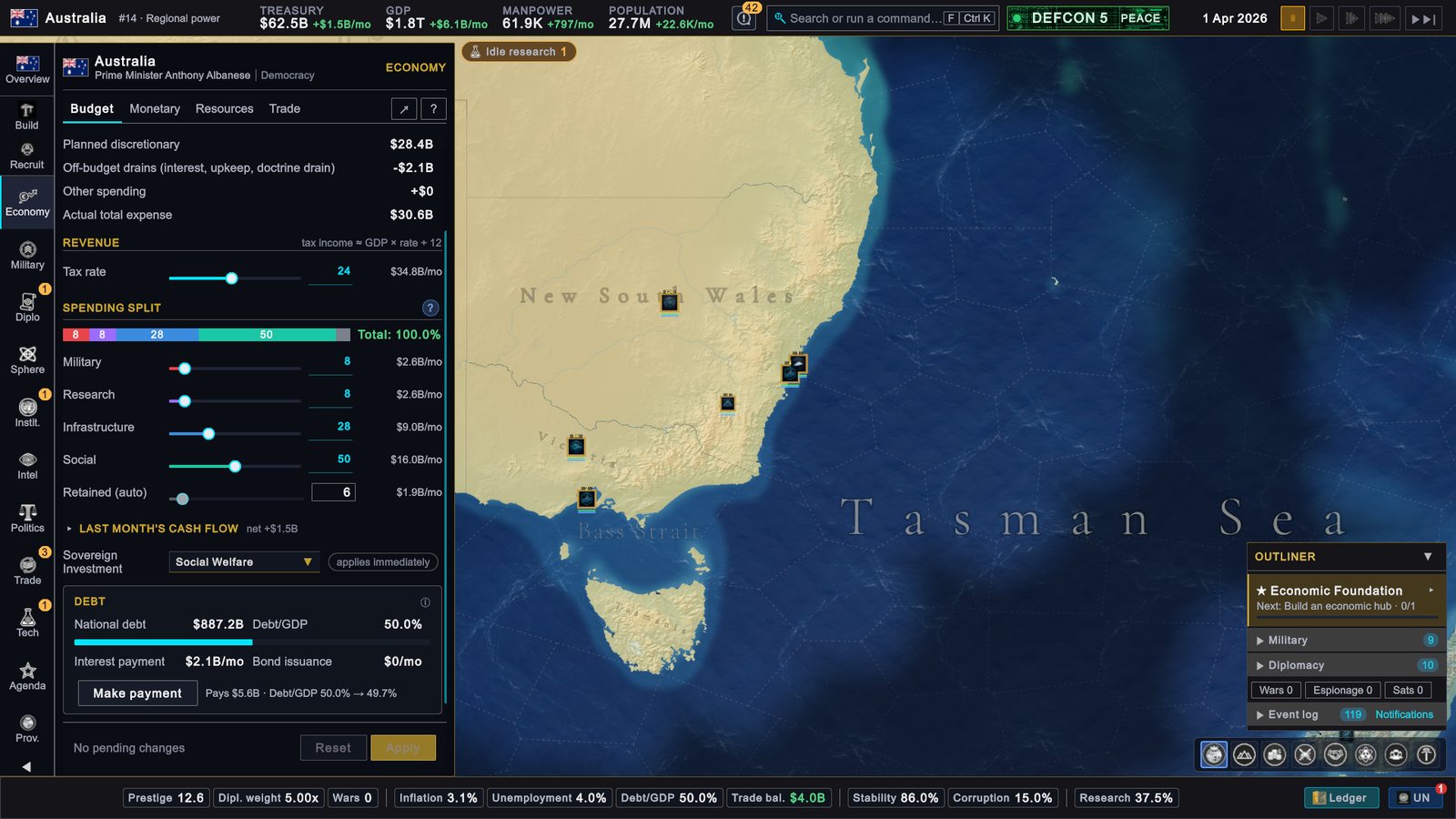
How it works
Revenue
Four tiles at the top show the treasury and last month’s revenue, expenses and net change. They are results, not plans.
Most revenue is tax: roughly GDP × tax rate ÷ 12 each month. The Tax rate lever runs from 0 to 50. Two things change how much of that arrives:
- Tax efficiency. Tax laws and some doctrines raise or lower collection.
- Corruption. Above a low level it leaks tax, up to about a sixth of it at the highest corruption.
The tax rate has no line of its own in the growth breakdown on GDP and growth; its direct effect is on revenue.
The other regular income lines are Tariff revenue (duties on imports), Trade services and Handling fees (income from trade and from trade centres in your provinces) and Interest from foreign lending. One-off lines cover sales of goods, event income and war reparations.
The spending split
The four spending levers divide your revenue. Their total cannot pass 100%, and whatever they leave is Retained (auto): it stays in the treasury. Nothing changes until you press Apply; Reset puts the levers back.
| Lever | What the money does |
|---|---|
| Military | Becomes the monthly defence budget, described below. |
| Research | Produces research points for the Knowledge Network, with diminishing returns: doubling the budget gives about 40% more points. A larger share also speeds up education in your provinces. |
| Infrastructure | Raises province infrastructure year by year, with more going to provinces that have little. Spending alone takes a province to 150; infrastructure buildings take it to the maximum of 200. |
| Social | Raises the level your stability drifts toward (each 10% of the split is worth 3 points), makes province unrest fade faster, improves healthcare access and trims unemployment. |
Three details change what the levers deliver:
- Before the split, the state sets aside most of the month’s expected debt interest. The levers divide what is left.
- While you are at war, Military is treated as at least 35%. The difference is taken from Infrastructure and Social in proportion.
- The dollar figure beside each lever is a preview for the value you are dragging to.
What the split does not cover
A budget that totals 100% can still lose money, because several costs are paid on top of it:
- Off-budget drains: debt interest, building and satellite upkeep, unit upkeep above the defence budget, and the running cost of some welfare doctrines.
- Other spending: construction, recruitment, state purchases of goods, envoys, political actions and event costs.
Planned vs actual compares the planned shares with what left the treasury, and Last month’s cash flow lists every income and expense line. Both need one closed month.
The monthly defence budget
The Military share becomes a defence budget for that month, and unit upkeep is paid from it. When upkeep is larger than the budget:
- 35% of the gap is charged to the treasury, as Military upkeep above budget.
- The rest is not paid. Your forces lose combat readiness in step with the unfunded share, down to 35% readiness when the budget covers nothing.
The defence budget also sets how fast manpower recovers: between half speed and one and a half times normal, depending on the budget’s size against your GDP.
Deficits and national debt
If the treasury is below zero when a month closes, the state borrows the shortfall. It shows as Bond issuance in the cash flow, the treasury returns to zero and Debt/GDP rises. The ratio stops at 260%.
Debt costs interest every month:
- The base rate is 2.5% of the debt a year.
- Above 100% of GDP lenders add a premium that grows with the debt, reaching 3 more points at 250%.
- A policy rate above neutral raises the government’s borrowing rate too. See Inflation and monetary policy.
High debt also weighs on stability. Above 90% of GDP, or above the ratio your country started with if that is higher, every 10 more points of Debt/GDP take 1 point off the level your stability drifts toward. A country with high debt, high inflation and stalled growth can also draw a debt crisis event.
Debt comes down in three ways:
- A surplus in the plan. When revenue is larger than the spending shares pay out, Debt/GDP falls toward your country’s starting ratio.
- An overflowing treasury. When the treasury holds more than 25% of GDP, a quarter of the excess leaves each month. It pays debt down to the starting ratio first. The rest goes where Sovereign Investment points: Social Welfare spends it on extra social programmes, while Defense, Research and Infrastructure add it to that month’s defence budget, research budget or infrastructure spending. This setting applies as soon as you pick it.
- Make payment. Once a month the button on the Debt card pays the smaller of 20% of the treasury and 2.5% of GDP, and leaves at least two months of expenses behind. When interest is larger than revenue it pays up to half the treasury. It can take debt below the starting ratio.
Foreign debt and reserves
National debt is what the government owes. Your country also has a foreign account, which the treasury does not pay into or out of. Private firms pay for imports and are paid for exports through the foreign exchange reserves. When their bills exceed their earnings the country first calls back what it lent abroad, then borrows from the world’s lenders up to a credit limit set as a share of GDP. That borrowing is foreign debt. Above the limit, private imports are cut to what the country earns.
Two things reach your budget from there: low import cover adds to inflation, and part of the interest on money your country lent abroad is paid into the treasury. The Foreign account card is on Trade › Overview; Trade explains it.
What to do
- Judge the budget by its result. After the first month closes, read the net tile and the cash flow, not the levers.
- In a deficit, find the line first. Unit upkeep above the defence budget, building upkeep and debt interest are common causes, and the cash flow shows which one it is.
- Use Retained as your safety margin. Lowering the four shares leaves more in the treasury each month and pulls debt down.
- Do not starve defence while you field an army. An unfunded gap costs only about a third of its size in cash, but the rest is paid in readiness.
- Raise research and infrastructure early. Both build up slowly, so shares raised early have longer to work.
- Stay under 100% Debt/GDP if you can. The interest premium begins there. Use Make payment in months when the treasury is comfortable.
- Decide where a large treasury overflows to. Cash above a quarter of GDP drains away month by month whichever option is selected, so pick the one you want.