A scenario decides who owns what. Content decides what exists: which units a country can recruit, what it can build, what there is to research. Old World Order has to swap nearly all of it for a world without aircraft or oil. This page shows which file does each job, and why the mod sometimes replaces a whole list and sometimes patches a few values.
Replace or patch
Most content files have two ways of working. A merge file changes or adds entries and leaves the rest of the base game alone. A replace file is the whole list: every base entry it does not name is switched off. Some files can only be patched, because the game stores their entries by position in saves.
| File | How the mod uses it | Why |
|---|---|---|
scenario/units_override.json | Replace | No modern unit belongs in 1450, so the file is the roster. |
scenario/buildings_override.json | Replace, plus a disabled list | It keeps 14 base ids under new names, adds one id of its own and names four it drops on purpose. |
scenario/resources_override.json | A disabled list | Resources are a fixed set. A mod can re-skin or disable them, not add new ones. |
overrides/doctrines.json | Replace | Seven branches are rebuilt from scratch. |
overrides/laws.json | Patch | Laws cannot be removed or reordered, so the mod disables options and renames others. |
overrides/interest_groups.json | Patch | The four age bands and five groups are fixed. The mod relabels them. |
overrides/game_settings.json | Patch | A handful of balance numbers. |
Content/specialists.json | Replace | The mod wants only its own specialists. |
Content/research_tracks.json | Adds | Tracks sit beside the doctrine branches. |
Switched off does not mean deleted. A base entry stays in the game’s data, but it is hidden from every menu, the AI does not pick it, and the command to build or recruit it is refused.
Units
Two files for one roster
scenario/units_define.json declares the 33 unit ids, each with a category and, for 25 of them, an owner:
{
  "id": "ottoman_janissary",
  "displayName": "Janissary",
  "category": "infantry",
"ownerIso3": "OTT",scenario/units_override.json, named by the header’s unitsOverrideFile, defines the same 33 ids in full. The Janissary again, with the terrain table left out:
{
  "id": "ottoman_janissary",
  "name": "Janissary",
  "category": "ground",
  "subcategory": "infantry",
  "stats": {
    "attack": 12.0,
    "defense": 10.0,
    "hp": 130.0,
    "speed": 1.1,
    "manpower": 800,
    "air_attack": 0.0,
    "anti_air": 0.0,
    "anti_sub": 0.0,
    "range": 1.5
  },
  "cost": {
    "money": 300,
    "build_time_months": 1,
    "required_building": null,
    "resources": []
  },
  "maintenance": {
    "money_per_month": 3,
    "manpower_per_month": 0,
    "resources_per_month": []
  },
  "prerequisites": {
    "tech": "none",
    "building": null
  }
}
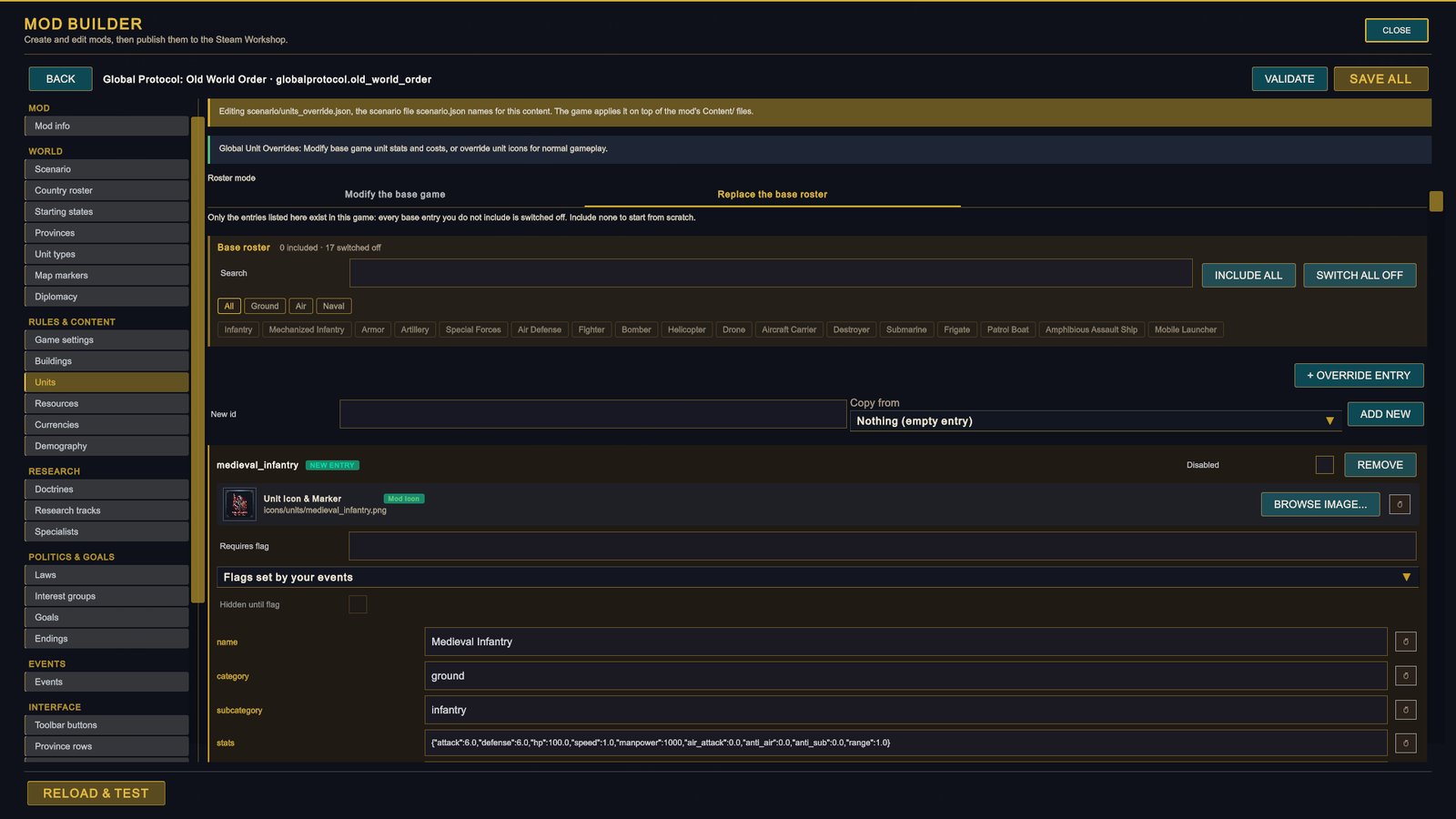
Which file to edit. When a roster file defines a unit id, that definition supplies the unit’s stats and costs, so change numbers in units_override.json. Each file has its own vocabulary for category: units_define.json takes a broad type such as infantry, cavalry, artillery or naval, and a roster file takes ground, naval or air.
The roster file starts with "mode": "replace", so every base unit it does not list is switched off. The header also carries disabledUnitCategories (Air, Missile, Special) and, in disabledUnitTypeIds, 17 modern unit ids.
The ships show a useful trick. The game draws map markers per subcategory, and those are fixed, so the mod’s ships borrow modern ones: the cog is an amphibious unit with a transport_capacity of 4, and the Ming treasure ship is a carrier.
Shared and nation-unique units
Who may recruit what comes from three rules working together:
ownerIso3makes a unit exclusive: only its owner recruits it, unless another roster grants it (see the third rule). Leave the field out for a shared unit: an empty string fails the schema.militaryUnitTypeIdsincountries_add.jsonis each nation’s roster. A nation with a roster recruits only the ids on it, plus the ones it owns. A nation whose roster lists no ship can build no fleet.- A roster is also a grant. Tver’s roster lists
muscovy_streltsy, a unit owned by Muscovy, and so Tver may recruit it too.
The mod has eight shared units (infantry, cavalry, crossbowmen, bombards, war elephants, galleys, cogs and carracks) and 25 exclusive ones.
Buildings
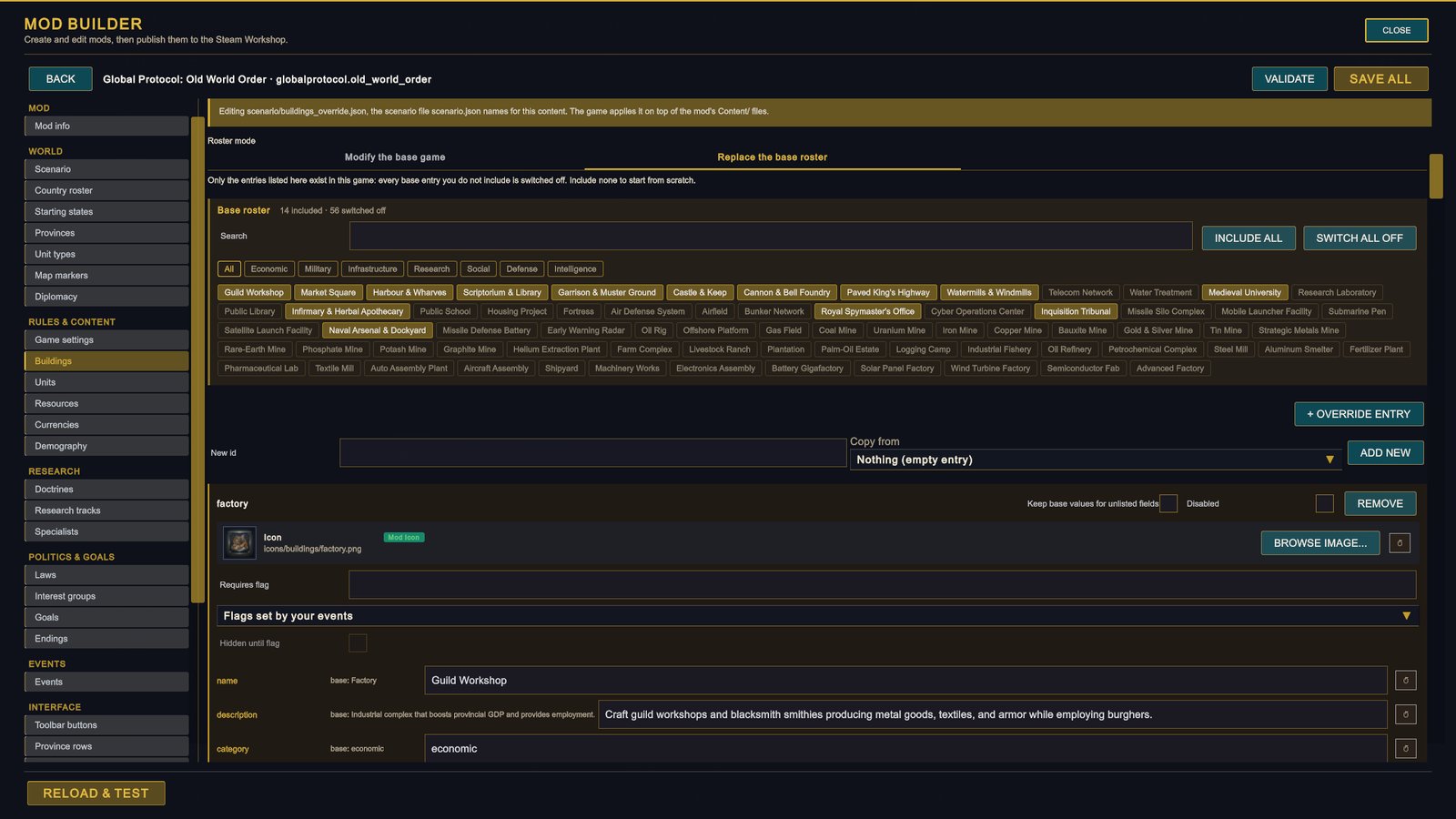
scenario/buildings_override.json begins:
{
  "mode": "replace",
  "disabled": [
    "airfield",
    "submarine_pen",
    "cyber_ops_center",
    "satellite_launch_facility"
  ],
  "buildings": [
Fourteen of its 15 entries re-use base ids; the fifteenth, radar_station, is an id of the mod’s own. Every other base building is switched off. The naval base becomes a dockyard:
{
  "id": "naval_base",
  "name": "Naval Arsenal & Dockyard",
  "description": "State arsenal and shipwright slipways building war galleys, carracks, and rigging naval armaments.",
  "category": "military",
  "cost": {
    "money": 1200,
    "build_time_months": 10
  },
  "maintenance_per_month": 8,
  "effects": {
    "defense_bonus": 15,
    "employment": 600
  },
  "prerequisites": {
    "tech": "none",
    "infrastructure": 25,
    "population": 25000
  },
  "max_per_province": 1,
  "max_level": 3,
  "level_scaling_factor": 0.4,
  "inherit": false
}
Why keep the old ids rather than invent dockyard? Some features find their building by id: fleets are recruited and docked at naval_base, espionage uses intelligence_hq and counterintel_bureau. Drop the id and you drop the feature. The game warns when a replace roster leaves one of these out, and naming it in disabled tells the game you meant it, which is what the four entries above do.
Two more details to copy. "inherit": false makes each entry the whole definition, so no modern recipe or effect leaks through. And every entry sets prerequisites.tech to "none": a building gated by a tier of a hidden doctrine branch is never offered.
Resources
scenario/resources_override.json holds one list of 31 ids:
  "disabled": [
    "Oil",
    "NaturalGas",
    "Coal",
    "Uranium",
A disabled resource is no longer produced, disappears from the market and resource screens, and cannot be bought, sold or named in a trade agreement. What a province produces instead is set in provinces_data.json, described on the scenario page.
Research
Doctrine branches
overrides/doctrines.json is in replace mode and lists seven branches: military, economy, government, society, diplomacy, intelligence and industry. Each has the five tiers a branch must have, two doctrine cards per tier, a milestone, three directives and a pool of hidden cards. One card:
{
  "id": "feudal_levies",
  "name_key": "owo.doctrine.military.t1.feudal_levies",
  "desc_key": "owo.doctrine.military.t1.feudal_levies.desc",
  "icon": "military_t1b_mass_mobilization",
  "effects": {
    "manpower_regen_mult": 1.15,
    "recruit_cost_mult": 0.9,
    "readiness_mult": 0.95
  },
  "ai": {
    "military": 0.5,
    "economy": 0.2
  }
}
In replace mode nothing is inherited: a listed branch is exactly what the file says. A base branch the file leaves out is hidden, so cyber, space and energy are gone, and the header’s disabledDoctrineBranches states it outright. Names come from the name_key and desc_key rows in the language files. The icon value is a file name in icons/doctrines/: for its doctrine cards the mod keeps the base game’s icon ids and ships its own picture under each.
Research tracks
Content/research_tracks.json adds three tracks of three nodes each. Tracks run in slots of their own and take nothing from doctrine research.
{
  "id": "double_entry_bookkeeping",
  "name": "Double-Entry Bookkeeping",
  "description": "Venetian merchant accounting methods that rationalize commercial enterprises and taxation.",
  "icon": "res_double_entry_bookkeeping",
  "cost": 650,
  "prerequisites": [
    "movable_type"
  ],
The file ends with a starting block that gives five nations a head start, for example "VNC": ["double_entry_bookkeeping"]. Node and track icons are found by their icon name in icons/ or icons/research/.
Specialists
Specialists are named people a country employs for a research or production bonus. The base game has none, so all 15 come from Content/specialists.json:
{
  "id": "orban_engineer",
  "name": "Urban (Orban)",
  "description": "Master brass and iron founder who designed the great Basilic bombard.",
  "role": "engineer",
  "portrait": "portraits/specialists/orban_engineer.png",
  "country": "OTT",
  "available_from": 1450,
  "hire_cost": 75000,
  "upkeep_monthly": 4000,
  "ai_weight": 2.5,
  "effects": {
    "unit_build_speed_mult": 1.3,
    "production_output_mult": 1.15
  }
}
country puts the specialist in that nation’s service when a new game starts; 14 of the 15 have one, and the last can be hired by anyone. The file sets "max_assigned": 3, the number one country may employ. effects may use four keys only: research_speed, construction_speed_mult, unit_build_speed_mult and production_output_mult. portrait is a path inside the mod folder. The mod’s events also hand out specialists, with a grant_specialist effect.
Rules: laws, interest groups, settings
overrides/laws.json has two parts. disabled_options hides 11 law options, and country_overrides gives 35 nations their starting laws:
{
  "disabled_options": [
    "conscription.predictive_mobilization",
    "conscription.cyber_reserve_corps",
"tax_regime.algorithmic_taxation", "OTT": {
"conscription": "selective",
"religion_state": "religious_law",
"press_freedom": "state_press",
"tax_regime": "balanced_tax",
"labor_law": "corporatist_unions"
},A disabled option keeps its place in the list but is hidden, skipped by the AI and refused by the law commands. Renaming is done in the language files, with politics.law.<category>.<option> rows.
overrides/interest_groups.json gives each of the five interest groups a new name and description through name_key and desc_key, so the workers group reads “Peasantry & Serfs”. It also sets how religious the followers of each religion label are, including labels the mod introduces in countries_add.json:
  "religiosity_by_religion": {
    "default": 0.85,
    "Christianity": 0.90,
    "Islam": 0.92,
overrides/game_settings.json is a sparse patch of three sections, diplomacy, population and military. You write only the keys you change:
  "population": {
    "fertility_base": 5.0,
    "life_expectancy_base": 36.0,
Demography seeds
Content/demography/seeds.json gives each of the 137 nations a starting age pyramid and vital rates:
    "OTT": {
      "region": "WesternAsia",
      "bands": [
        0.42,
        0.33,
        0.19,
        0.06
      ],
      "le": 36.0,
      "tfr": 5.5,
      "cbr_target": 40.0,
      "cdr_target": 36.0
    },
bands are the shares of four age groups (0 to 18, 19 to 36, 37 to 56, 57 and over) and must add up to 1. le is life expectancy and tfr the fertility rate. Without a row, a nation that re-uses a real country’s code would start with that country’s modern pyramid. Seeds are read when a new game starts.
Art
| What | Where | Rule |
|---|---|---|
| Building, unit and doctrine pictures | icons/buildings/, icons/units/, icons/doctrines/ | One image per id, named after the building id, the unit id or the doctrine’s icon. The game looks in the mod first and falls back to its own art. |
| Map markers | overrides/military_markers.json | Unit pictures are portraits. A marker on the map changes only when this file points a subcategory or a unit at an image. |
| Flags | flags/<code>.png | 128×80 pixels, named by flagPngPath. |
| Leader portraits | portraits/leaders/<code>.png | Named by leaderPortraitPath, shown for the starting leader. The mod ships 20. |
| Specialist portraits | portraits/specialists/<id>.png | Named by each specialist’s portrait. |
The marker file maps every one of the 33 units to its own picture and sets a fallback per subcategory:
{
  "army": {
    "subcategory_icons": {
      "infantry": "icons/units/medieval_infantry.png",
      "cavalry": "icons/units/medieval_cavalry.png",
      "artillery": "icons/units/medieval_bombard.png"
    },
    "unit_icons": {
      "medieval_infantry": "icons/units/medieval_infantry.png",
Two scripts in scripts/ help with art. python scripts/audit_inventory.py lists the buildings, units and doctrines that have no icon. python scripts/process_image.py <source> <category> <id> cleans the white border of an art file and saves it as a 512×512 icons/<category>/<id>.png; it needs opencv-python and numpy.