Global Protocol is a grand strategy game. You run one country in a simulated world, for years of game time, with no levels and no turns. This page tells you what to expect before you click anything.
You run one country
You pick a country on the country select screen and you become its government. This wiki uses Australia for every example.
You decide the things a government decides in the game:
- how the state spends its money and how much tax it takes,
- what gets built and what gets researched,
- which laws are in force,
- how your country treats other countries,
- where your armed forces go.
In a single-player game the computer runs the other countries. The wiki calls them AI countries. They trade, sign agreements, fall out with each other and sometimes go to war, whether you watch them or not.
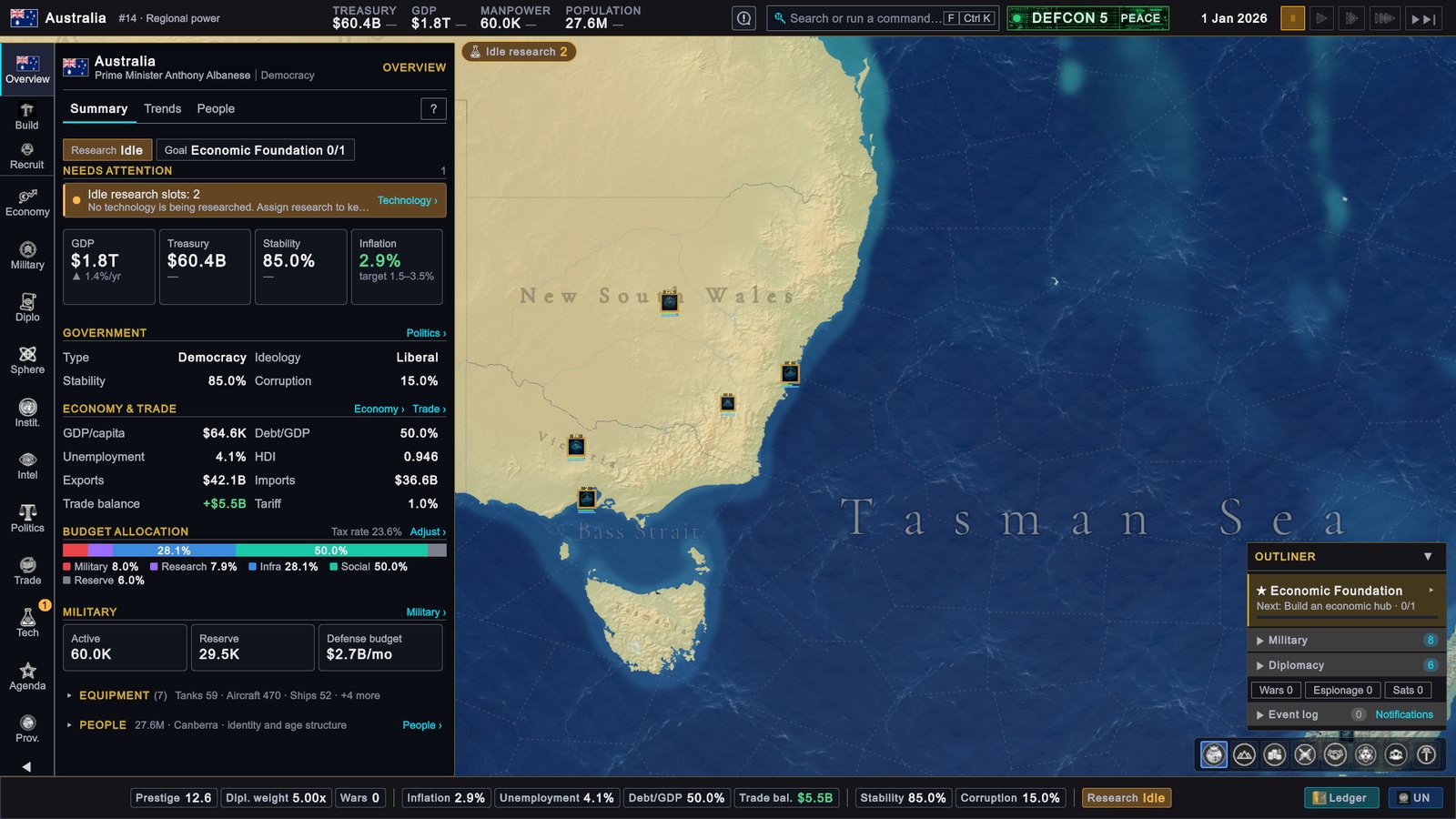
Time flows in days, and you can stop it
Every game starts on 1 January 2026. The date is in the top bar, on the right.
Time moves one day at a time. There are no turns: while the clock runs, every country acts at once. You can pause at any moment (Space by default) and the game starts paused. While paused you can open every page, read every number and give orders. Nothing moves until you unpause.
A month in the game has 30 days. How long that takes depends on the speed you choose:
| Speed | One day | One month | One year |
|---|---|---|---|
| Normal | 2 seconds | 1 minute | 12 minutes |
| Fast | 1 second | 30 seconds | 6 minutes |
| Very Fast | 0.4 seconds | 12 seconds | 2 min 24 s |
| Max | 0.2 seconds | 6 seconds | 1 min 12 s |
These are the times with the default day length, on a computer that keeps up. You can make a day shorter or longer in the settings. See Time, speed and saving.
Play slowly at first. Pause, read, give one or two orders, then run a month at Normal speed and look at what changed. The first month takes one minute.
What runs by itself
You do not have to manage everything. These things happen without you:
- Your private economy. Your companies import what the economy is short of and export what it has too much of, every month. The game calls this private-sector trade.
- The monthly numbers. Your treasury (the state’s money) and the other figures in the top bar change as the months pass. The top bar shows the change per month once the first month has ended.
- Other countries. The AI runs them. See AI countries.
- The Year Review. When a new year begins, the game shows a summary of the year that ended.
What waits for your decision
The game does not choose these for you:
- how the budget is split,
- what to build and where,
- what to research,
- which laws to change,
- what to offer or demand from other countries,
- where your armies, fleets and air wings go.
Sometimes the game asks you a question in a popup, called an event. An event waits for your answer, and by default the game pauses while the popup is open. If you switch that pause off in the settings and leave an event unanswered for 30 days of game time, the game picks the first available answer for you.
You can hand a few routine jobs to the game later. One example is auto trade: standing orders that buy a resource when your stock runs low and sell what is left over.
There is no end date
The game has no last day. You can play one country for as long as you like.
What “winning” means
The game recognises five kinds of victory: Military Hegemony, Economic Superpower, Diplomatic Leader, Technological Ascendancy and Nuclear Deterrence. Each one has its own conditions.
- The game does not look for a winner during the first ten years. The first check comes early in 2036.
- After that it checks about once a month.
- If your country meets one of them first, you see the VICTORY screen with your FINAL SCORE.
- An AI country can get there before you. Then the screen says DEFEAT.
- On both screens, CONTINUE PLAYING carries on with the same game.
The conditions are on Victory, score and the Ledger.
Playing without aiming for it
You do not have to chase a victory. Many players set their own target: make the country richer, keep the peace, win one war, or see how the world changes. The game also gives your country goals of its own on the Agenda page. A goal is a list of steps, and many goals give a reward when you finish them. See Agenda and national goals.
What you can ignore in your first game
The game has many systems. These can wait until you are comfortable with money, building and research:
- International institutions. The United Nations and other organizations hold votes. International institutions
- Spheres of influence. Powerful countries gather smaller ones around them. Spheres of influence
- Sanctions and economic warfare. Ways to hurt another country without fighting. Sanctions, economic warfare and ultimatums
- Intelligence and espionage. Spy missions against other countries. Intelligence and espionage
- Envoys. Agents you place in other countries. The game’s screens call them specialists. Envoys
- The trade network. Sea routes, the narrow passages they cross, and trade blocs, which the game calls trade arrangements. Trade network, chokepoints and blocs
- Missiles and missile defence. Long-range strikes and the defences against them. Missiles and missile defence
- Nuclear weapons. The weapons themselves and DEFCON, the alert level that goes with them. Nuclear weapons and DEFCON
- Satellites. Satellites that let you see what happens far from your borders. Satellites
- The navy and the air force. You only need them once you fight. Navy and Air power
- Multiplayer and mods. Playing with other people, and changes to the game made by players. Multiplayer and Mods and scenarios
Do not ignore the coloured alerts under the top bar. They name the things that need you most.
How to use this wiki
- The beginner path. The first eight pages of this section are a walkthrough, in order: this page, then picking a country, your first ten minutes, the screen piece by piece, your first month, your first year, what to do when something goes wrong, and your first war. Each page ends with a link to the next one.
- The guide pages. The other sections explain one system per page: Economy, People and politics, Diplomacy, War and military, Research and intelligence, Goals and the world.
- The reference tables. Lists of every unit, building, good, law and doctrine (a doctrine is something you research), with their numbers. Start with the Glossary when a word is new to you, and the FAQ for quick answers.
- The version pill. Every page shows the game version it was checked against. This page describes version 0.5.35. If your game has a higher number, small details may differ.
- Names in bold. A name in bold is a name you see on screen. Economy › Budget means: open Economy, then click Budget.
If your screen looks different
- You picked another country. Every country starts with its own money, neighbours and problems. The steps are the same; the numbers are not.
- A mod is active. A mod can change countries, rules, text and the look of the screen. Start your first game without mods.
- Your game is in another language. This wiki uses the English names. The buttons are in the same places in every language.