Armies do not move borders in Global Protocol: peace deals do. Taking a province in war makes it occupied, which gives you its output, raises your war score and lets you demand it. It becomes yours only when a peace deal says so.
Where to find it
- On the map. The province tooltip shows OCCUPIED BY, UNDER SIEGE BY, RESISTANCE and DEVASTATION. The province page in the right dock has a banner for a siege, with Details › for the siege page.
- The peace view. Open the war page (click a war in Military › Wars) and press Sue for peace.
- Offers from the other side arrive in Diplomacy › Inbox.
How it works
Sieges
An army that stops in a province held by a country it is at war with starts a siege; an army in a battle does not besiege. Every province has a defence value: larger for a big population, good infrastructure and defensive buildings. The besieger wears it down each day.
- More units, and units with a higher attack, work faster. A share of artillery adds up to 30%.
- Several armies of one country stack, with less gain from each extra army.
- Fortifications, and a garrison that was there when the siege began, slow it.
- The besiegers lose a little morale and strength every day.
When the defence reaches zero the province falls, provided the besieger has enough units for its size: about one for every two million inhabitants, and at least one. The siege page shows Siege Progress, Estimated Collapse in days, and what is holding the siege up, such as too few units to occupy.
A siege pauses while the besieger fights a field battle. If the besieger leaves, the defence recovers by 5% a day.
Occupation
An occupied province still belongs to its owner, but another country controls it.
- The occupier receives the province’s output and resources at half efficiency, earns war score for the share of enemy provinces it holds, and may demand the province in the peace.
- The owner receives nothing from the province, and its war exhaustion grows faster the more of its land is held.
Occupation does not need a standing garrison. The province stays occupied after your army moves on, until the war ends or the owner retakes it. The owner needs no siege for that: it brings in as many of its own troops as a capture takes while no enemy army stands there.
Capturing a province does not change its owner. In the base game ownership moves only when a peace deal names the province. Mods and scenarios can transfer provinces by event.
Unrest, resistance and devastation
- Unrest jumps by 30 points when a province falls and keeps rising while it is occupied. Unrest lowers what a province produces.
- Resistance is a 0 to 100 figure that climbs in an occupied province, faster where unrest is high and the garrison is thin. After liberation it fades by about a point a day. A province that changes owner in a peace deal starts with resistance already raised.
- Devastation is war damage, also 0 to 100. Every day of fighting in a province adds to it, and so does bombing. It cuts the province’s production by up to 80%, damages infrastructure once it passes 10, and drives people out each month. It heals by about a point a day.
The peace view
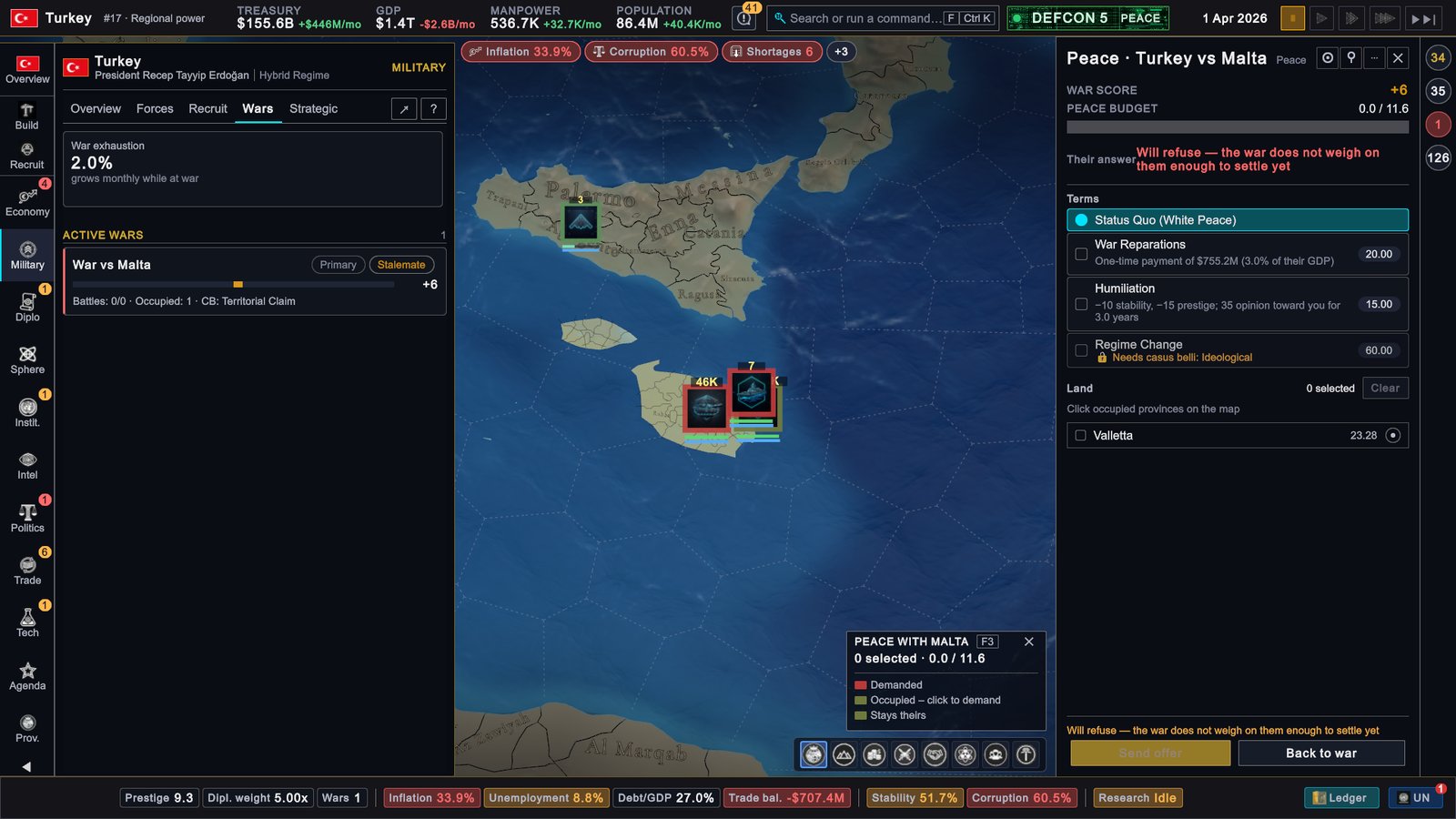
At the top of the peace view are your WAR SCORE, your PEACE BUDGET as spent out of available, and Their answer. Below are the Terms and the Land list.
Your budget is the larger of two things: your war score, when it is positive, and the ground you hold. Ground counts either as the share of their provinces you occupy or as half the price of the provinces you hold, whichever is higher. Occupying everything gives the full 100 and makes each province a quarter cheaper.
| Term | Cost | Needs | Effect |
|---|---|---|---|
| Status Quo (White Peace) | 0 | Nothing | The war ends with no change |
| War Reparations | 20 | Nothing | One payment from their treasury: 3% of their GDP, limited by what they can pay. The row shows the sum |
| Humiliation | 15 | Nothing | They lose 10 stability and 15 prestige and resent you for years |
| Regime Change | 60 | Ideological reason | A ruling party aligned with you takes office; they lose 10 stability |
| Land | 10 to 40 a province, up to 50 for a capital or a very large province | Territorial Claim or Reconquest, or a decisive win | Each picked province becomes yours |
White peace excludes every other term. A locked term shows what it needs.
Land without a land reason. Any side can take provinces if it holds at least one of them and its peace budget is 55 or more. Until then the Land section reads “Land can’t be demanded”.
Picking provinces
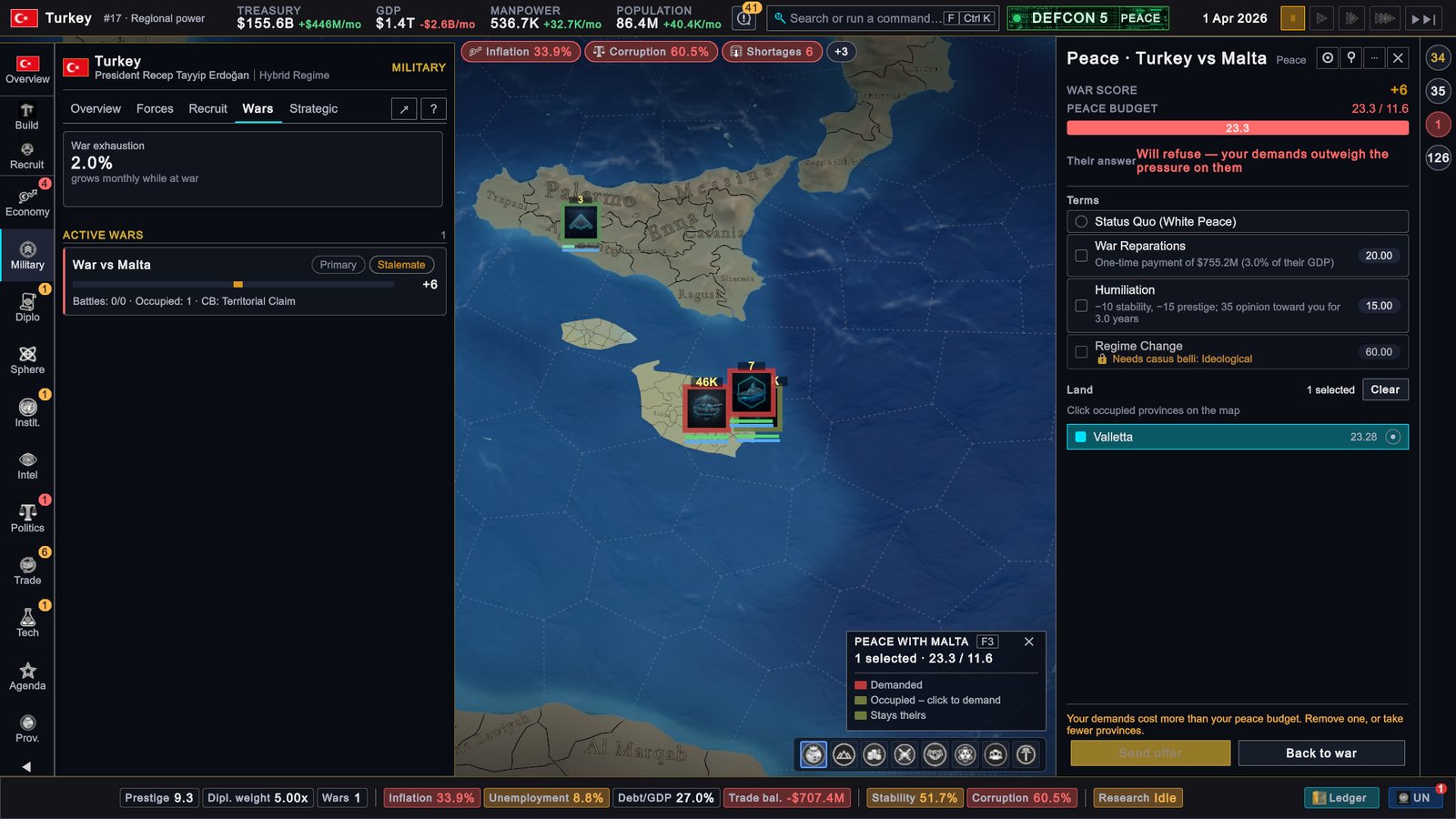
While the peace view is open the map shows three colours: Demanded, Occupied – click to demand and Stays theirs. Click an occupied province on the map, or tick it in the Land list. Only provinces you occupy can be picked. Hover a row to see its price built up from economy, infrastructure and population. Terms that cost more than the budget cannot be sent.
Why they refuse
Their answer reads Will accept or “Will refuse” with a reason. An AI country decides the moment you press Send offer; if it refuses, the war goes on.
| The game says | What it means |
|---|---|
| they are winning and won’t settle for nothing | You offered a white peace while their war score against you is +25 or better |
| they took major ground and won’t accept a white peace | They have held at least two of your provinces in this war |
| their leaders want the war to go on | An aggressive or expansionist government will not take an early white peace |
| the war does not weigh on them enough to settle yet | White peace: the pressure on them is below what they need |
| your demands outweigh the pressure on them | The same, with demands attached |
They accept outright when you hold close to half their land, when they are losing decisively, when they are worn out by the war, or when their whole side is far behind and you ask for a concession.
Otherwise the tooltip on Their answer lists what is weighed. Pressure comes from the War score balance, Their exhaustion, the Ground you hold, Their side’s deficit and War length, which starts to count after two years. Against it stand the Cost of your demands, Their intent and the Coalition balance.
Offers you receive
A peace offer in your Inbox lists its terms before you answer: the provinces you would give up by name, and the reparations either side would pay. Accepting ends the war at once on those terms. Rejecting continues it, and the proposer waits longer before offering again. An unanswered offer lapses after 120 days. A losing enemy may offer tribute.
In multiplayer, a deal sent to another player is an offer they must accept, and it can include at most four provinces.
After the deal
- The picked provinces change owner at once. Every other occupation between the signers ends, and armies standing where they may no longer be are sent home.
- A truce of 24 months starts between the signers. You cannot declare war on each other while it runs.
- Both signers’ war exhaustion is halved, and suspended trade between them resumes.
- Land you took adds aggressive expansion in proportion to its price. Annexing a whole country adds 25 more.
Separate peace. If both signers are Primary in the war, the whole war ends and every partner on both sides gets the same truce. If either signer is Allied, only that country leaves and the wider war continues; the peace view warns you with a “Separate peace” note.
What to do
- Occupy what you want to keep. Unoccupied land cannot be demanded, however high your score.
- Read Their answer before you send. It updates as you change the terms.
- Break a deadlock with ground or time. Hold more of their land, or blockade their coast to raise their exhaustion.
- Garrison the provinces that matter. The owner retakes an empty province without a siege.
- Count the cost of land. Each province adds aggressive expansion, and a devastated province produces little until it heals.