Goods are what your economy produces and uses: fuels, metals, food, manufactured products and services. Each one has a monthly balance and a national stockpile. A shortage of the wrong good slows construction, makes recruitment dearer and stirs unrest, while a surplus is exported and earns money.
Where to find it
- Economy › Resources. Click Economy on the rail (E by default), then the Resources tab.
- Markets. A full-screen table of every good. Open it with ↗ Markets in the Resources tab, or type “Markets” into the command palette (F by default).
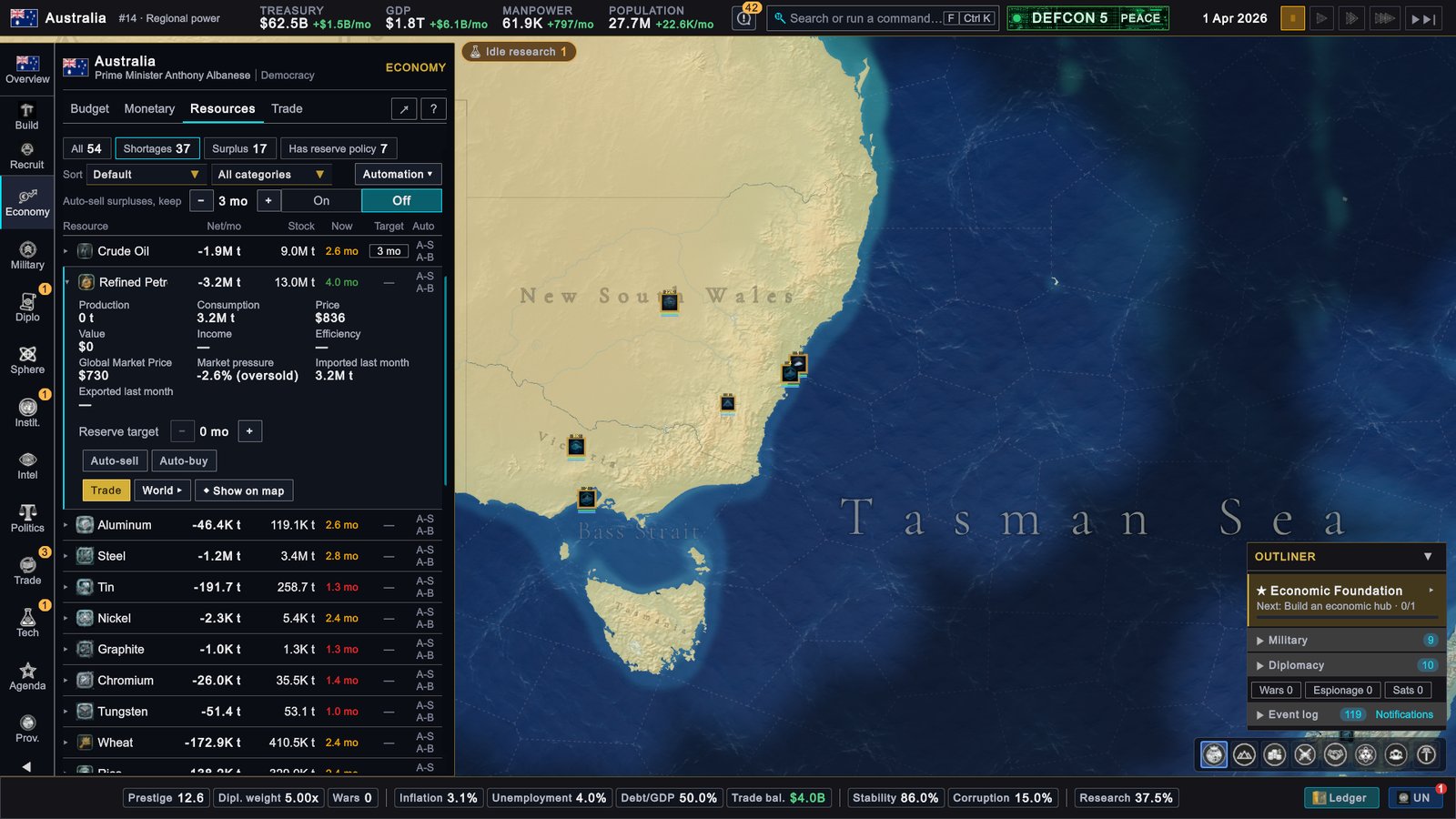
- On the map. Expand any good and click Show on map to see which provinces hold a deposit of it. Brighter provinces have richer deposits.
How it works
Goods and categories
The base game tracks 54 goods in seven categories. The category menu on the Resources tab and in Markets filters by them.
| Category | Goods |
|---|---|
| Energy | Crude Oil, Natural Gas, Coal, Uranium, Refined Petroleum |
| Metals | Iron Ore, Copper, Bauxite, Gold, Silver, Tin, Phosphate, Potash, Aluminum, Steel |
| Critical minerals | Lithium, Cobalt, Nickel, Rare Earth Minerals, Helium, Graphite, Manganese, Chromium, Tungsten |
| Agriculture | Wheat, Rice, Corn, Soybeans, Livestock, Fish, Coffee, Cocoa, Sugar, Cotton |
| Forestry | Timber, Rubber, Palm Oil, Wool |
| Manufactured goods | Electronics, Semiconductors, Batteries, Solar Panels, Wind Turbines, Automobiles, Aircraft, Commercial Ships, Industrial Machinery, Chemicals, Plastics, Fertilizer, Pharmaceuticals, Textiles |
| Services | General Services, Financial Services |
Prices and other figures for each good are in the goods reference.
Where goods come from
Deposits. Raw goods come out of provinces that hold a deposit of them. A province can hold several deposits, each with its own richness, and it has one main good. Deposits do not have to be discovered: the province panel lists them, and Show on map lights them up for any good. When the main good is a raw one, the province produces only 15% of it until an extraction building for that good stands there. Its other deposits yield a smaller amount, and extraction buildings raise that as well.
Processing. Refined and manufactured goods need a processing building in the province and a supply of inputs. Steel needs Iron Ore and Coal. Refined Petroleum needs Crude Oil and Natural Gas. Electronics need Semiconductors, Plastics and Copper. Without the building the province makes a tenth of the good. With it, output follows Efficiency: how fully your country’s production, stockpile and imports cover the inputs. Below 100%, output is cut.
Buildings and construction covers which building makes which good.
What uses them
Consumption is what your population, industry and armed forces use each month. A larger and richer population uses more, factories use their inputs, and every military unit burns Crude Oil as upkeep. Recruiting units also draws goods such as Steel and Electronics from the stockpile.
Balance, stockpile and cover
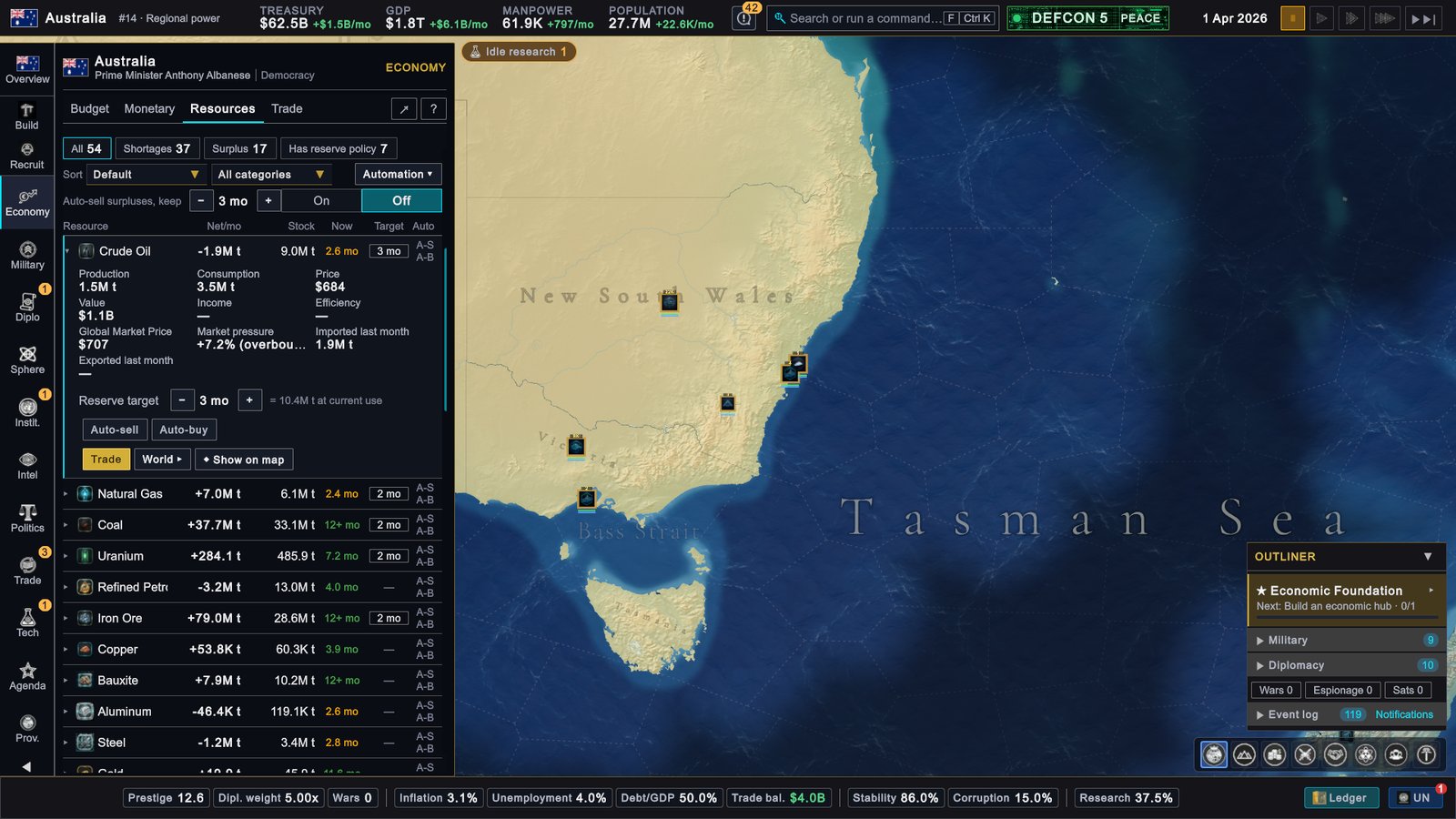
| Column | Meaning |
|---|---|
| Net/mo | Production minus consumption each month |
| Stock | Units in the national stockpile |
| Now | How many months of your own use the stock covers |
| Target | Your reserve target, in months of use |
| Auto | A-S and A-B light up when auto-sell or auto-buy is on |
When a good is in surplus, private firms export part of it every month (the Auto-export share), which adds to your trade balance. The rest goes into the stockpile until it reaches a ceiling: your reserve target if you set one, otherwise a standard amount for that good.
When a good is in deficit, the gap is drawn from the stockpile. Private firms also import what the economy is short of, paid through the foreign account and not by your treasury. Those deliveries arrive when the month closes.
Price is your home price. It drifts up when production plus imports fall short of use, and down when they exceed it. Global Market Price is what the world market quotes, and Market pressure shows how far recent buying or selling has pushed it.
What a shortage does
A shortage is a monthly gap: you use more than you produce. Seven goods carry penalties when that happens.
| Good | Construction speed | Recruitment cost | Unrest |
|---|---|---|---|
| Crude Oil | Slower | Higher | Rises |
| Natural Gas | Slower | Rises | |
| Coal | Slower | ||
| Uranium | Slower | ||
| Iron Ore | Slower | Higher | |
| Lithium | Higher | ||
| Rare Earth Minerals | Higher |
The penalty grows with the share of your use that is missing. A stockpile worth three months of the shortfall cancels it, and a smaller one cancels part of it. Buying does not close the gap itself; it builds the buffer that removes the penalty. Added up over all goods, construction cannot fall below half speed, recruitment cannot cost more than double, and shortages add at most 1.5 unrest a month.
Shortage effects at the top of the Resources tab shows the three totals and lists your shortages of strategic goods, each with Trade › and, where a building would help, Build ›.
A shortage of an input is a separate problem. It lowers Efficiency for the goods made from it, and factories running short also produce less GDP. See GDP and growth.
Reserve policy and automation
Expand a good to set its policy:
- Reserve target is the stock you want to hold, from 0 to 24 months of use.
- Auto-buy buys toward the target each month, or toward the buffer that clears a shortage penalty if that is larger. It stops at the target, spends a limited amount each month and leaves a protected minimum in the treasury.
- Auto-sell sells part of the stock above the target each month.
- Trade opens a ticket for a one-off purchase or sale on the world market. World ▸ opens the world production table for that good.
Above the list, Auto-sell surpluses, keep switches auto-sell on for every good in surplus and keeps the number of months you choose. Automation ▾ holds Buy all shortages and Clear all. Reserve manager ▸ shows every target in one window.
State purchases are paid from the treasury. World market orders, contracts and trade agreements are explained on Trade.
The Markets workspace
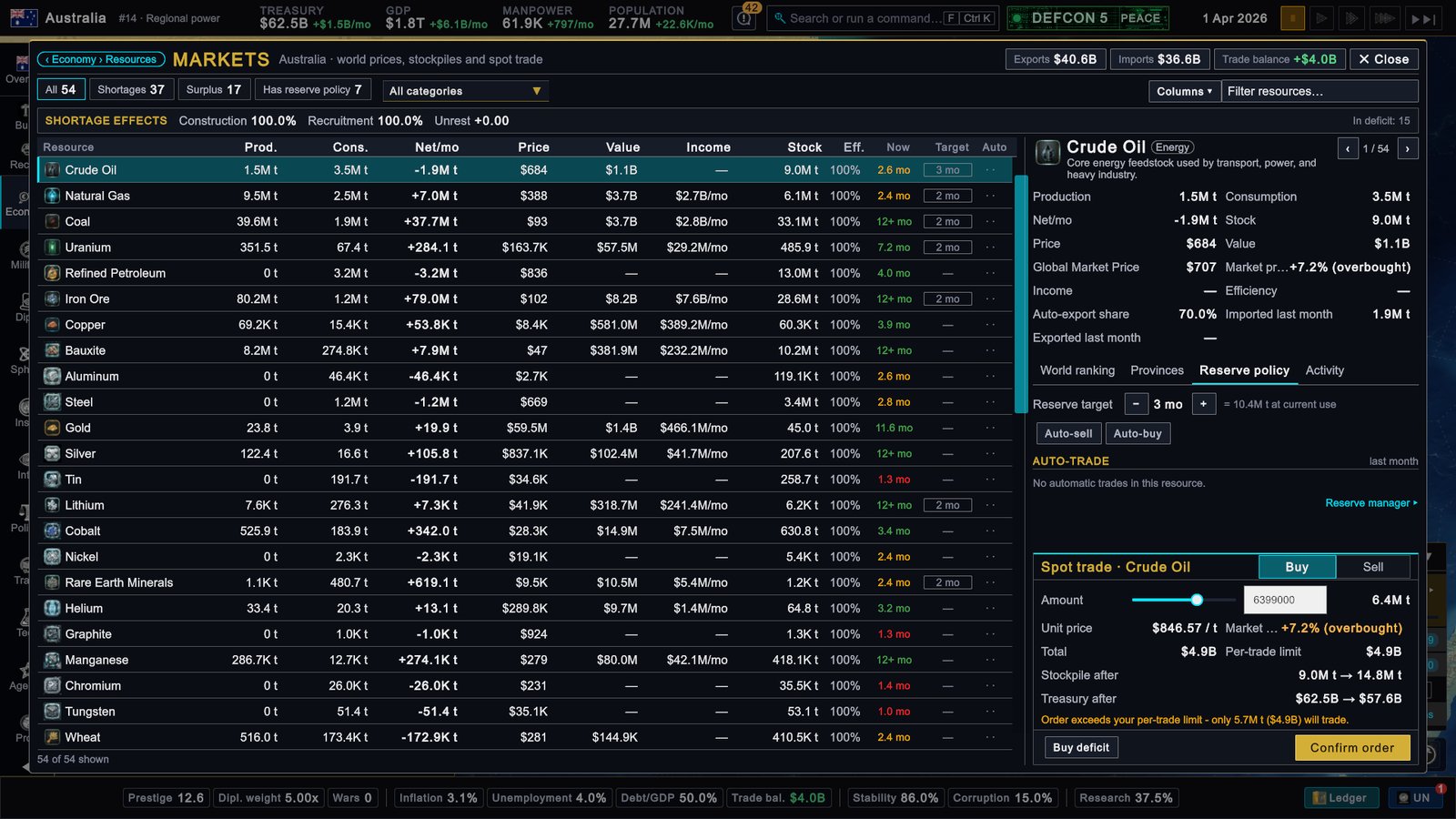
Markets shows the same data as the Resources tab with more columns: Prod., Cons., Net/mo, Price, Value, Income, Stock, Eff., Now, Target and Auto. Click a column to sort, use Columns ▾ to hide some, and type in the filter box to find a good.
Selecting a row opens a pane on the right with four tabs: World ranking (where you stand among producers), Provinces (which of your provinces produce it or hold a deposit), Reserve policy and Activity (recent trades). Under them is the Spot trade ticket.
Energy
In the simulation, energy means the five goods in the Energy category. There is no separate electricity figure to balance. These goods matter more than most: four of the seven penalty goods are energy goods, every unit burns Crude Oil, and Refined Petroleum, Natural Gas and Coal feed the chemical, fertilizer and steel chains.
Your country also has an energy resilience value, which some event choices raise. Above its starting level it softens the inflation that rising import prices cause. See Inflation and monetary policy.
What to do
- Check the tab after the first month closes. Click the Shortages chip. Deal with the seven penalty goods first.
- Look for a deposit before you look for a seller. If one of your provinces holds the good, an extraction building there is the lasting fix.
- Otherwise, hold a buffer. Set a reserve target of three months or more and switch on Auto-buy. Check that the treasury can carry the cost.
- Feed your factories. Low Efficiency on a manufactured good means an input is short. Fix the input, not the factory.
- Let surpluses earn. Switch on Auto-sell surpluses, keep with a few months held back.
- Stock Crude Oil before a war. Your forces burn it every month, and a shortage raises recruitment cost when you need more units most.