Your government type decides three things in Global Protocol: whether you face elections, whether your laws need a vote in parliament, and how exposed you are to a coup. Your leader is the face of that government, and voters, generals, crowds, old age or a victorious enemy can all replace them. You keep playing the same country whoever is in charge.
Where to find it
Open Politics on the rail (K by default). The first tab is Government. The line under your country’s name at the top of the panel shows the leader’s title and name and the government type on every page.
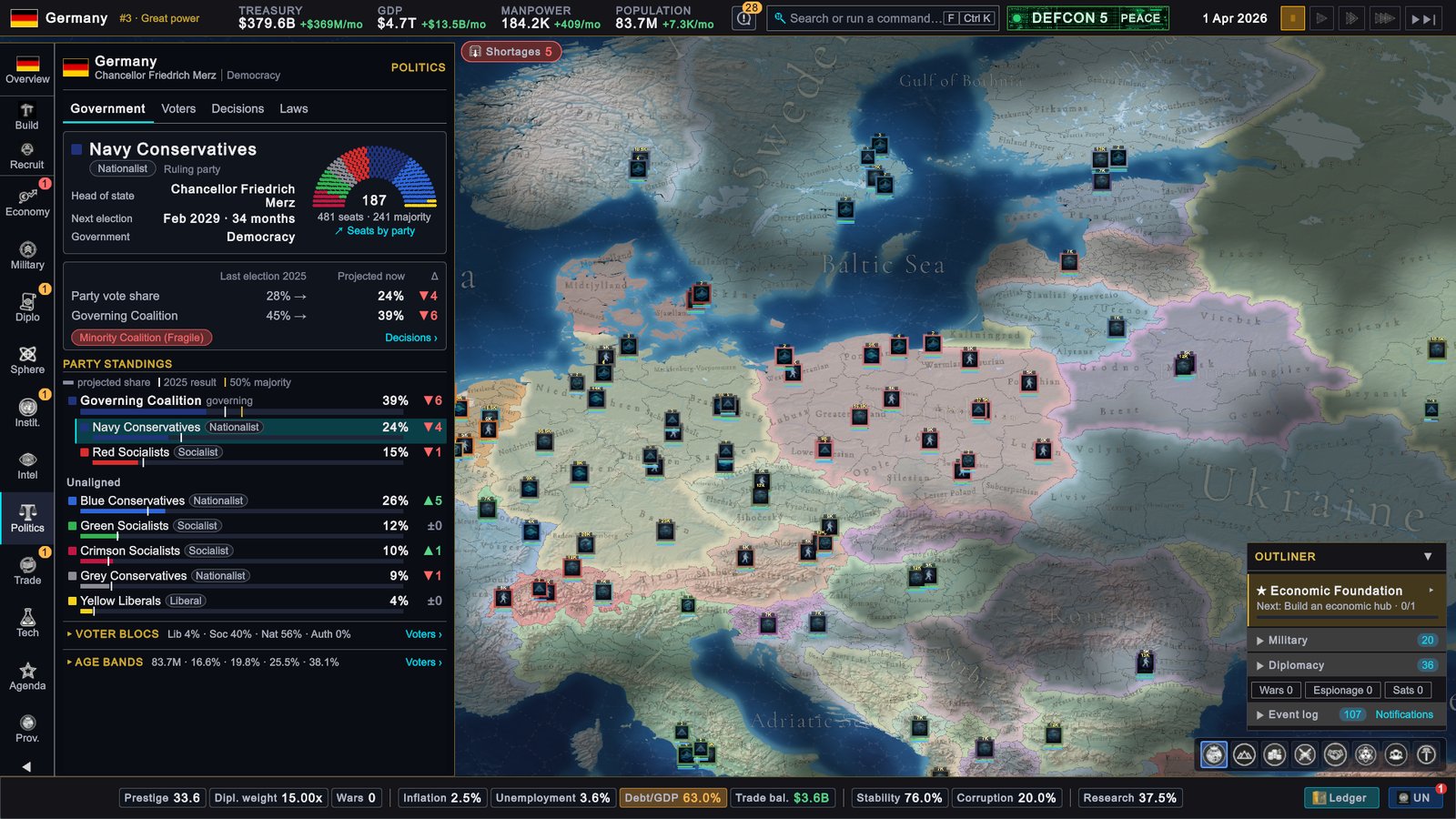
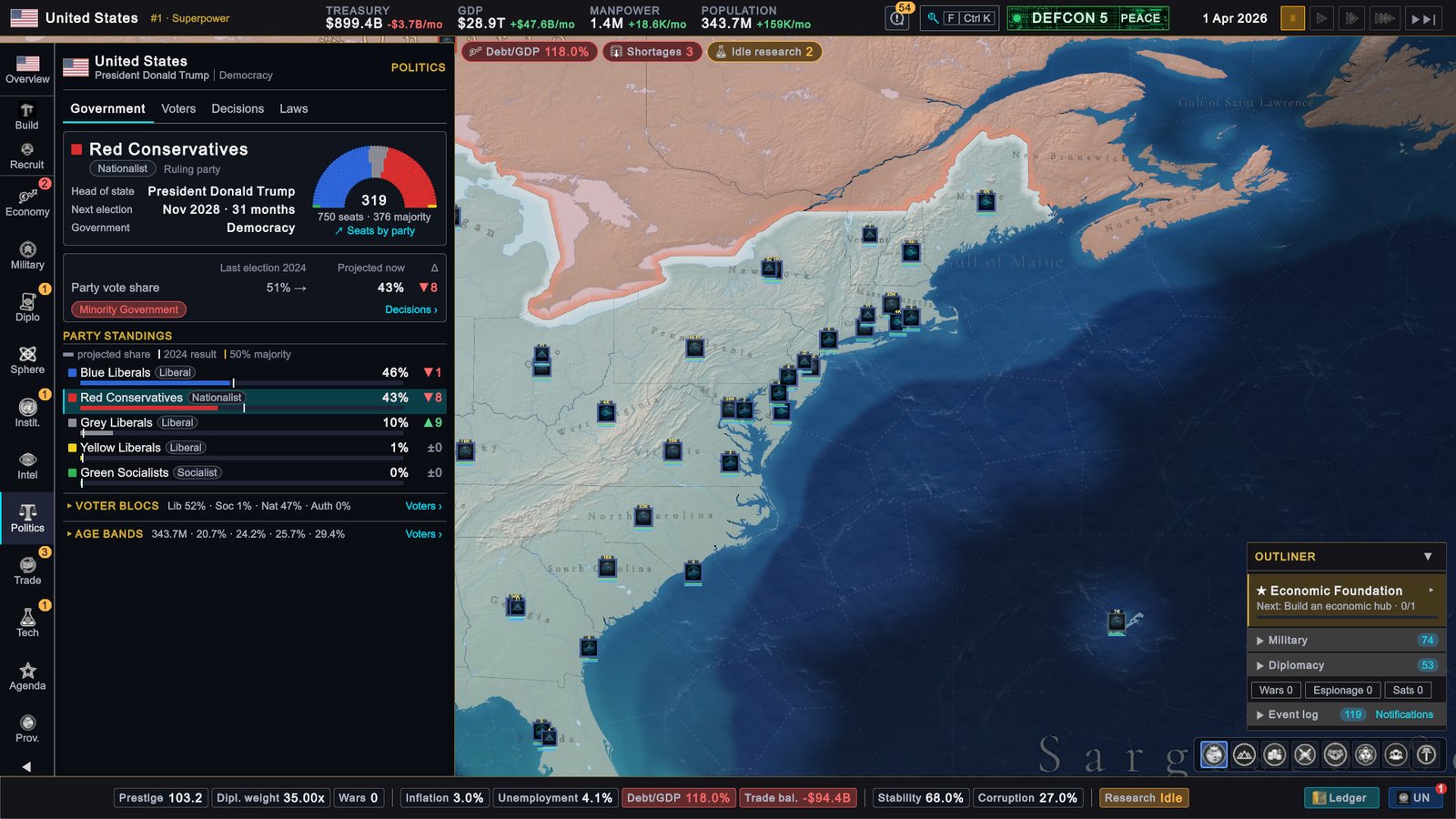
The Government tab reads from top to bottom:
- Ruling party (or Ruling regime where there is no parliament), with its voter bloc, the Head of state, the Next election with the months left, and the Government type.
- A parliament diagram with the number of seats and the majority line. Seats by party opens the full view.
- The mandate: Party vote share and the governing coalition at the Last election, Projected now, and the difference. A chip under it says whether the governing side still holds a working majority.
- Party Standings: one bar per party, with a tick at its last result and a line at 50%.
- Voter blocs and Age bands, one line each. Both open Politics › Voters.
To look at another country, click it on the map and open the Politics tab of its card.
How it works
Government types
There are nine types. This is what each changes in play.
| Type | Elections | How laws change | Protection against coups |
|---|---|---|---|
| Democracy | Yes | Vote in parliament | Strong: coup risk is cut to 15% |
| Hybrid Regime | Yes | Vote in parliament | Partial: coup risk is cut to 45% |
| Monarchy | Only where the country has a set election date | Decree, or a vote in a parliamentary monarchy | None |
| Authoritarian, Theocracy, Military Junta, One-Party State, Communist State, Transitional | Only where the country has a set election date | Decree | None |
Elections follow the country’s own term length and its next election date at the start of the game. Where the data has no term length, a democracy votes every four years and a hybrid regime every five.
The type also decides which events can reach you, since some events only fire for certain governments. The full list of types, subtypes and titles is in the Government types and leader titles reference.
Ideology
Every government has a position on two axes: economy (planned to market) and society (authoritarian to libertarian). The game sorts positions, parties and voters into four blocs: Liberal-Capitalist, Socialist-Communist, Nationalist-Conservative and Authoritarian-Theocratic.
The position matters in three ways:
- Relations. Governments with similar positions drift closer each month, and distant ones drift apart. It is the Ideological alignment line in a relation’s breakdown. See Relations, trust and opinion.
- Elections. When the opposition wins, the government takes the winning party’s position.
- Revolutions. The further the government stands from where the country has drifted, the likelier a revolution becomes once unrest is high.
The position is not fixed. In the simulation, war pushes it to the right and toward authority, a long peace pulls it back, a deep recession and high unrest push it toward the extremes, and the countries you have relations with pull it toward their own.
The leader
Each country starts with its 2026 leader and title. A leader has a name, a title, an age and a time in office, and no traits or bonuses of their own.
- Title. A new leader’s title follows the new government type: Prime Minister or President in a democracy, President in a hybrid, authoritarian or one-party state, General in a military junta, King in a monarchy, Supreme Leader in a theocracy, Chairman in a communist state and Interim President in a transitional government. Countries with their own list of leader names can carry their own title instead.
- Term limit. A leader who keeps winning elections serves at most three terms in a row. After that the party wins with a new leader.
- Death. Each month a leader has a small chance of dying. It rises between the ages of 55 and 75, with long years in office, and in wartime. A successor takes over, the government type stays, and pending legislation carries on.
Giving your leader a title of your own
On Politics › Government, the Head of state row has a pencil after the leader’s title. Click it to open Customize leader title.
- Title generator. Three pickers build the title: Prefix, Core title and Suffix. Each has a search box, and None leaves a prefix or suffix out. Randomize picks all three for you, and Reset selection puts the pickers back the way they were when you opened the window.
- Write your own title. Type any short title in the box under the pickers. A title you type replaces the generated one; clear the box to use the generator again.
- Live preview shows how the title will read everywhere in the game.
- Apply title sets it. It costs nothing. Restore default removes your title and gives the leader the usual one back.
A custom title stays through elections. It ends when the government type changes, and the leader then carries the title of the new type. In a multiplayer game the other players see your title too.
How a government can change
| Change | When it can happen | What it does |
|---|---|---|
| Election | On the election date | The largest coalition wins. A re-elected government gains 8 stability and keeps its leader. An opposition win brings a new leader, party and position. The type stays. |
| Military coup | Any month with coup risk above zero | A new nationalist leader takes over and you lose 25 stability. A democracy or hybrid regime becomes a military junta, and elections stop. |
| Revolution | Average unrest above 70 | The type changes with the direction the country has drifted: communist state, authoritarian, military junta, or hybrid regime. You lose 40 stability. |
| Government reform | A small chance each month while stability is below 40 and corruption above 60 | The government falls peacefully. Authoritarian, military junta and one-party governments become hybrid regimes; a hybrid regime becomes a democracy. Other types keep their type under a new leader. |
| Leader’s death | Any month | A successor, same type. |
| Imposed government | A victor demands regime change in a peace deal | A new leader and ruling party close to the victor’s position, a stability loss, and a government that starts friendly to the victor. The type stays. |
Some event choices can also change the government type.
Three rules limit the turmoil. Coups, revolutions, reforms and deaths cannot happen within 12 months of the last change of government. Where elections are held, they cannot happen in the 12 months before one. And any change that breaks the government’s authority, which is every row above except a leader’s death and a re-election, cancels a legislative package still in debate.
When it happens to you, a notification names the change (Election Results, Military Coup, Revolution, Government Reform, Leader Passes Away or Imposed Government) and the game pauses if Pause on Event Popup is on in the Gameplay settings. If the new type holds elections, a new election clock starts; if it does not, the clock is removed.
What to do
- Know your type before you plan. A government that rules by decree changes laws at once but pays in hidden resentment. A parliament is slower and safer.
- Watch Next election and Projected now together. If the governing coalition is projected below its last result, you have until the date to fix what voters are punishing. See Elections, parties and voters.
- Keep stability above 30. Below it, coup risk appears for any government, and a democracy that suffers a coup loses its elections with it.
- Keep average unrest below 70. That is the line where revolution becomes possible.
- Do not let stability and corruption both go bad. Stability under 40 with corruption over 60 opens the way to a forced government reform.
- Remember the 12 months before an election. A coup or revolution cannot strike in that window, whatever your stability.
- In a war you are winning, weigh regime change. That demand takes no land, and it gives you a friendlier neighbour. See Peace and occupation.