Every pair of countries holds two numbers about each other: relations, which is how warmly one regards the other, and trust, which is how far it believes the other keeps its word. Most agreements need a minimum of one or both. Each side keeps its own values, so a country can like you more than you like it.
Where to find it
- Diplomacy page. Click Diplomacy on the rail (R by default). It has the tabs Overview, Relations and Inbox.
- Country card. Click a country on the map or its name in any list. The card opens on the right with the tabs Overview, Relations, Intel and Politics. Its header shows your relation with its band, Their view when the other side’s value differs, and how exact your data on the country is.
- Status bar. Prestige and Dipl. weight sit at the bottom of the screen.
- Map. The diplomatic map mode colours countries by the same five bands; see Map modes and the globe.
How it works
The Overview and Relations tabs
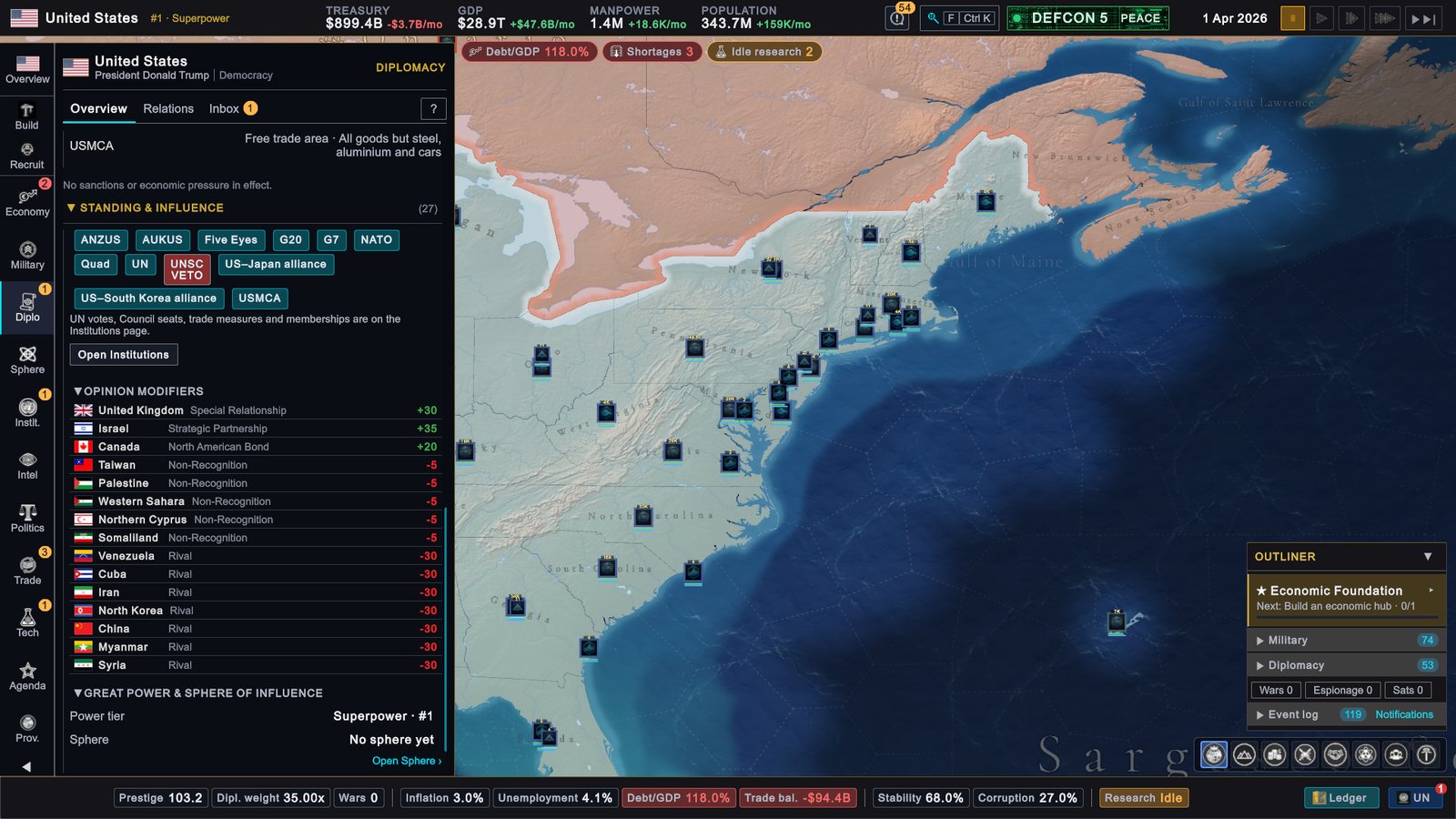
Overview is a summary of your position. At the top, Diplomatic capacity shows five tiles: Diplomatic power, Treaties, Embassies, Prestige and Diplomatic weight. Below them are the aggressive expansion gauge, a row of counted chips, and one line with your war status, rivals and war exhaustion. The blocks follow: ALLIANCES & GUARANTEES, AGREEMENTS & BLOCS, PRESSURE & SANCTIONS and STANDING & INFLUENCE.
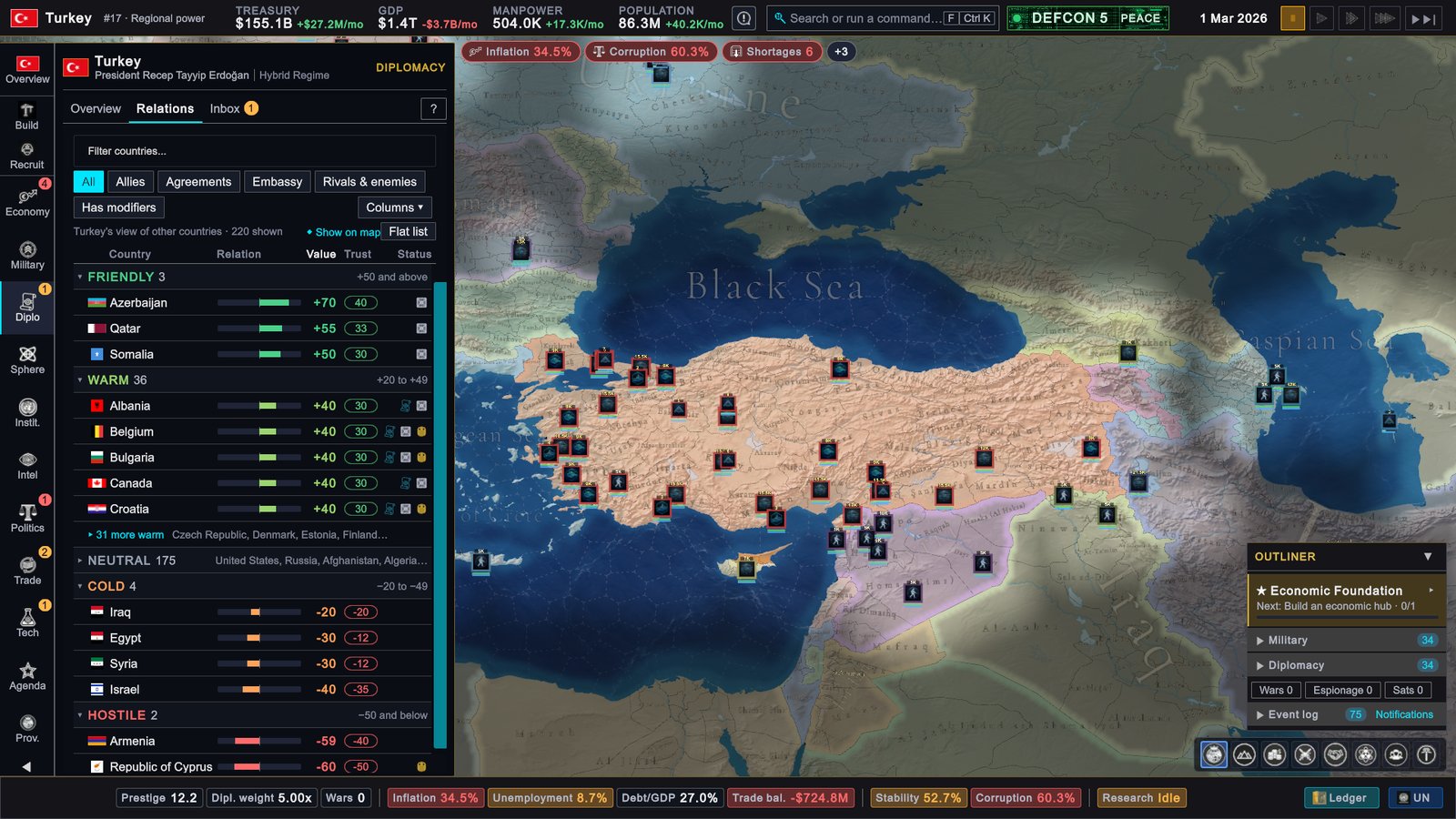
Relations lists every country in five bands. The filter chips are All, Allies, Agreements, Embassy, Rivals & enemies and Has modifiers. Each row shows the relation as a bar and a value, the trust value, and status icons. Columns adds Theirs, the other country’s value toward you. Hover a row for the breakdown; click it to open the country card.
Relations
A relation runs from -100 to +100.
| Band | Value |
|---|---|
| Friendly | +50 and above |
| Warm | +20 to +49 |
| Neutral | -19 to +19 |
| Cold | -20 to -49 |
| Hostile | -50 and below |
A relation does not jump to a new value. Each pair has a target value: the regional base (history and geography, set when the game starts) plus the opinion modifiers in force, lowered by the other country’s aggressive expansion. Every month the relation closes one tenth of the gap to that target, and at least one point.
On top of that pull, a monthly passive drift of up to 3 points comes from how alike the two governments are: ideology, leadership style, shared ethnicity or religion, laws and doctrines, plus who is allied to whose friends and enemies. This drift does not lift a relation above its target value by itself. A trade agreement adds 2 points a month while it lasts, and a sanction removes 2.
Some actions change the value at once: an insult, an aid package, a declaration of war (a drop of 60 on both sides) and the reaction of other countries when you start an offensive war.
Opinion modifiers
Opinion modifiers are the lasting reasons behind a target value. The country card lists the ones between you and that country. The common ones:
| Modifier | Effect on the target value | Lasts |
|---|---|---|
| At War | -100 | While the war lasts |
| Past War | -40 | Fades over two years after the peace |
| Rival | -30, both ways | While the rivalry stands |
| Insult Sent | -25 | Fades over one year |
| Broke Guarantee | -50 | Fades over four years |
| Trade Partner | +15 | While the trade agreement runs |
| Guaranteed Independence | +20 | While the guarantee runs |
| Aid Received | +15 | Fades over two years |
Many pairs also start the game with a named modifier for a standing dispute or bond, such as Non-Recognition or Special Relationship.
Trust
Trust also runs from -100 to +100 and has its own bands: High trust from 60, Reliable from 25, Cautious from -10, Low trust from -45 and Untrusted below that. It moves toward its own target value, more slowly than relations: one twentieth of the gap each month. The target is a starting base plus trust modifiers, and half of the aggressive expansion penalty.
Trust modifiers come from kept and broken promises:
| What you did | Their trust in you | Lasts |
|---|---|---|
| Answered a call to arms | +30 | 3 years |
| Honoured a guarantee | +25 | 2 years |
| Kept pacts, trade agreements and alliances for a year or more | Up to +30 | While they last |
| Broke a non-aggression pact by declaring war | -50 | 4 years |
| Broke an alliance, or abandoned a guarantee | -40 | 4 years |
| Ignored a call to arms | -35 | 3 years |
| Cancelled a treaty | -30 | 4 years |
| Cancelled a non-aggression pact | -20 | 2 years |
| Were caught spying | -15 | 2 years |
Their trust in you must reach +20 for an alliance, +30 for a defence pact and -20 for a non-aggression pact. To guarantee a country, your own trust in it must be +10 or more.
Prestige and diplomatic weight
There is no separate reputation score: what other countries remember about you is held in trust and opinion modifiers, pair by pair. Two country-wide numbers sit beside them.
Prestige is your standing in the world. It adds up the size of your economy, your manpower, memberships (the G7, the G20, a Security Council seat, the UN) and temporary gains and losses, such as treaties you comply with or a call to arms you refused. Diplomatic weight comes from the G7, the G20 and Security Council seats only.
Both feed Diplomatic power, together with GDP. Diplomatic power sets how many treaties and embassies you can hold.
Aggressive expansion
Aggressive expansion (AE) measures how alarmed the world is by your conquests, from 0 to 200.
- What raises it. Declaring a war you chose adds 10. Taking land in a peace deal adds more the more valuable the land is, and annexing a whole country adds 25 on top. The first nuclear detonation adds 40 and each later one 10.
- What it does. Every country’s target relation toward you drops by up to 30 points at AE 100 and 60 at AE 200, and trust targets drop by half as much. The game warns you at 50 and 75. At 100 a coalition forms against you: AI countries that dislike you join it, and once it has three members and more strength than you and your allies together, it declares war.
- How it fades. About 2 points a month, and only while you are at peace. The coalition dissolves when AE falls below 50. While you have AE and are at peace, the DIPLOMATIC AE REDUCTION button on a country card removes 20 points.
Embassies
An embassy is a permanent mission in another country’s capital. It gives you:
- A diplomatic channel. Alliances, defence pacts, arms limitation and non-proliferation treaties need one. Your own embassy is a full channel. Their embassy in your capital, or a shared organization, is a half channel.
- Better odds. Improve Relations missions work faster through a channel, and your proposals are read as if relations were a few points higher.
- Information. You see the area around the host’s capital and its figures are exact; the card header reads Exact · embassy.
To propose one, your relation toward the host must be 0 or more, your trust in it -30 or more, and you need a free slot. The Embassies tile shows slots used and your capacity, which grows with diplomatic power; hosting other countries’ embassies adds a little power. War suspends embassies between the two sides. After the peace, use RETURN AMBASSADOR to reopen yours.
Recalling your ambassador lowers relations by 10 on both sides and cannot be undone for 90 days. Closing your embassy leaves the host with a small penalty that fades over a year. Expelling theirs lowers their opinion of you by 20, fading over two years, and costs their trust in you.
What to do
- Read the target value before spending effort. If it is low because of a rivalry or a past war, a mission only lifts the relation for a while.
- Open embassies early with countries you want agreements with. Capacity is limited, so close ones a shared organization already covers.
- Protect trust. Relations recover in months; a broken pact costs trust for years.
- Watch AE during wars. It does not fade while you fight.