In a country that holds elections, the voters decide whether your government and its leader stay. The game tracks who supports which bloc month by month, so an election result is the end of a trend you could watch, not a dice roll. The leanings described here are the simulation’s model of an electorate, not a statement about real voters.
Where to find it
- Politics › Voters (K opens Politics by default): voter blocs, the voter pyramid and interest groups.
- Politics › Government: the date of the next election, the mandate and the party standings.
- Overview › People: the share of your population of voting age.
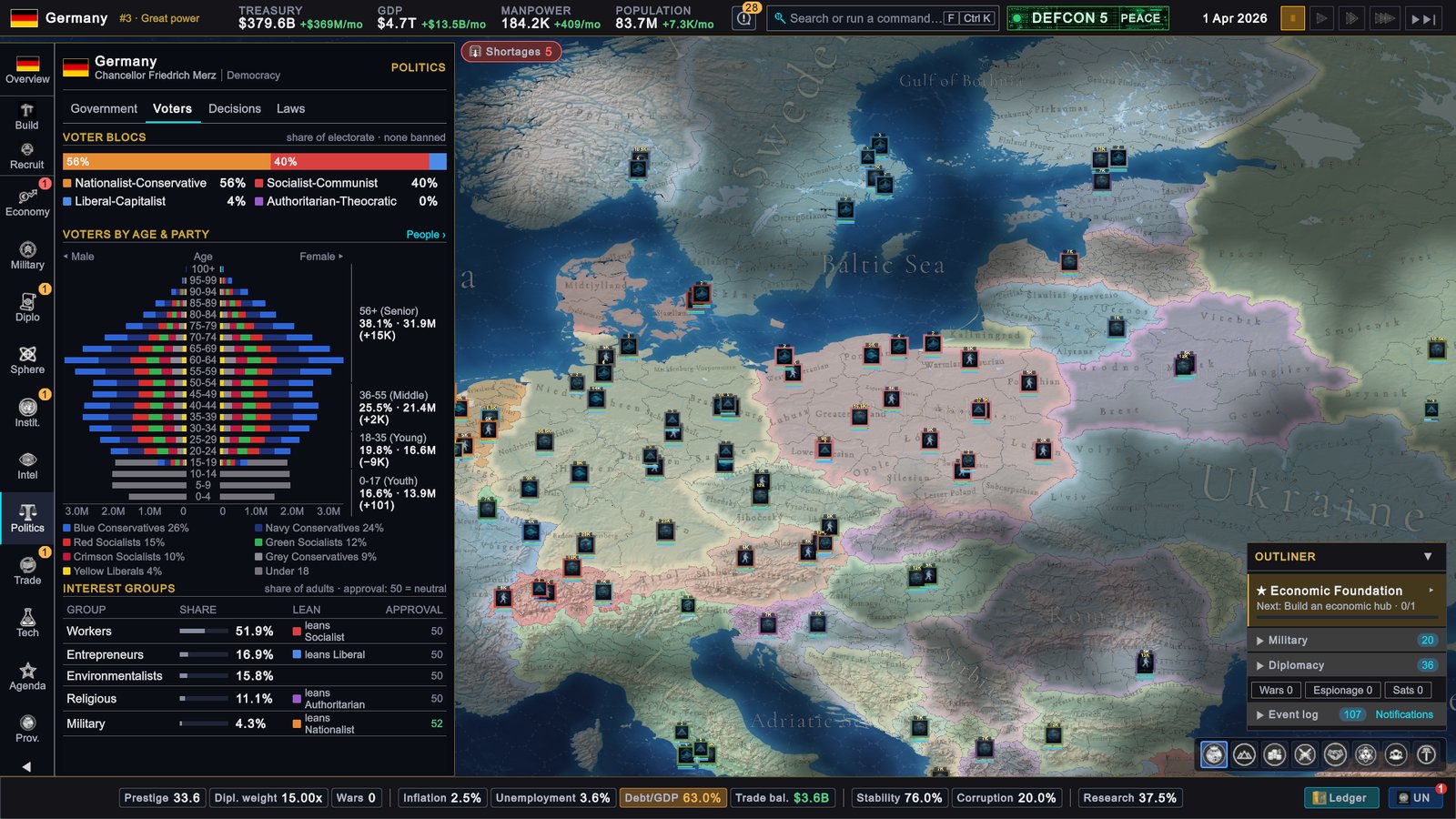
The Voters tab has three blocks:
- Voter blocs. One bar split into the four blocs, as shares of the electorate, with a note of any banned bloc.
- Voters by age & party. The age pyramid, with each row coloured by party. Brackets mark the four age bands with their share and headcount. The rows marked Under 18 do not vote.
- Interest Groups. One row per group with its Share of adults, its Lean toward a bloc and its Approval, where 50 is neutral.
How it works
Who holds elections
Democracies and hybrid regimes hold elections. Some other governments do too, where the country has a set election date. The cycle is the country’s own term length. See Government and leaders.
Blocs, parties and coalitions
Every voter belongs to one of four voter blocs: Liberal-Capitalist, Socialist-Communist, Nationalist-Conservative and Authoritarian-Theocratic.
Parties sit inside blocs:
- Many countries have their own party line-up. Each party has a size, a position and sometimes an electoral coalition, taken from that country’s last election and its standing at the start of the game. The game does not use real party names. A party is named by a colour and its bloc, such as “Red Socialists” or “Orange Traditionalists”.
- Every other country has four generic parties, one per bloc: Liberals, Socialists, Conservatives and Traditionalists. They are named the same way, with a colour in front.
A party’s projected vote follows its bloc. When the Socialist-Communist bloc grows by a tenth, each party in it grows by about a tenth.
Parties in the same coalition are counted together. On the Government tab the chip under the mandate tells you whether the governing side is projected to hold a majority of seats: Working Majority (Stable) or Minority Coalition (Fragile) for a coalition, Single-Party Majority or Minority Government for a party governing alone.
Age bands
Voters are split into three adult bands, and each band keeps its own split between the blocs.
| Band | Turnout | Reacts to events | Leans, in the simulation |
|---|---|---|---|
| 18-35 (Young) | 55% | Fastest | Liberal-Capitalist and Socialist-Communist |
| 36-55 (Middle) | 70% | Moderately | No lean |
| 56+ (Senior) | 80% | Slowest | Nationalist-Conservative and Authoritarian-Theocratic |
Because turnout rises with age, an ageing population shifts the national vote toward what older voters want, even if nobody changes their mind.
What moves the vote each month
The main rule is accountability: voters credit or blame the bloc of the governing party for the state of the country.
| Condition | Governing bloc | Who gains otherwise |
|---|---|---|
| GDP growth above 2% a year | Gains | Liberal-Capitalist gains from any growth |
| GDP growth below 2% a year | Loses | |
| Unemployment above 5% | Loses | Socialist-Communist |
| Inflation above 4% | Loses | Nationalist-Conservative |
| Average unrest above 50 | Loses | Authoritarian-Theocratic |
One terrible month cannot wipe out a bloc: the monthly swing is capped. In countries with their own party line-up, support also springs back toward the country’s long-run pattern, so a bad year dents the governing bloc and a recovery restores it.
Interest groups
Five groups cut across the blocs: Workers, Entrepreneurs, Military, Religious and Environmentalists. Their sizes are worked out each month from the state of your country.
| Group | Grows with |
|---|---|
| Entrepreneurs | GDP per head and urbanization; low or flat taxes and looser labour laws |
| Military | The share of your people in uniform and the military share of the budget; conscription laws |
| Religious | The country’s main religion and a religious Religion & State law; shrinks as education rises |
| Environmentalists | Education together with urbanization, GDP per head, and tiers in the Energy and Society doctrine branches |
| Workers | Everyone else, never less than a quarter of adults |
Each group leans toward some blocs and away from others, so a changing mix moves the vote slowly. Groups also buy different goods, which shifts demand in your economy.
Approval works differently from what you might expect. It does not react to laws or to the economy. It moves when you take a stance in international institutions, such as sponsoring or voting on a condemnation, being condemned yourself, or joining or leaving an organization, and after some events. Above 50 a group pulls its vote toward the governing bloc, below 50 away from it. Each reaction fades month by month. Hover a group’s approval to see what moved it.
Tools that move voters
- Laws marked Electorate drift pull voters toward one bloc a little every month. See Laws.
- Reforms, Smear campaigns and Ban on Politics › Decisions push blocs up or down directly. They are covered in Stability, corruption and coups. A banned bloc scores zero.
- Fund opposition is the same idea aimed at another country. It needs an intelligence headquarters and an idle Political Architect envoy. See Envoys.
Election day
When the countdown reaches zero, the game adds up the projected vote of each coalition. The largest coalition wins, and its biggest party leads the government.
- The governing party wins again. The leader stays and you gain 8 stability. A leader serves at most three terms in a row; after that the party wins with a new leader.
- The opposition wins. A new leader takes office, the winning party becomes the ruling party, and the government takes that party’s position. The government type does not change.
A notification called Election Results names the winning party and its share, and the event log keeps the entry. The game pauses if Pause on Event Popup is on.
After the election
- The Last election column on the Government tab resets to the new result, and the next election is one full term away.
- If the election brought a new leader, a legislative package still in debate is cancelled, and its cost is not returned.
- A new position means your relations start drifting in a new direction.
- If a foreign country funded the bloc that won, the game forms an alliance between the sponsor and the new government where it can.
Votes on laws do not use the seats from election night. They use each party’s projected share on the day of the vote, so your parliament follows the polls between elections.
What to do
- Compare Projected now with the last result. It is the earliest warning you get. A falling governing share is far cheaper to fix with two years to go than with two months.
- Fix what the table punishes. Inflation above 4% and unemployment above 5% are the usual causes. See Inflation and monetary policy.
- Do not submit a large reform package shortly before an election you may lose. A change of government cancels it and you lose the money.
- Think in decades with reforms and laws. Their pull on voters is small each month and large over ten years.
- Treat bans and smears as expensive. They work at once, but they build hidden resentment that lowers stability and raises coup risk.
- Mind your votes abroad. A stance in an international institution that your large interest groups dislike costs you support at home.