Everything you do toward one country starts from its card. Some actions take effect at once, some are proposals the other side must accept, and the hostile ones have a price.
Where to find it
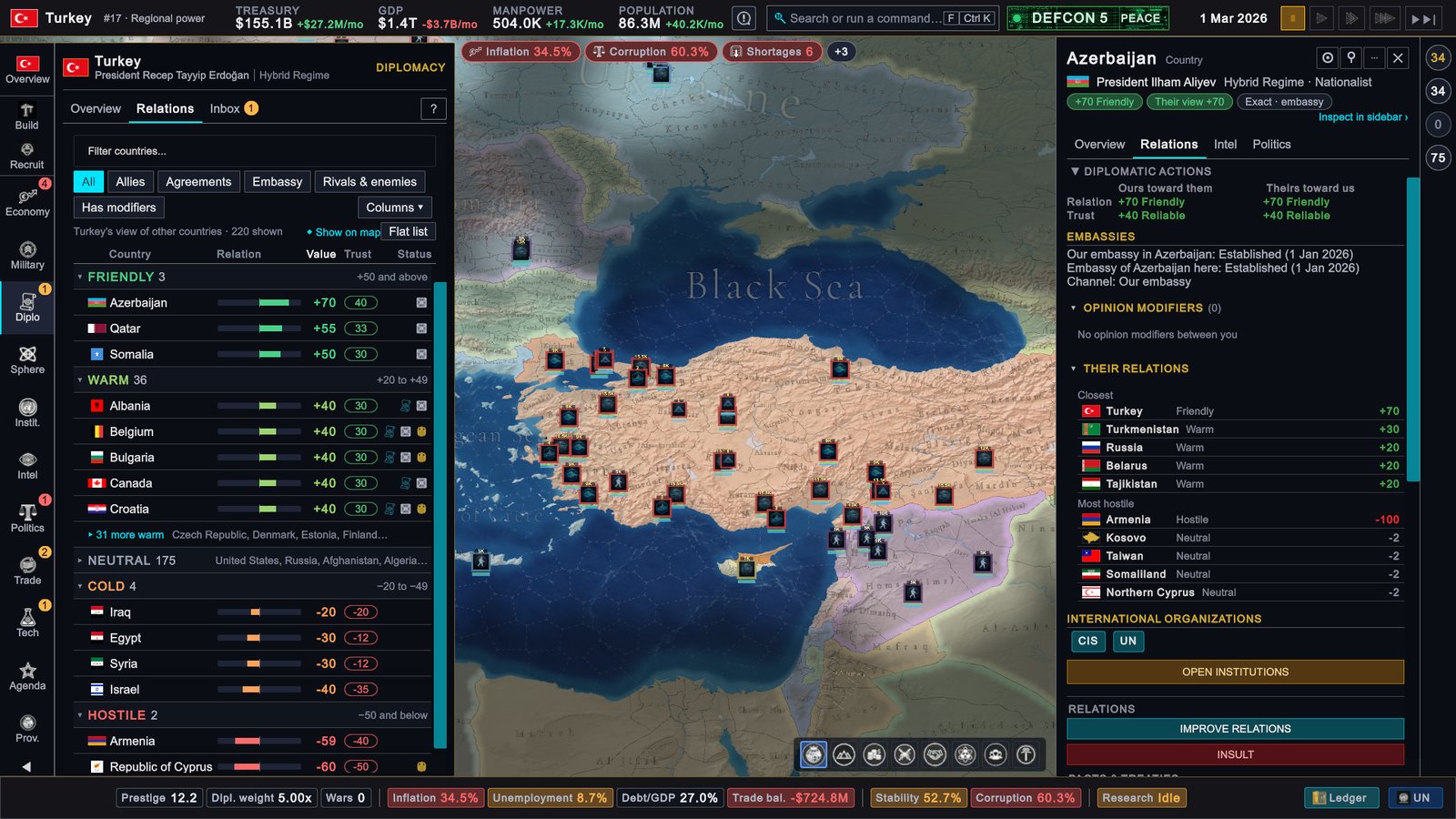
- Country card › Relations. Click a country, then the Relations tab on its card. The top shows relation and trust in both directions, the embassies and the opinion modifiers. The action buttons follow in groups.
- Diplomacy › Actions. Inspect in sidebar › on the card turns the sidebar to that country. The Diplomacy page then has an Actions tab with the same buttons.
- Diplomacy › Inbox. Proposals sent to you wait here, and on the Waiting for your answer card at the top right of the screen.
A greyed button says why when you hover it. If the only thing missing is an embassy, clicking the button offers to propose one first.
How it works
What every proposal checks
No peaceful proposal goes out while you are at war with the country or in a truce with it, or while the action is on cooldown. If relations in either direction fall to -80, the game cancels the pair’s agreements (alliances excepted) and blocks new ones until relations climb back above -40; the buttons then give the reason Relations are too hostile for new agreements right now.
An AI country answers a proposal at once, by fixed rules and not by a dice roll. A human player answers from their own Inbox.
Relations
- IMPROVE RELATIONS. Free. Relations rise 2 to 4 points on both sides at once (more when they are low), then a mission runs for 180 days and adds a point every three days, faster through an embassy. It stops at a ceiling of 60 above the regional base, lower when the pair has grievances. It gains nothing while a sanction stands between you and cannot pass +10 with a rival. When the mission ends, the relation slides back toward its target value.
- INSULT. Relations drop 10 on both sides at once and the target keeps an Insult Sent grudge of -25 that fades over a year.
Pacts and treaties
| Button | You need | An AI accepts when | What it gives |
|---|---|---|---|
| OFFER TRADE AGREEMENT | No sanction or trade war between you; neither side in a union that negotiates trade for its members | Its relation toward you is 20 or more (50 if it holds you as a rival) | The terms you pick in the window, +2 relations a month and a Trade Partner bonus. See Trade |
| OFFER NON-AGGRESSION PACT | Its trust in you at -20 or more; fewer than 4 pacts on each side; not fellow members of NATO or the CSTO | Its relation is 15 or more and it does not hold you as a rival | A promise not to attack. It does not block a declaration of war, but breaking it that way costs 50 trust for four years |
| PROPOSE ALLIANCE | Relations of 50 or more in both directions, its trust at 20 or more, a diplomatic channel | Its interest beats a bar shown in the tooltip | A military alliance: each side is called when the other is at war, and armies may cross each other’s land |
| OTHER PACTS & TREATIES | A free treaty slot on both sides | Depends on the treaty (below) | Opens the treaty picker |
| TRADE ARRANGEMENTS… | Depends on the arrangement | Join, invite to, found or leave a customs union or free trade area. See Trade network, chokepoints and blocs |
For an alliance, the other side weighs its opinion of you, its trust, rivals you share, how close your governments and peoples are, the organizations you share, the balance of strength, the wars you are already in, and its own willingness to ally. An AI country flagged as neutral signs no alliance and no defence pact.
Breaking an alliance costs 40 relations on both sides and 40 trust for four years. Cancelling a non-aggression pact costs 20 trust; cancelling a trade agreement costs 10.
The treaty picker
OTHER PACTS & TREATIES opens a list titled TREATY TYPE, with Treaties in force against your capacity. Capacity grows with diplomatic power, up to 15. A treaty you already hold shows Cancel in place of Propose.
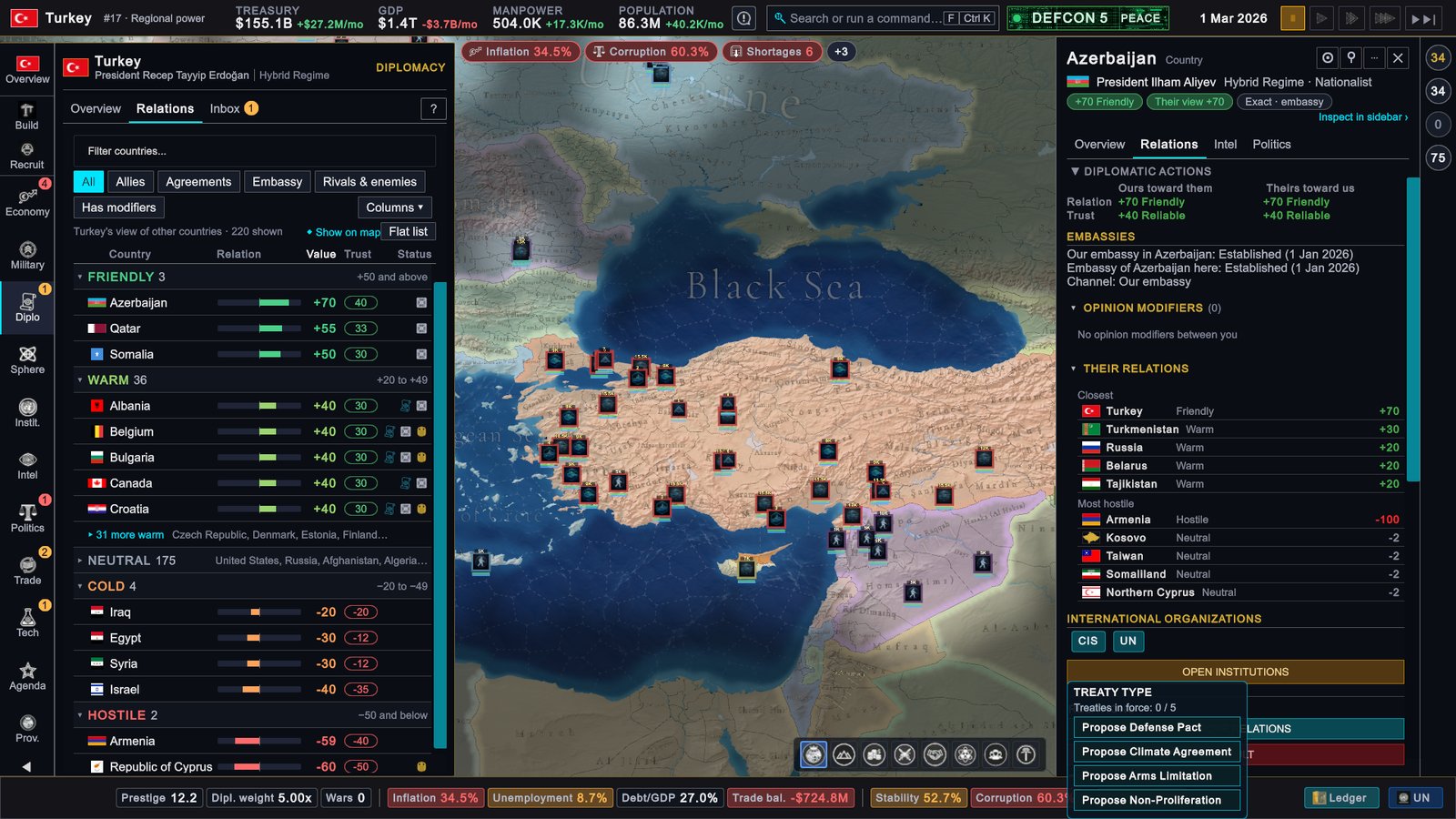
| Treaty | Extra requirements | An AI accepts when | Effect |
|---|---|---|---|
| Defense Pact | A channel; its relation at 60 and its trust at 30 or more; no alliance already; not fellow members of NATO or the CSTO | Its relation is above 70 (about 66 with your embassy there) | Armies may cross each other’s land, and you cannot start a trade war or currency manipulation against a pact partner. It does not call the partner into a war: that takes an alliance |
| Arms Limitation | A channel | Its relation is above 50 and its own military spending is near the cap | +5 prestige while your military share of the budget stays at or below 3% |
| Non-Proliferation | A channel | Its relation is above 60 and it holds no nuclear warheads | +3 prestige while you hold no warheads |
| Climate Agreement | None | Its relation is above 40 | +2 prestige |
Going over a treaty’s limit costs the partner’s trust in you (15, for two years). Cancelling a treaty costs 30 trust for four years and relations as well: 50 for a defence pact, 30 for non-proliferation, 20 for arms limitation and 10 for a climate agreement.
Guarantees, rivals and coalitions
- GUARANTEE INDEPENDENCE. You promise to defend a smaller country. You must be at peace, your relation toward it must be 0 or more, your trust in it 10 or more, and its manpower at most half of yours. It lasts 120 days and raises its opinion of you by 20. If it is attacked you get GUARANTEE CALLED: HONOR GUARANTEE puts you in the war and earns trust; BREAK GUARANTEE costs prestige and relations. REVOKE GUARANTEE counts as abandoning it: -50 opinion and -40 trust.
- DESIGNATE RIVAL. You may hold three rivals. Both sides take Rival, -30, for as long as it stands, and an AI rival cancels its trade agreement with you and refuses a non-aggression pact. REMOVE RIVAL ends it.
- JOIN COALITION. Shown on the card of a country whose aggressive expansion has reached 100. You cannot join against an ally, or during a war or truce with the target. Once the coalition has three members and enough combined strength, it declares war together.
The Inbox and calls to arms
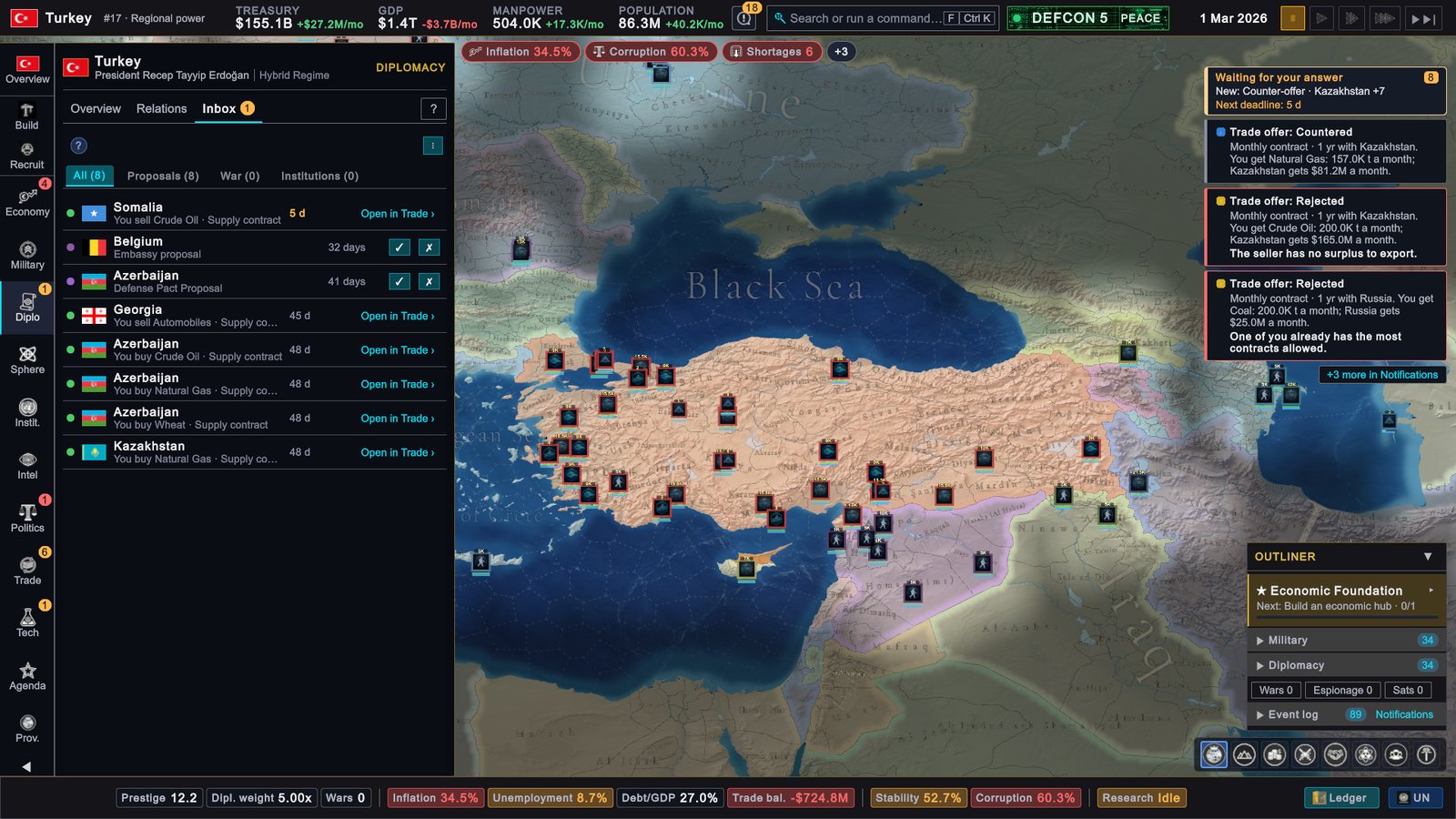
The Inbox sorts requests under All, Proposals, War and Institutions. Proposals for an alliance, pact, treaty, trade agreement or embassy wait 48 days; a peace offer waits 120. Rejecting one costs a few relation points and the sender waits before asking again. Trade offers open on the Trade page and institution items on the Institutions page.
A CALL TO ARMS opens as a window when an ally is at war and calls you. HONOR ALLIANCE joins the war on its side. REFUSE breaks the alliance and costs prestige and 40 relations. You have 12 days; no answer counts as a refusal and also costs that ally’s trust.
When you are the one at war, an AI ally weighs its willingness to come. One that is at peace and solvent starts at 65% or more. Each war it already fights, a treasury below zero, war exhaustion above 20 and earlier calls from you count against it; the enemy being its rival counts for it. If you were attacked, the ally comes when its willingness is half or more. If you declared the war and called your allies, each one rolls against its willingness, so a willing ally can still stay out. An ally that stays out loses prestige, and your relation with it and trust in it drop.
Members of NATO and the CSTO are not called this way when a fellow member is attacked from outside: the institution votes on collective defence instead. See International institutions.
What to do
- Build the channel first. An embassy unlocks alliances and three of the four treaties and raises how your proposals are read.
- Read the tooltip before proposing. It shows the other side’s numbers against what it needs, and a refused treaty stays locked for a long cooldown.
- Choose alliance or defence pact on purpose. Only the alliance brings the partner into your wars, and it can also pull you into theirs.
- Guarantee only what you will defend. Breaking or revoking a guarantee costs more than not giving it.