War is the most expensive thing you can do in Global Protocol, and plenty of good games go by without one. This page starts with how to stay out of wars. Then it walks through a whole war in order, from the reason for it to the peace deal. It ends with what to do when someone attacks you.
The mechanics here are kept shallow on purpose. The War and military pages go deeper, starting with Going to war.
How to stay out of wars
Watch your relations
Relations are how warmly one country regards another, from −100 to +100. Each side keeps its own number, so a country can dislike you more than you dislike it.
- Open Diplomacy › Relations (R opens Diplomacy by default). Countries are grouped as Friendly (+50 and above), Warm, Neutral, Cold and Hostile (−50 and below).
- The list shows your view of them. To see their view of you, click Columns ▾ and switch on Theirs.
- An AI country, one the computer runs, can start planning a war against a country it rates at −25 or lower. Keep your neighbours above that. A country with a strong grievance against you can plan a war at a better rating too, but it drops the plan if its rating of you climbs to +25 or higher.
- To repair a relation, click the country on the map, open the Relations tab on its card and click IMPROVE RELATIONS. More in Relations, trust and opinion.
Have friends
- An alliance is the strongest protection. When you are attacked, every ally is asked to join at once. The AI drops any war plan against a country that becomes its ally, and a target with strong allies looks far less tempting. PROPOSE ALLIANCE needs relations of 50 or more in both directions, enough trust (how far they believe you keep your word) and an embassy, a permanent diplomatic mission, between the two of you.
- Some countries start protected. Australia begins allied with the United States and New Zealand. Members of NATO defend each other.
- A defence pact is not an alliance. The Defense Pact treaty does not bring the partner into your wars. Only an alliance does.
- A guarantee is one country’s promise to join the war if another is attacked. If you give one with GUARANTEE INDEPENDENCE, you are the one who has to fight. Do not hand them out lightly.
- A non-aggression pact is a promise, not a lock. Two countries promise not to attack each other. A country that declares war through one breaks the pact and loses the victim’s trust for years. It still gets its war.
- Trade helps. The AI is less willing to attack one of its main trade partners, or a country it shares a trade agreement or a trade bloc with. The game calls trade blocs trade arrangements.
Every pact is covered in Diplomatic actions and treaties.
Do not provoke
- INSULT lowers relations in both directions. Sanctions (cutting trade with a country) and ultimatums (a demand with a deadline) sour them too.
- Conquest raises your aggressive expansion, a score of how alarmed the world is by you. At 100, other countries can form a coalition, a group acting together, and declare war on you together.
- A small army next to a strong, unfriendly neighbour is an invitation. The AI prefers wars it expects to win.
Use the setting
The AI AGGRESSIVENESS setting you chose when you started the game is the largest dial of all. On PEACEFUL, AI countries do not start wars of their own. On LESS AGGRESSIVE they do so far less often. See Picking your first country.
A war from start to finish
-
Open the target’s card. Click the country on the map. Its card opens on the right. Click the Relations tab and scroll to the WAR & PEACE group.
-
Click DECLARE WAR. Nothing is declared yet. If the button is greyed out, hover it for the reason. The usual ones are Active truce and Cannot target an ally.
-
Choose your reason for war. The window lists them under CASUS BELLI. A casus belli is the stated reason for a war. You do not have to earn one first: four are offered every time, and you must pick one before the confirm button works. The choice matters at the end, because it decides what you may demand in the peace.
Reason Offered What it lets you demand at the peace Territorial Claim Every time Land Reconquest Every time Land Ideological Every time A change of government Humiliation Every time No land, no change of government Honor Guarantee Only when the target is at war with a country you guarantee The same as Humiliation Coalition War Only when you are in a coalition against the target The same as Humiliation Every reason also allows the three general terms: a peace with no changes, a payment, and a humiliation of the loser.
-
Read the window before you confirm.
- Enemy Allies lists who is likely to defend the target, with each one’s strength. The defender’s allies are asked to join automatically.
- Call Allies to War lists your own allies, each with a tick box and the chance that it says yes. Nobody is ticked to begin with. Only the ones you tick are invited, and each may still decline. Members of a defensive organisation such as NATO cannot be invited to a war you start, so the list may be missing.
- Force Comparison sets your side against theirs and prints Advantage or Disadvantage with a percentage. A large disadvantage is a reason to click NO.
- Price of this war lists what the declaration costs you: the rise in aggressive expansion, whether you stay under the coalition line, how far other countries’ relations with you drop, and what the UN is likely to do.
-
Click DECLARE WAR, or NO to back out. Once you confirm, the war exists. Trade with the enemy stops and the embassies between you are suspended.
-
Select an army. Click its marker on the map, or click its row on Military › Forces. The unit bar appears at the bottom of the screen.
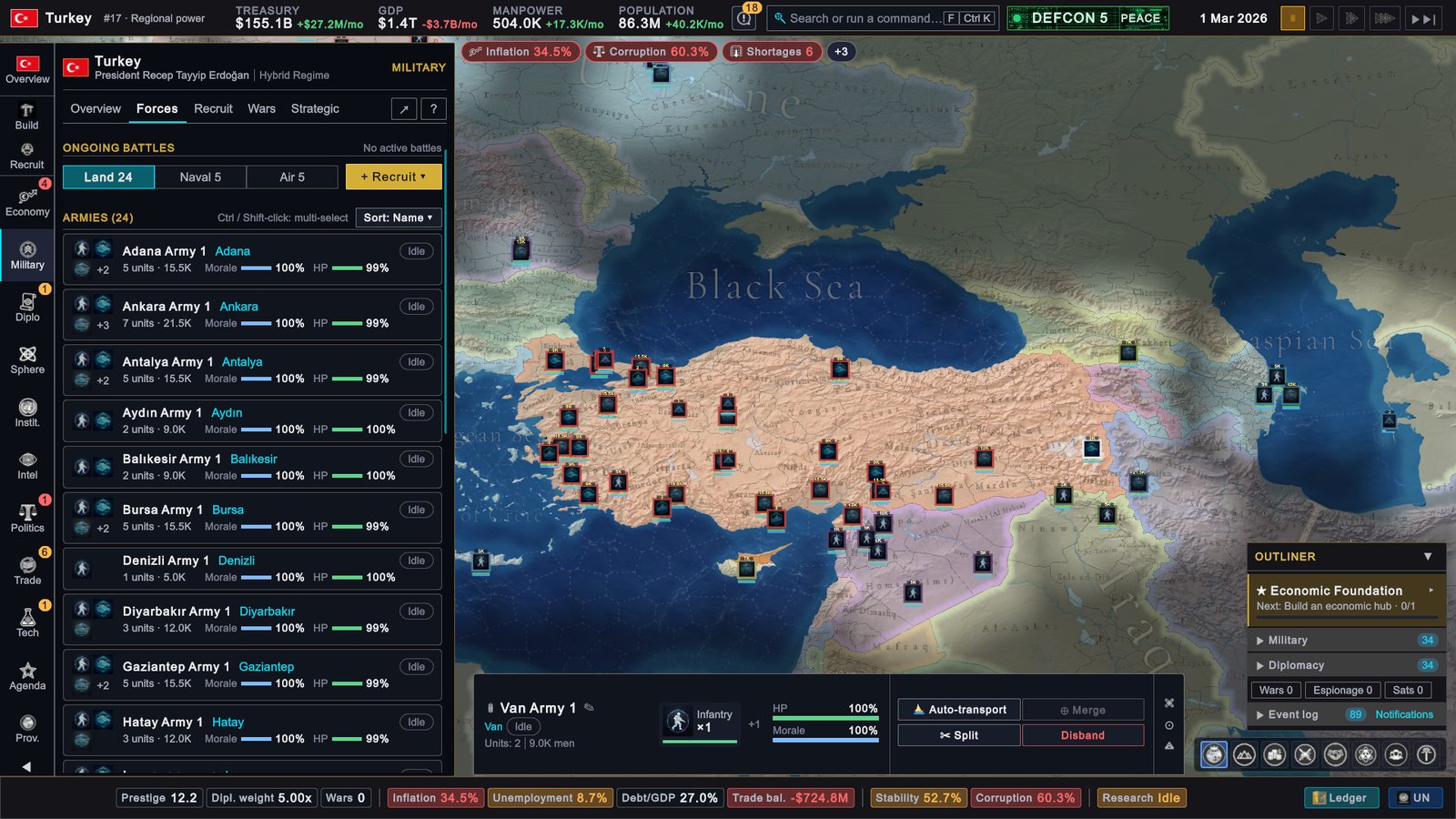
Turkey, 1 March 2026: an army selected, with the unit bar and its order buttons at the bottom of the screen. -
Order it to move. With the army selected, right-click the province to march to. A province is one of the small areas the map is divided into. The game picks the route.
-
Or order it to attack. Right-click the marker of an enemy army, and your army goes after it. Armies at war fight when they meet in a province. An army already in a battle takes no new orders until the battle ends.
-
Cross the sea. Click Auto-transport, then click where to land. The game picks the route and the ships, and a box titled SEA TRANSPORT asks you to confirm with the number of days it will take. A right-click on a province across the sea books a transport the same way. You do not load the army onto ships yourself. The transport needs a fleet of yours with free room that can sail to the boarding port. Without one you read “No transport ships available for sea lift.”
More in Navy.
-
Win battles. A battle starts by itself when your army and an enemy army are in the same province. The battle is fought day by day. Units lose health, and the losing side loses morale, the will to fight. The side whose morale breaks retreats. Terrain changes how well each kind of unit fights: infantry, for example, fights below its full strength in mountains and jungle. Fortifications in a province help whoever defends it. Health and morale come back while an army rests out of combat. A toast reads BATTLE WON or BATTLE LOST. More in Land forces.
-
Take ground. An army standing in an enemy province with nobody left to fight lays siege to it. The siege wears down the province’s defences day by day, and a larger army is faster. When the defences are gone the province is occupied and a toast reads PROVINCE CAPTURED. Occupation means you control the province for the length of the war. It still belongs to the enemy until a peace deal says otherwise. You do not have to leave the army there: the province stays occupied until the war ends or the owner retakes it with troops.
-
Watch the war score. Open Military › Wars. Each war is a card with a bar and a number from −100 to +100. Above zero you are ahead. The score rises when you win battles and hold enemy provinces, and it reflects the strength of the two sides. The label next to it reads Early War for the first 30 days, then Winning, Decisive, Stalemate, Losing or Collapsing. Click the card to open the war page, with the enemy’s forces, their war exhaustion (the strain the war puts on a country) and what the war has cost each side.
-
Offer peace. On the war page, click Sue for peace.
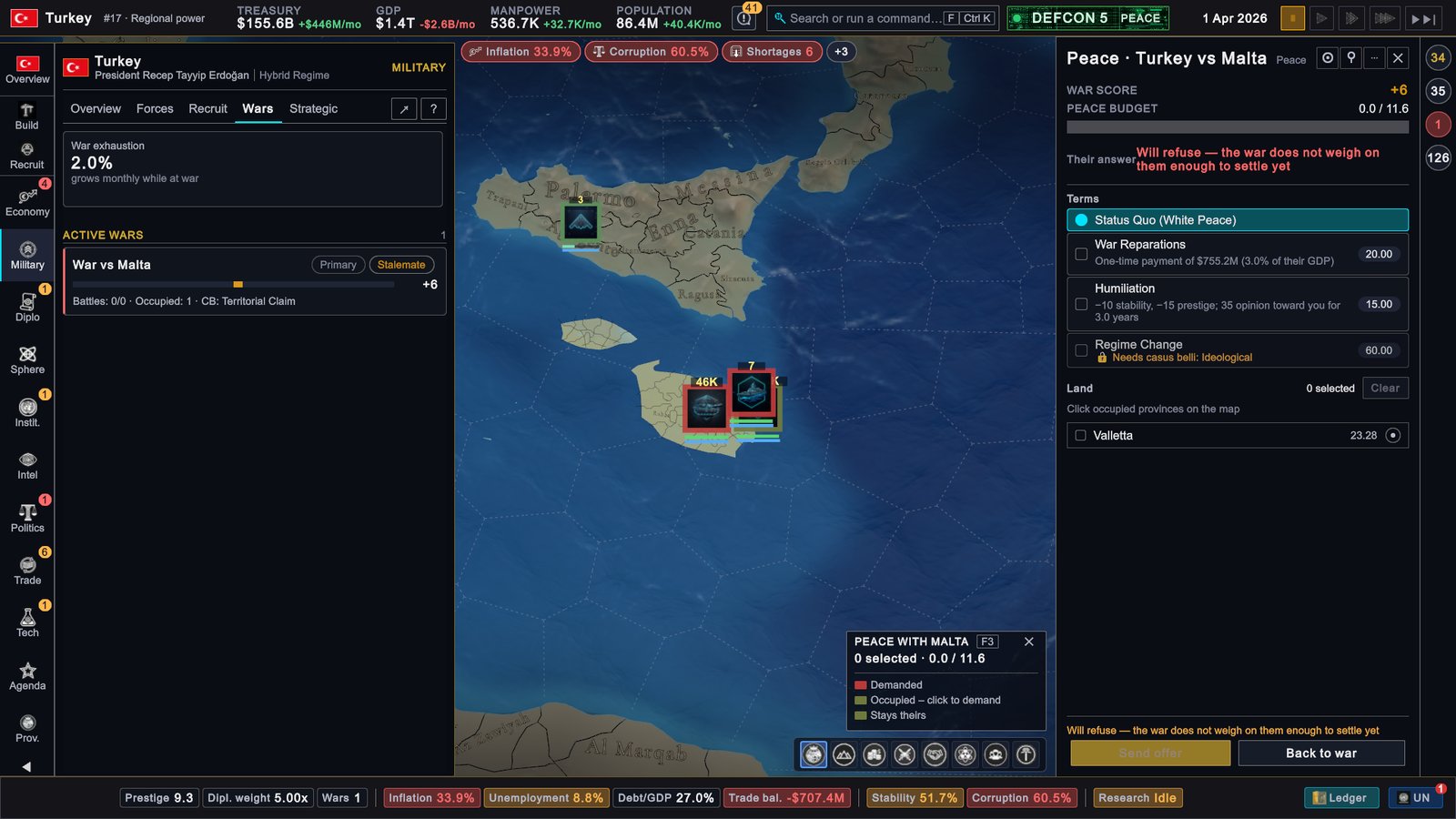
A war between Turkey and Malta, set up for these screenshots: the peace view with the terms, the peace budget and the other side's likely answer. - Under Terms, pick what you want. Status Quo (White Peace) ends the war with nothing changed. War Reparations is a one-time payment to you. Humiliation costs them stability and prestige. Regime Change replaces their government and needs the Ideological reason.
- Under Land, click occupied provinces on the map to demand them. This needs the Territorial Claim or Reconquest reason, or a decisive win while you hold their ground.
- Every demand has a cost. The total must fit inside your PEACE BUDGET, which grows with your war score and the ground you hold.
- Their answer tells you what they will say before you ask: Will accept, or Will refuse with the reason. Typical reasons are “your demands outweigh the pressure on them” and “they are winning and won’t settle for nothing”.
- Click Send offer, or Back to war to close the view.
-
Keep the truce. A peace deal starts a truce between the two of you that lasts two years. Neither side can declare war on the other until it ends. More in Peace and occupation.
When to offer peace
- As soon as their answer is “Will accept” for terms you are happy with. A longer war rarely gets cheaper.
- Before your own war exhaustion gets high. A warning pill appears at 50%.
- When you are losing. You then have no peace budget and cannot demand anything, but you can still offer Status Quo (White Peace). They may refuse while they are winning. The enemy can also send you an offer. It arrives in the Waiting for your answer card and lapses if you leave it unanswered for 120 days.
What a war costs you
| Cost | What happens |
|---|---|
| War exhaustion | War exhaustion is the strain of the war on your country. It grows for as long as you are at war, faster when you lose battles, are outnumbered, have provinces occupied or have your coast blockaded. It pulls your stability down. It fades in peacetime. |
| Money | When your Military budget share does not cover the upkeep of your forces, part of the gap is taken from the treasury and your units fight worse. Trade with the enemy stops for the length of the war. |
| People | Replacing losses draws on your manpower, the pool you recruit from. |
| Reputation | Declaring an offensive war adds to your aggressive expansion, and every province you take in the peace adds more. Countries that were not involved think less of you. |
A cheaper way in. If you send an ultimatum first (ISSUE ULTIMATUM on the country’s card) and it is refused, the Declare War window shows Justified by a refused ultimatum. The reputation price of the war is then halved. If they yield instead, the two of you sign a truce and no war follows.
If someone attacks you
What you see. The game pauses and a window opens: WAR DECLARED BY and the attacker’s name. It gives the reason, your active personnel and theirs, how many alliances the enemy has, and which allied countries have already joined the war. Click ACKNOWLEDGE to close it. The Wars chip on the status bar, the strip along the bottom of the screen, counts the war.
Your first three actions. Stay paused while you do them.
-
Read the war. Open Military › Wars and click the war’s card. Look at the enemy’s manpower and allies next to your own. This tells you whether to fight or to look for a way out.
-
Put your armies in the way. Open Military › Forces, select your armies and move them to the provinces the enemy will reach first. Join small armies in the same province with Merge. A province with fortifications is easier to hold.
-
Pay for the fight. In Economy › Budget raise the Military share and click Apply. Then queue new units on Military › Recruit.
Calling allies. You do not have to. Your allies are asked the moment war is declared on you, and each one decides for itself. An ally with poor relations with you may stay out.
When an ally of yours is attacked, you get the same question. A CALL TO ARMS request appears with two choices, HONOR ALLIANCE and REFUSE, and twelve days to answer. Refusing, or letting the request run out, breaks the alliance and costs you prestige (your standing in the world) and relations.
If the war is hopeless, open the war page and click Sue for peace. Check Their answer for a white peace every month or so.
If your screen looks different
- DECLARE WAR is greyed out or missing. Hover it: you have a truce with that country, or it is your ally. If the button is not there at all, you are already at war with that country, and OFFER PEACE shows in its place.
- Your army ignores a right-click. Unit orders do not work from the globe view. Zoom in to the flat map.
- There is no Land section you can use in the peace view. Your reason for war does not allow land, and you have not won decisively.
Next
Time, speed and saving: the clock, the speed controls and how to save.