National laws are your slowest and most durable lever in Global Protocol. Each one changes several numbers at once, from tax revenue to unrest, for as long as it stays in force. Changing a law costs money and time, and in a country with a parliament it needs a majority.
Where to find it
Open Politics › Laws (K opens Politics by default). While a package is in debate, the Legislation row of the outliner counts down to the vote.
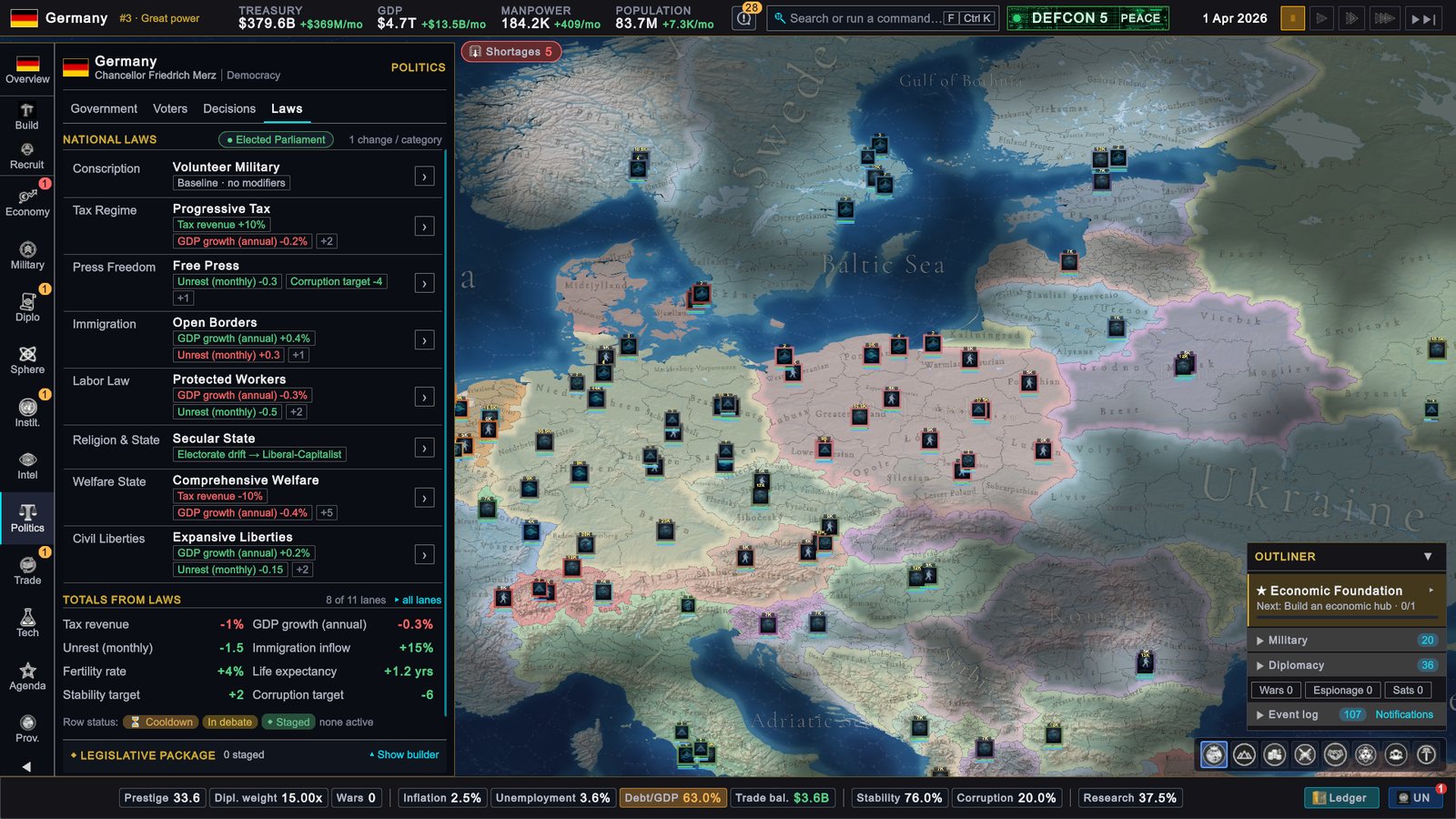
The tab has three parts:
- National Laws. One row per category with the option in force and its main effects as chips. A chip at the top says Elected Parliament or Rule by decree. Row chips mark a category that is on Cooldown, In debate or Staged.
- Totals from laws. What all your laws add up to. all lanes shows the lines that are at zero as well.
- Legislative Package. The changes you have staged. Show builder opens it.
How it works
Categories and options
There are eight categories. Exactly one option is in force in each, and every country starts with its own set.
| Category | Options | Mostly moves |
|---|---|---|
| Conscription | 6 | Manpower regeneration, recruitment cost, military upkeep |
| Tax Regime | 6 | Tax revenue, GDP growth |
| Press Freedom | 5 | Unrest, stability target, corruption target |
| Immigration | 6 | Immigration inflow, GDP growth, unrest |
| Labor Law | 6 | GDP growth, unrest, stability target |
| Religion & State | 5 | Stability target, unrest, where voters drift |
| Welfare State | 5 | Tax revenue, life expectancy, fertility, unrest |
| Civil Liberties | 4 | Unrest, stability target, corruption target |
Every option, with its numbers, is in the Laws reference.
A law can do four kinds of things:
- Effects on your country. The eleven lines in Totals from laws: tax revenue, GDP growth, manpower regeneration, recruitment cost, military upkeep, unrest, fertility, life expectancy, immigration, stability target and corruption target.
- Electorate drift. Some options pull voters toward one bloc a little every month.
- Interest groups. Some options grow or shrink a group. Mandatory service enlarges the Military group, a religious law the Religious group, low taxes the Entrepreneurs. Laws do not change a group’s Approval.
- Relations. Press, immigration, religion and civil liberties laws count in diplomacy. Countries with laws like yours warm to you over time, and countries with opposite laws cool.
Thirteen options are locked behind doctrine tiers. A locked card names what it needs, for example Requires Government Tier 3: complete that tier of the doctrine branch in the Knowledge Network.
Changing a law
Laws change through a legislative package: one or more changes submitted together, at most one per category.
-
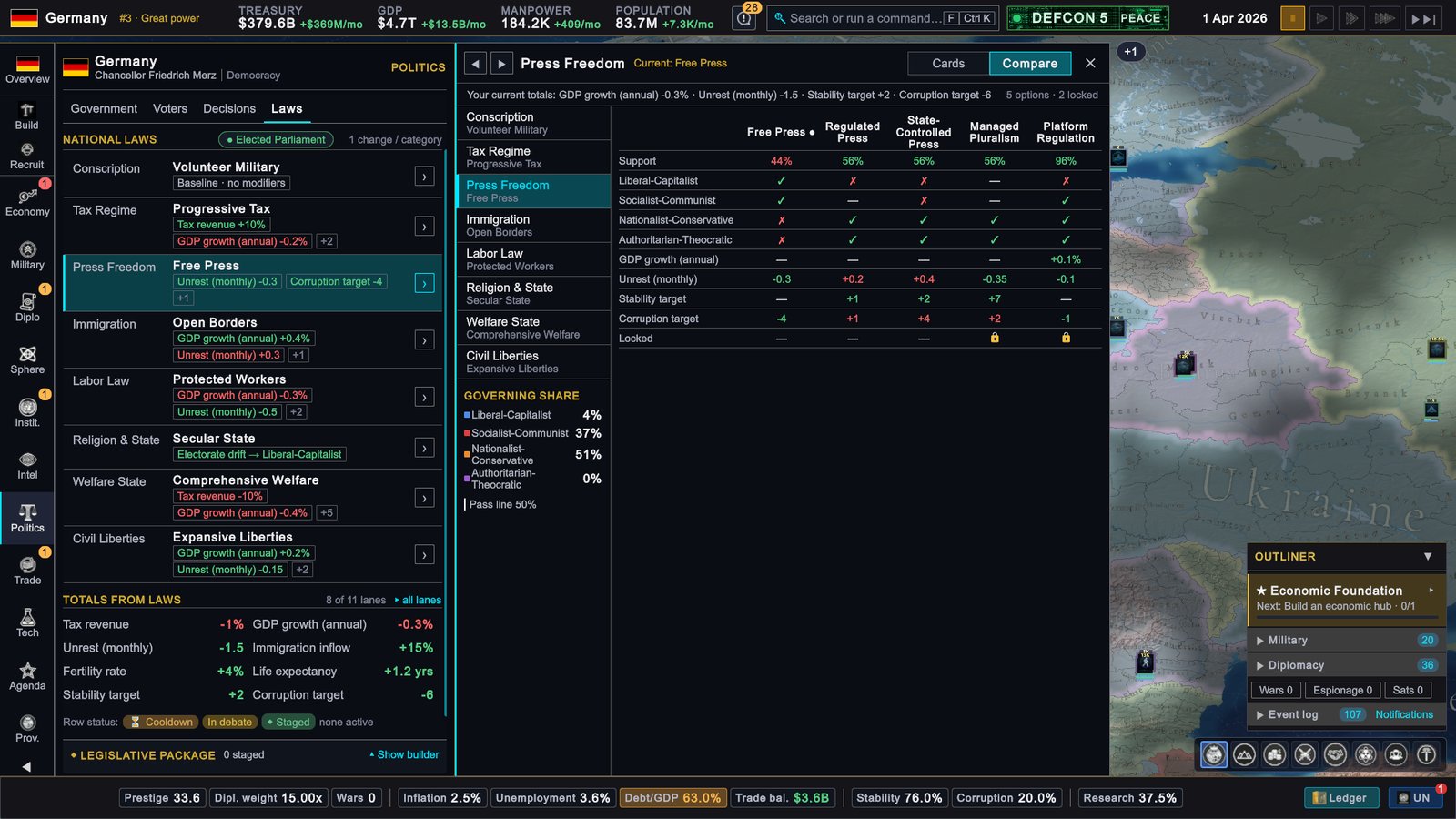
Open the picker. Click the arrow at the end of a category’s row. Cards shows every option with its effects, its price and its support. Compare puts the options side by side.
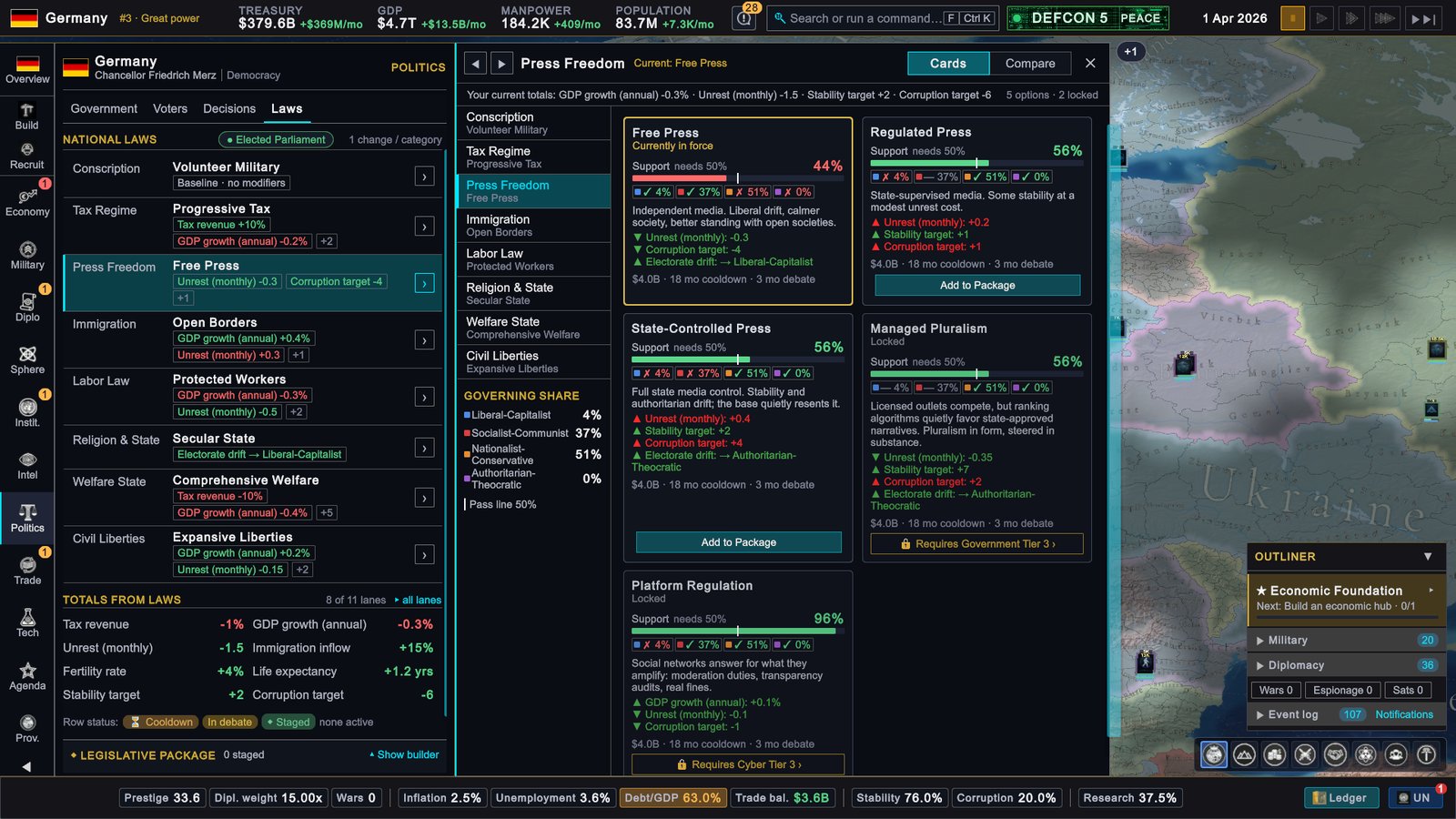
Germany, 1 April 2026: the law picker. Each card shows which blocs back the option and what it would change. -
Read the support line. Each card shows the share of parliament in favour, the pass line, and a mark for each bloc: in favour, against or undecided.
-
Stage the change. Click Add to Package. The button becomes Remove from Package; picking another option in the same category offers Replace in Package.
-
Open the builder. It lists the changes, the Projected support for the whole package and the Total cost. Under Negotiation, blocs that oppose the package may make demands. Accept applies a demand to the package.
-
Submit. Click Submit Package. You pay the full cost at that moment.
What decides the vote
Each bloc has a fixed opinion of each option. A party votes with its bloc, and an undecided bloc counts as not in favour. Support is the share of parliament whose blocs are in favour. A package passes with more than 50%.
For a package with several changes, each bloc judges the whole. Strong feelings weigh more than mild ones, so one popular change can carry an unpopular one. There is a limit: if a bloc hates one of the changes outright, that is a redline. The bloc opposes the whole package and no concession moves it. The builder warns you.
Bloc positions lock when you submit. The vote at the end of the debate applies them to the parties’ projected shares on that day. A package that was passing can fail if your supporters lose ground during the debate, and the reverse.
Negotiation
A bloc that opposes the package, without a redline, can ask for a price: add its favourite option in another category, withdraw a change it dislikes, or replace that change with the option it prefers. A demand is a real change of law, and accepting it reshuffles everyone’s position. Check the projected support again before you submit.
Time and cost
| Rule | |
|---|---|
| Cost | Each change costs its category’s price, between $3 billion and $5 billion. You pay at submission and get nothing back if the package fails or is cancelled. |
| Debate | Three months for each change in the package. |
| Next package | After the vote, parliament is busy for six months plus two months for each change. |
| Cooldown | A category that changed cannot change again for 12 to 24 months, shown on its card. A failed vote starts no cooldown. |
| Cancelled | A change of government cancels a package in debate. |
Doctrines can move these numbers in either direction. Some make laws cheaper or debates faster, others the opposite, and most of them sit in the Government branch.
Rule by decree
A government without an elected parliament skips the vote. The package takes effect the moment you submit it, with the same cost, cooldown and waiting time before the next one.
The price is clandestine resentment, the hidden anger of the people you overruled. Each decreed change adds resentment in proportion to how much of your electorate opposes it, and the builder shows the total as Projected resentment if decreed. Resentment drags stability down, raises coup risk and feeds unrest until it fades. See Stability, corruption and coups.
What to do
- Start from the problem, not the category. Find the line in Totals from laws that hurts, then look for it in the effect chips on each row.
- Read both sides of a card. Most options trade one thing for another: growth for unrest, stability for corruption, manpower for GDP.
- Bundle with care. A package of three changes debates for nine months and blocks parliament for a year afterwards. Bundle when one change needs another to pass; otherwise send the urgent one alone.
- Never include a redline for a bloc you need. Check the bloc marks on each card before you stage it.
- Submit when your supporters are strong. The vote uses the shares on decision day, so a package submitted during a slump is at risk.
- Mind the calendar. Do not start a long debate shortly before an election you might lose.
- If you rule by decree, count the resentment. One opposed decree is affordable. A string of them is how a stable autocracy gets a coup.
Stability target, not stability. A law marked Stability target raises the level your stability settles at. It does not add stability each month, and all laws and doctrines together can raise the target by 10 at most.