Intelligence decides how much you know about other countries and what you can do to them in secret. Your agency’s scores set how often your missions succeed and how often foreign ones are caught. The missions themselves are carried out by specialists, the agents covered on the Envoys page.
Where to find it
Click Intel on the rail to open the Intelligence page (I by default). It has three tabs: Operations, Agency and Dossiers. Y by default opens Operations directly. A strip of chips under the tabs stays visible on all three: missions in use, specialists, idle specialists, counter-intel and detected threats.
How it works
Your agency and its three scores
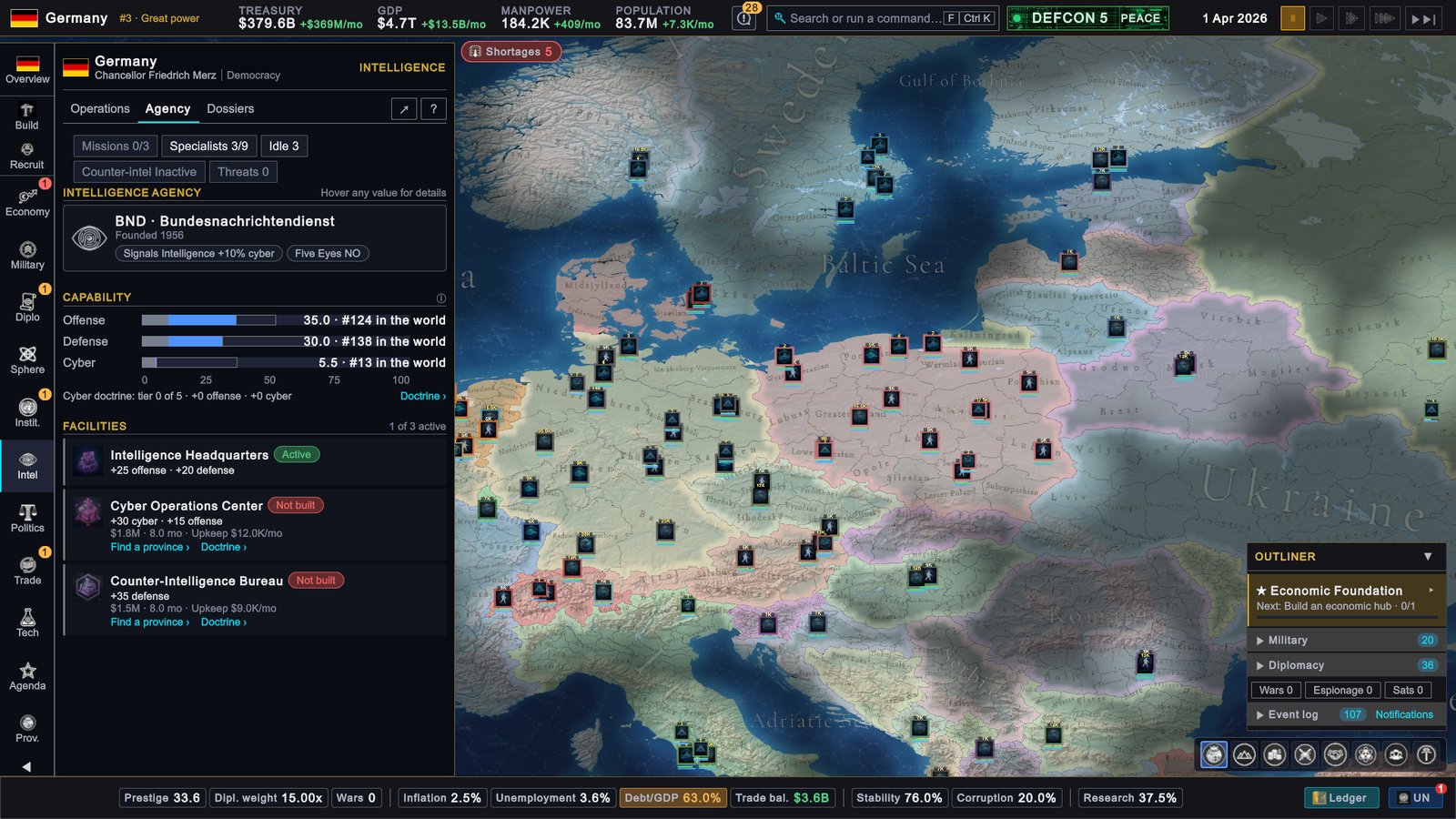
Most countries start with a named agency that has a fixed specialization. The agency has three scores, recalculated at the end of each month:
- Offense is used when you run missions abroad.
- Defense is used against missions run on you.
- Cyber helps Sabotage Economy and Steal Technology.
For a country with an agency, the scores are built like this:
| Source | Offense | Defense | Cyber |
|---|---|---|---|
| Base | 10 | 10 | 5 |
| The agency | +25 | +20 | |
| Cyber Operations Center | +15 | +30 | |
| Counter-Intelligence Bureau | +35 | ||
| Each completed Cyber tier | +5 | +5 | +2.5 |
The specialization multiplies part of a score: Human Intelligence gives +15% offense, Counter-Intelligence +20% defense, Cyber Operations +25% cyber, Signals Intelligence +10% cyber, and Balanced +5% offense and defense. Members of the Five Eyes alliance get +20% offense and defense on top.
The facilities are buildings. One of each anywhere in your country is enough. The Counter-Intelligence Bureau needs Cyber tier 1 in the Knowledge Network; the Cyber Operations Center needs Cyber tier 3. A third building, the Intelligence Headquarters (Cyber tier 1), matters only to the small countries that start without an agency: they cannot launch missions until they build it. For everyone else the agency counts as the headquarters, and the Agency tab says so.
Missions
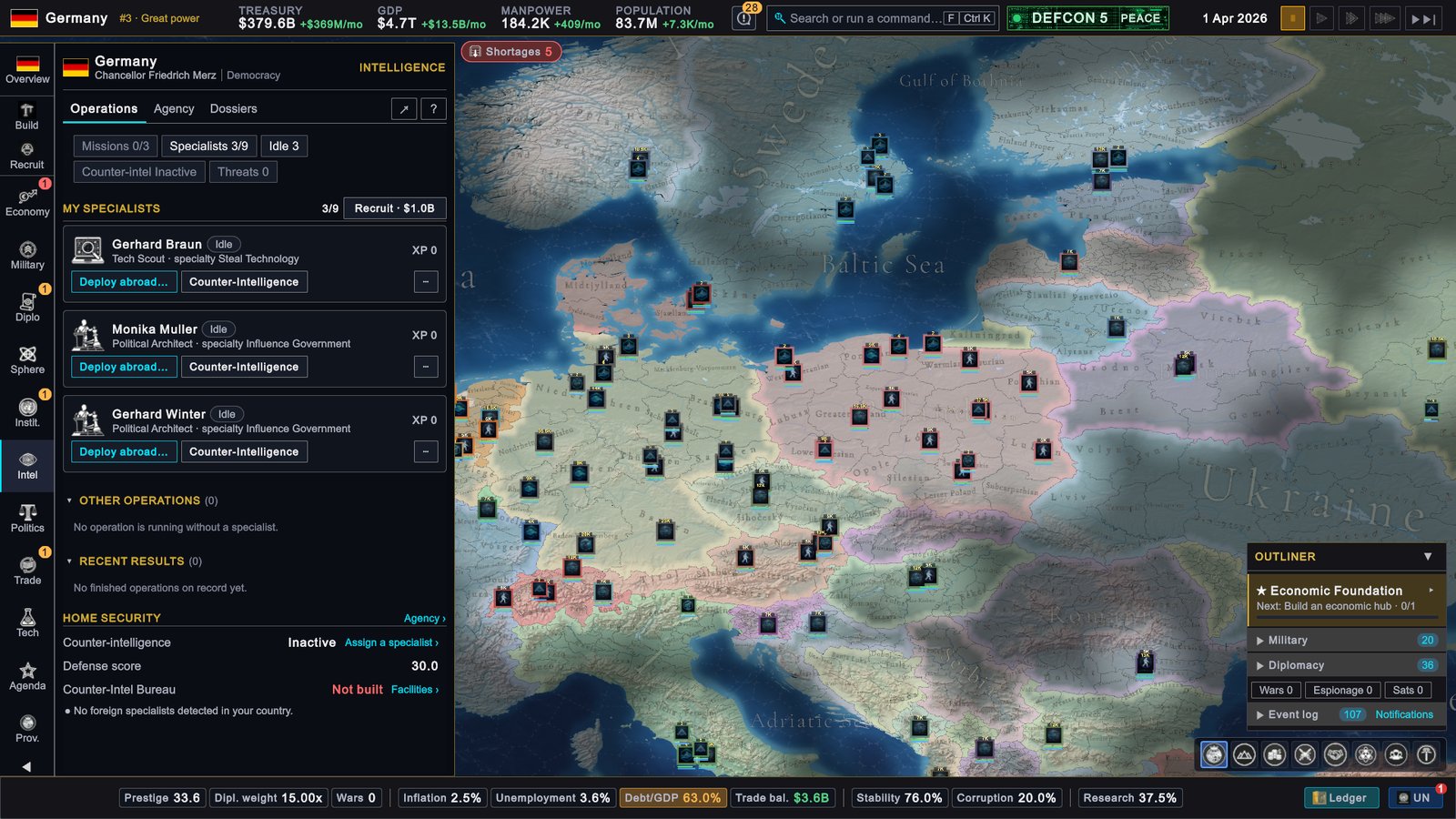
A mission against a country needs one of your specialists deployed there. You can run three missions at a time. Each lasts six months and costs a monthly fee: $50M, or 0.02% of your GDP if that is more. When a mission ends, the same mission type cannot be started again for three months.
| Mission | Who runs it | On success |
|---|---|---|
| Gather Intelligence | Any specialist deployed in the target | A report in Dossiers, the target’s provinces revealed on the map, and vision around its capital for about six months |
| Sabotage Economy | An Economic Hitman in the target | A one-off cut to the target’s GDP (about 1%, more with a high Cyber score) and a cyber incident |
| Sabotage Infrastructure | A Shadow Operator in the target | The target loses stability |
| Steal Technology | A Tech Scout in the target; you also need a Cyber Operations Center | A cyber incident in the target |
| Influence Government | A Political Architect in the target | The target loses stability, more when your offense outweighs its defense |
| Fund Opposition | An idle Political Architect; started from the target country’s Politics page | The funded bloc gains vote share. Costs $250M a month |
| Counter-Intelligence | Any idle specialist, at home | See the warning below |
A cyber incident lowers the target’s GDP a little every month for about six months. After it ends, the country cannot suffer another one for a year. Sabotage Economy skips its one-off cut when the target is already under an incident.
The buttons for these missions are on the specialist’s card in Operations. Request intelligence on a foreign province also starts Gather Intelligence, and needs a specialist deployed in that country like any other mission.
Success and detection
When a mission ends the game makes two rolls.
Success compares your Offense with the target’s Defense. Equal scores give an even chance before adjustments. Gather Intelligence is the most likely to work and Steal Technology the least. The specialist’s standing in the country and your doctrines with Espionage Success add to the chance, which stays between 5% and 95%.
Detection starts from a base of 15%. A Counter-Intelligence Bureau in the target adds 25 points and its Defense score a little more. The mission type then scales the result: Sabotage Infrastructure is the most exposed, Gather Intelligence the least. The target’s doctrines with Counterintel Detection raise it, a specialist who is well established lowers it, and a mission that would have succeeded is half as likely to be caught.
Detection wins over success. A detected mission is exposed and pays nothing.
When an operation is exposed
- The mission ends with the result CAUGHT and has no effect on the target.
- The target’s relations with you drop by 25 and it trusts you less.
- Your stability drops by 1.
- The specialist is expelled: sent home and unavailable for 90 days. The position they had built in that country is lost.
A mission that fails without being detected costs only the fees.
Counter-intelligence at home
Home security, at the bottom of Operations, shows your Defense score, whether you have a Counter-Intelligence Bureau, and every foreign specialist you have detected. Foreign specialists are checked for once a month and are easier to spot the longer they have been in place. Press Expel on a detected one to send them home and bar their country from sending anyone for a year.
The Counter-Intelligence mission does not raise your defences. It keeps a specialist on home duty and changes neither your Defense score nor your chance of detecting foreign missions. It still uses a specialist, a mission slot and the monthly fee. Your protection comes from your agency, the Counter-Intelligence Bureau, Cyber tiers and doctrines.
Dossiers and how good your information is
How precisely you see another country’s figures is its intel fidelity:
| Fidelity | What you see | How you get it |
|---|---|---|
| Exact | True values | An established embassy, or a report with 80% accuracy or more |
| Approximate | Rounded values marked ~ | A report with 50% accuracy or more |
| Rough | Low, Medium or High | A weaker report |
| No intel | ??? | Nothing |
A Gather Intelligence report has 30% accuracy plus the Intel Confidence of your doctrines, and expires after about two years. Without those doctrines a report gives rough figures only. Another country’s research needs Approximate or better.
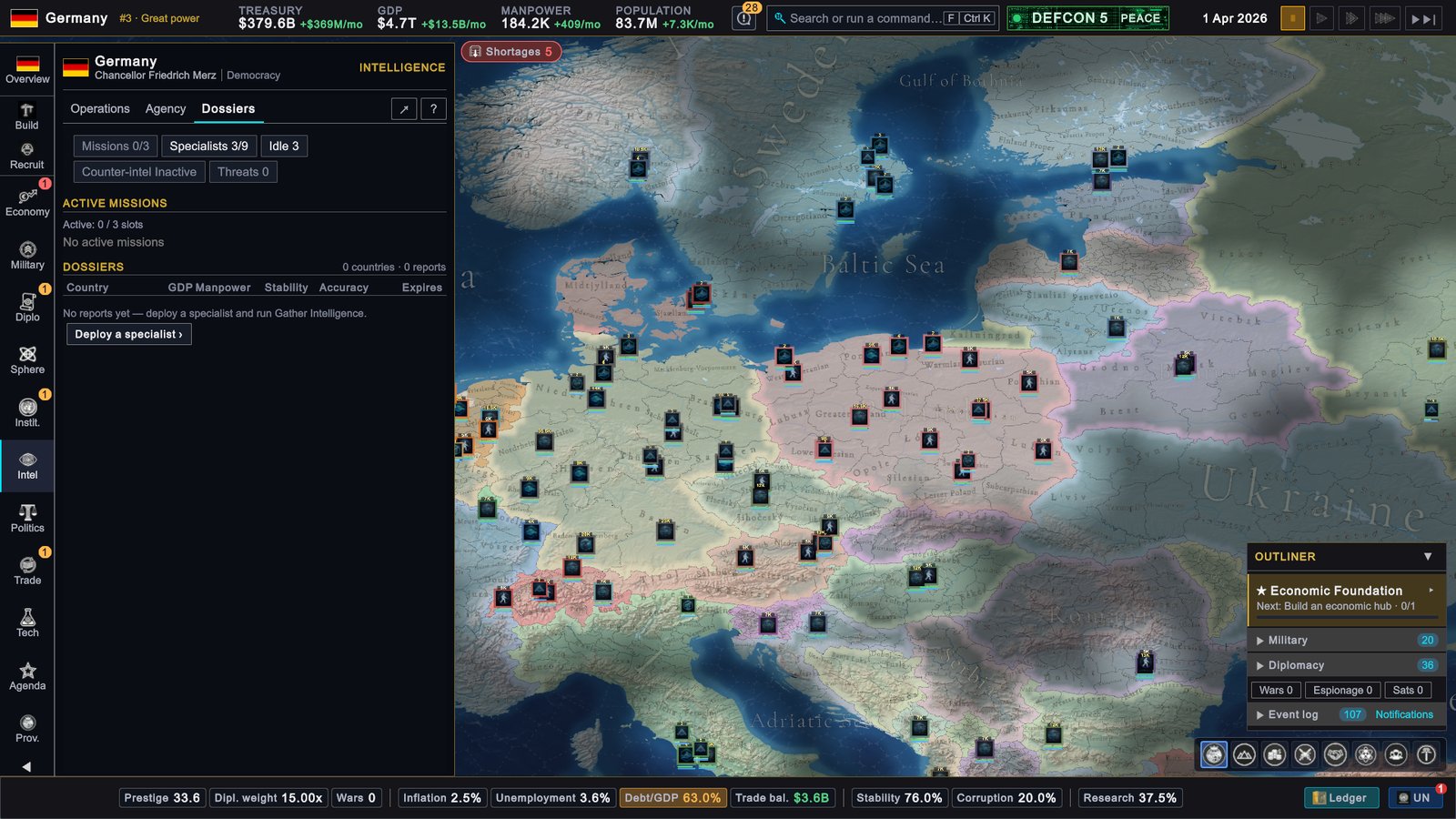
The Dossiers tab lists every country you hold reports on, with GDP, manpower, stability, accuracy and time to expiry from the newest report. A row with more than one report opens to show the older ones. Click the country name to open its card.
What to do
- Open an embassy first. An established embassy gives exact figures with no risk. Use Gather Intelligence where you have no embassy, or to reveal provinces before a war.
- Build the Counter-Intelligence Bureau if you are a target. It is the largest single addition to Defense and to your chance of catching missions.
- Research Cyber. Each Cyber tier raises all three scores, and tiers 1 and 3 unlock the facilities.
- Let the specialist settle before a risky mission. Shadow Operators and Tech Scouts add to success and cut detection more in their later phases.
- Count the full price. A mission costs six monthly fees, and exposure costs 25 relations and three months of the specialist’s time.