Nuclear weapons are the most destructive tool in Global Protocol and the most expensive one to use. This page covers who holds them, how the DEFCON alert level moves, how a launch and the answer to it play out, and what a strike costs the target, the launcher and everyone else. Building, basing and firing missiles in general is on Missiles and missile defence.
Where to find it
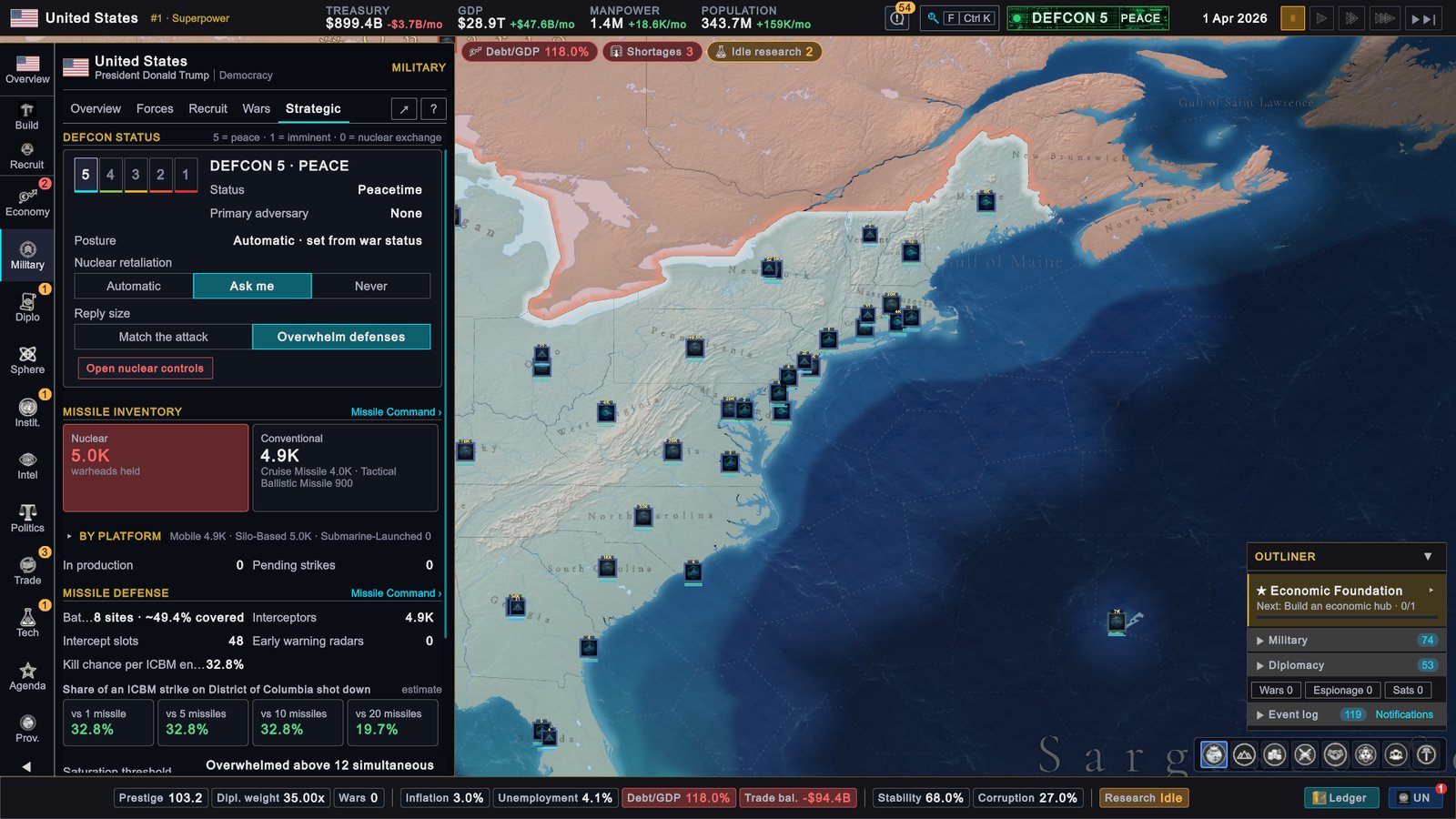
- The DEFCON indicator in the top bar shows your level and its name, for example “DEFCON 5 PEACE”. Clicking it opens Missile Command.
- Military › Strategic has the DEFCON STATUS card: the level, your primary adversary, the Nuclear retaliation and Reply size settings, and Open nuclear controls. Military opens with M by default.
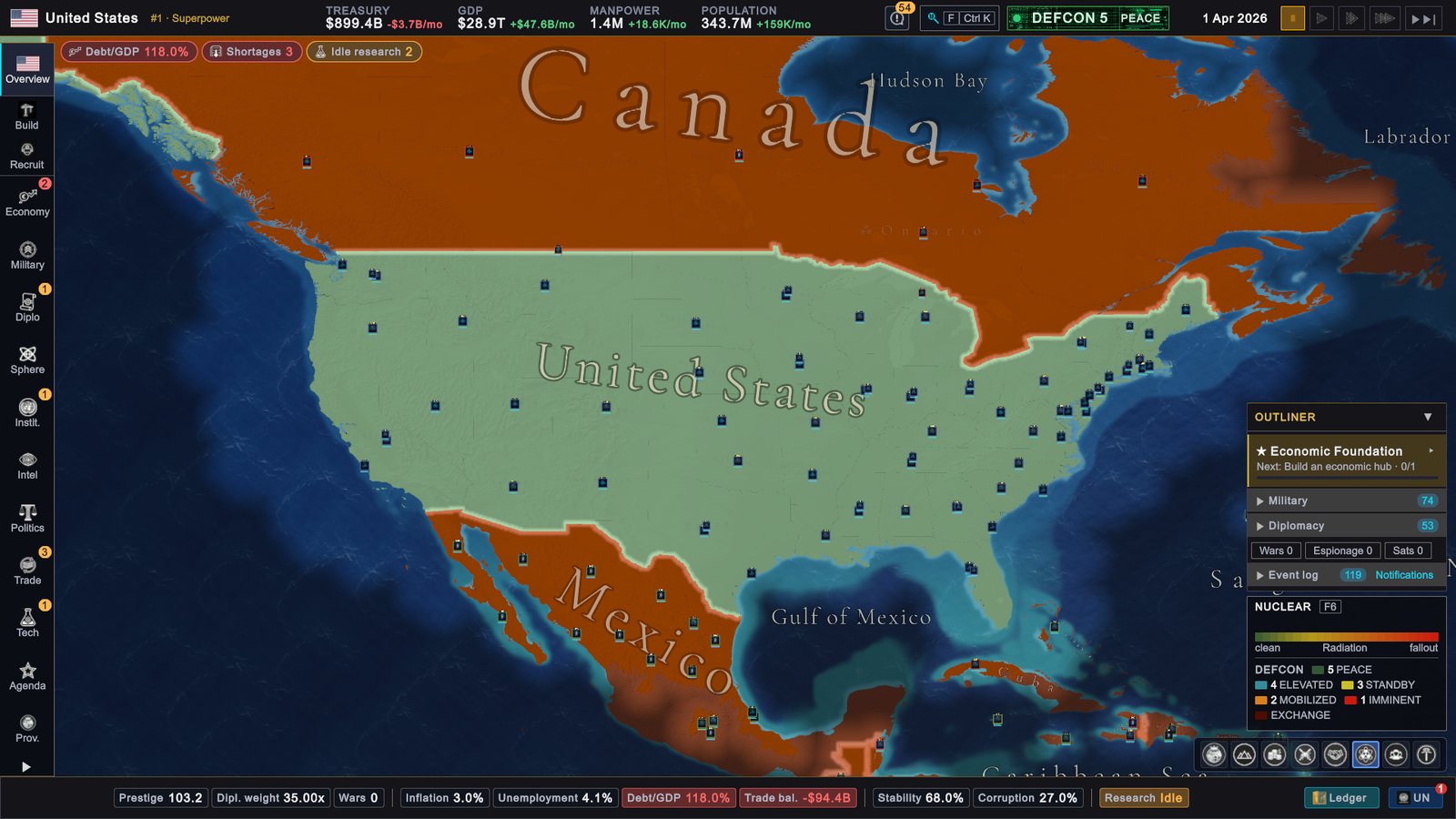
- The Nuclear map mode (F6 by default) colours irradiated provinces by radiation and every other province by its owner’s DEFCON level.
How it works
Who has warheads
China, France, India, Israel, North Korea, Pakistan, Russia, the United Kingdom and the United States start with nuclear arsenals, based in their capital province. Each nuclear missile counts as one warhead.
Any other country can join them: research the Military tier a nuclear missile needs, build the facility that bases it, and produce one. From the day your first warhead is finished, your country has a DEFCON level. If you hold a Nuclear Non-Proliferation treaty when that happens, you are in breach of it and your treaty partner loses trust in you.
The DEFCON levels
DEFCON is your country’s nuclear alert level. It is set by the game from your wars; the card says so under Posture. A country without warheads stays at 5, and its card reads NON-NUCLEAR.
| Level | Name | When you are there |
|---|---|---|
| 5 | Peace | You are at peace. |
| 4 | Elevated | A passing step while the level moves between 5 and 3. |
| 3 | Standby | You are at war with anyone. |
| 2 | Mobilized | A nuclear warhead has hit you in the last few days. |
| 1 | Imminent | You have ordered a nuclear strike. |
| 0 | Exchange | Your own warheads are in the air, from a strike or a retaliation. |
The level worsens one step a day, so a new war takes two days to bring you from 5 to 3. It improves only once you are at peace and no warhead has hit you in the last few days, again one step at a time. Levels 2, 1 and 0 therefore stay with you until your wars are over. AI countries can hold a more severe level than the table gives, for example in a war against another nuclear power.
Launching
A nuclear strike uses the Nuclear side of STRIKE CONTROLS in Missile Command, or Launch missiles on a submarine fleet. You need:
- DEFCON 3 or lower, which in practice means being at war;
- a target province whose owner you are at war with;
- a nuclear missile within range, based in a province you control or loaded on a submarine.
Ordering the strike sets you to DEFCON 1, and the launch itself sets you to DEFCON 0. The left-click on the target is the order: there is no confirmation and no recall. Flight and interception follow the rules for every missile.
Retaliation
A country that holds warheads detects a nuclear launch against it on the day it is fired. How it answers is the Nuclear retaliation setting:
| Setting | What happens |
|---|---|
| Automatic | Your forces fire back the next day, without asking. |
| Ask me | You get a decision. This is where a human player starts. |
| Never | Nothing is fired automatically. |
Reply size sets how large the answer is. Match the attack sends one warhead back for each one launched at you. Overwhelm defenses adds enough to exhaust the attacker’s batteries around its launch sites. Either way one reply is capped at 50 warheads, and it only uses missiles that can reach.
With Ask me, the game pauses and shows NUCLEAR LAUNCH DETECTED: who fired, how many warheads are coming, where they were launched from, how large your reply would be, and how many days remain before the first one lands. Retaliate fires the reply; Hold fire does not. You have 10 days, and no answer means your forces hold fire. The popup cannot be dismissed with Esc.
A reply is aimed at the provinces the attack was launched from. Warheads that cannot reach those go to the attacker’s other nuclear sites, then to its most populous provinces. AI countries answer automatically. A reply does not trigger a second reply from the other side.
What a strike does
A warhead hits its target province and a number of rings of provinces around it: one ring for the two shortest-range missiles, two for the intermediate-range one, three for intercontinental and submarine-launched ones. Sea zones count, so fleets nearby are hit too.
| Target province | Rings around it | |
|---|---|---|
| Population | Most are killed, up to a ceiling per warhead that depends on the missile type | A smaller share, with a much lower ceiling |
| Units | Every army, docked fleet and air wing is destroyed | Damaged, less with each ring |
| Buildings and infrastructure | Destroyed | Partly destroyed, by chance |
| Economic output | Four fifths of the province’s output is gone | A tenth in the first ring, less further out |
| Radiation | Maximum | Half in the first ring, halving with each ring |
| Missiles based there | Destroyed, with any being built there | Untouched |
On top of that, the struck country loses a slice of its whole GDP for every warhead that lands on its soil, and the launcher takes a smaller GDP shock of its own. Both are capped per month.
Radiation lingers. An irradiated province produces less in proportion to its radiation, down to nothing at the maximum, and its food output falls the same way. Radiation halves every year and a half. The Nuclear map mode shows where it is.
Nuclear winter is the shared cost. Each warhead that lands on a province of at least 250,000 people adds soot to the sky. Up to about ten such strikes nothing happens; beyond that, food production falls in every country in the world, by roughly 7% at a hundred strikes. The soot halves every two years, so the cut fades. While it lasts, an icon appears beside the DEFCON indicator with the current cut in its tooltip.
Diplomatic consequences
For the country that launches a first strike:
- Your relations figure toward every other country, which is your view of them, drops by 100. Your allies are the exception: toward them it drops by 10. This repeats on every day your warheads detonate.
- Aggressive expansion rises by 40 for your first detonation of the campaign and by 10 for each one after.
- Prestige takes a penalty of 30 that fades over time.
- The strike is put before the United Nations as an urgent item. See International institutions.
A retaliation carries none of the relations and aggressive expansion costs.
What to do
- Decide your retaliation setting in peacetime. Ask me gives you the choice each time; Automatic answers without stopping the game. Check Reply size at the same time.
- Count the bill before a first strike. The relations drop, the aggressive expansion spike and a likely reply are the price. Weigh them against what the strike wins you.
- Expect an answer aimed at your launch sites. A reply targets the provinces you fired from, and missiles based in a struck province are destroyed. Spread your arsenal with Rebase, and put some of it on submarines.
- Read the AI’s position. AI countries are built to treat a first strike as a last resort: one is weighed only when an enemy holds some of the AI’s home provinces, the AI holds none of the enemy’s, and it is losing badly. An AI that has already been hit with a nuclear weapon in that war drops this restraint.
- Use the deterrent you have. AI countries count a target’s warheads against declaring war on it, and in their own war planning only the most aggressive AI leaders consider a nuclear-armed target.