Every country in Global Protocol has a population with an age structure. People are born, grow older, move and die month by month, and the result decides how many recruits, voters and consumers you have. Everything on this page is the simulation’s own set of rules: it starts from real figures for 2026 and then follows the game’s model.
Where to find it
- Top bar. Population, with its change per month.
- Overview › People. Open Overview on the rail (O by default), then the People tab. This is the main screen for this page.
- A province. Click a province. The People section of its Overview tab lists fertility, life expectancy, healthcare, education, literacy and urbanization. Unrest sits in the tiles above.
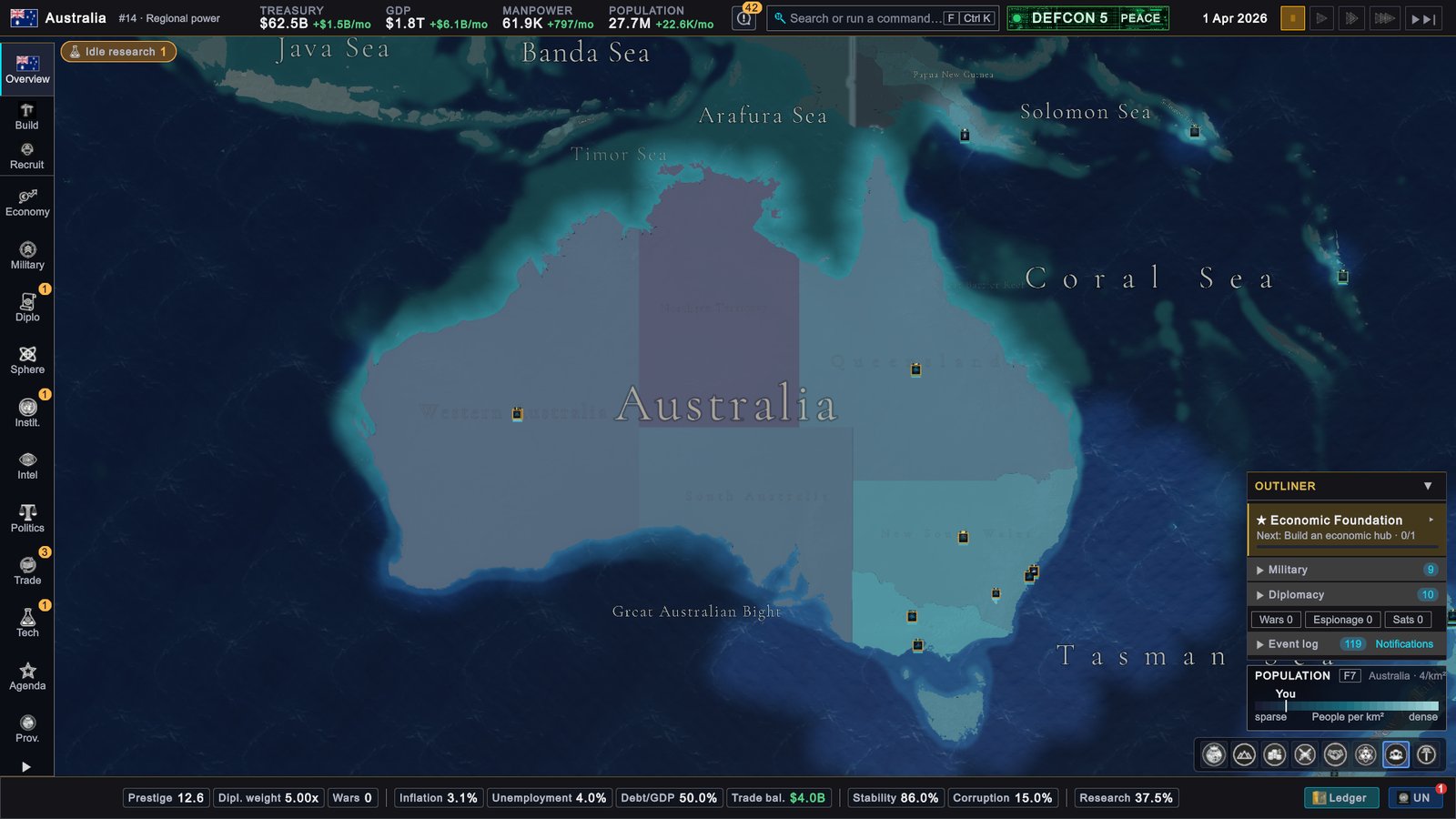
- Population map mode. F7 by default. It colours provinces by population density: darker is sparse, brighter is dense.
- Politics › Voters. The same pyramid, coloured by party.
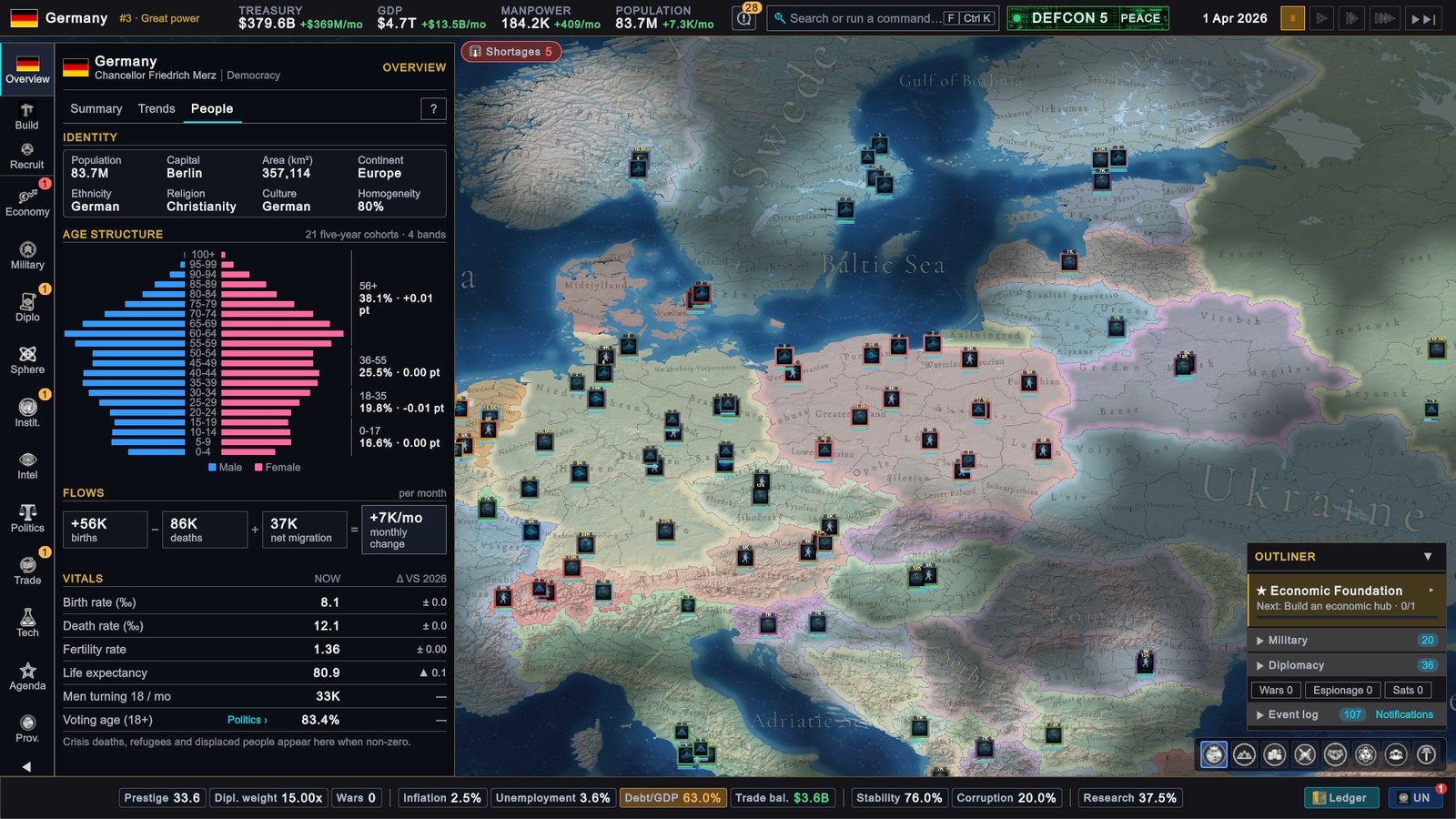
The People tab has four blocks:
- Identity. Population, capital, area, continent, ethnicity, religion, culture and homogeneity.
- Age structure. A pyramid of 21 five-year rows, men on one side and women on the other, bracketed into four bands: 0-17, 18-35, 36-55 and 56+.
- Flows. Births minus deaths plus net migration equals the monthly change.
- Vitals. Birth rate, death rate, fertility rate and life expectancy, each with its change since 2026, then Men turning 18 / mo and Voting age (18+). Crisis deaths, refugees and displaced people show up here only when they are not zero.
How it works
The age pyramid
Behind the chart, the game tracks every single age from 0 to 100 and over, separately for men and women. Each country starts on 1 January 2026 with a pyramid built from real population statistics. After that the simulation runs it, once a month:
- deaths are taken age by age, based on life expectancy;
- births are added from the number of women of childbearing age and the fertility rate;
- migrants are added or removed.
Every January, everyone moves up one year.
A country’s population is the sum of its provinces. Every province starts with its country’s figures for life expectancy, fertility, education, healthcare and urbanization. From then on each province changes separately, so a rich capital and a poor border province drift apart.
Life expectancy and fertility
Both move slowly toward a target. A policy change shows over years, not months.
| Lever | What it does in the simulation |
|---|---|
| Social share of the budget | Raises healthcare access over time, which adds years of life |
| Research share of the budget | Raises education over time, which adds years of life and lowers fertility |
| GDP per head of the country | A richer country lives longer and has slightly fewer children |
| Hospital, Water Treatment | Add years of life in their province |
| Housing Project | Raises fertility a little in its province |
| Welfare State laws | Targeted Programs, Universal Services and Comprehensive Welfare add years of life; the last two also raise fertility |
Laws, doctrines and buildings together add at most three years of life expectancy in a province. On the fertility side, education and wealth stop pushing once a province reaches about 1.3 children per woman. A country that starts below that level stays where it started.
Crisis deaths and displacement
Radiation and war devastation in a province add deaths on top of the normal rate. Young children and old people are hit hardest. Devastation also drives people out of the province. These are the Crisis deaths / mo and Displaced / mo rows in Vitals.
Migration
The game models three flows.
- Inside your country. People move between neighbouring provinces toward the more developed and calmer one.
- The country’s migration rate. Each country has a long-run net migration rate from its starting data. Your Immigration law multiplies the inflow: Open Borders, Guest Worker Program and Digital Visa Corridors raise it, Closed Borders lowers it. Across the world, total immigration is scaled to match total emigration.
- Refugees. When unrest in a border province passes 60, people flee into the neighbouring country, but only if that country is safer than yours. The game judges safety by war and stability.
Movement between provinces is capped: a province cannot lose or gain more than 2% of its people this way in one month.
Education, healthcare and cities
- Education rises with the Research share of your budget. A Public School speeds it up in its province. The higher it already is, the slower it climbs.
- Healthcare rises with the Social share of your budget, in the same way.
- Literacy follows education with a delay.
- Urbanization follows the province’s GDP per head and its infrastructure.
Education is the long lever: it adds to GDP growth, makes unrest fade faster, lengthens lives and lowers fertility.
Jobs and unemployment
The game has no job market building by building. Each country has one unemployment rate, shown on the status bar at the bottom of the screen. It drifts toward the country’s own natural rate. Growth above the country’s usual trend pulls it down, a slump pushes it up, and a larger Social share trims it slightly.
High unemployment costs you in three places:
- It lowers the level your stability settles at, once it is more than two points above the natural rate.
- Voters blame the governing party for unemployment above 5%, and the Socialist-Communist bloc gains from it.
- With unemployment above 8% and an unusually large share of 18-35-year-olds among your adults, every province gains unrest each month.
Recruits and voters
Men who turn 18 feed your military reserve. Men turning 18 / mo shows how many, and a share of them join automatically. Everyone aged 18 or over is part of the electorate. See Elections, parties and voters.
Identity
Two identity facts feed other systems. Countries that share your main ethnicity or religion warm to you a little each month, and your main religion sets the base size of the Religious interest group. Culture and homogeneity are shown for reference; the rules on this page do not read them.
What to do
- Read the Flows line first. It tells you whether births, deaths or migration is driving the change. A shrinking country with low fertility will not turn round quickly.
- For a faster effect, use the Immigration law. It acts on next month’s inflow. Fertility and life expectancy take years.
- Keep unrest below 60 in border provinces. Above that you lose people to your neighbours.
- Put hospitals and schools where the people are. Their effect is per province, so a big province gains more people-years from the same building.
- Fund Research and Social for the long game. They raise education and healthcare slowly, and both are hard to rebuild once neglected.
- Watch unemployment if your population is young. That is the combination that turns into unrest.
- Check Men turning 18 / mo before a long war. It is the size of the cohort your reserve refills from. The Conscription law changes how much of it you get.