A sphere of influence is a group of countries that have joined a leading power by consent. The leader picks a charter that says what the sphere is for, members take its benefits, and rival leaders compete for the same countries through influence. In a standard game nobody starts inside a sphere.
Where to find it
- Sphere of Influence page. Click Sphere of Influence on the rail (B by default). The tabs are My sphere, Candidates and World.
- Top bar. Your global rank and power tier sit next to your country’s name.
- Diplomacy › Inbox. Sphere invitations, defection offers and petitions sent to you wait here for 60 days.
How it works
Power tiers
Only a country with a power tier can lead a sphere. The tier follows a ranking score built from GDP, manpower and completed doctrine tiers, and is recalculated every day.
| Tier | Who holds it | Member slots | Project slots | Reach |
|---|---|---|---|---|
| Superpower | Rank 1, or rank 2 with at least 60% of the top score | 10 | 3 | The whole world |
| Great power | The top 8 by score | 6 | 2 | The whole world |
| Regional power | One of the two strongest in its region below the great powers, ranked 40 or better, with at least half the score of the best of them | 3 | 1 | Its own region, the regions next to it, and any land or sea neighbour |
A promotion counts at once. A demotion starts a 12-month grace period, shown as Demotion pending, during which you keep the old slots and reach. When it runs out, members beyond the new limits are released without penalty. A country with no tier sees How to become a regional power on My sphere, with the three conditions and where it stands on each.
Founding a sphere and choosing a charter
With a tier, My sphere shows a Found a sphere card. Found a sphere… opens a window with three charters; pick one and press Found sphere. Founding costs no money, and invitations and projects both need a charter first.
| Charter | Members get | The leader gets |
|---|---|---|
| Economic | Exports +10% and growth +0.3% a year | Exports +1% per member, up to +8%; prestige per member |
| Security | The leader’s guarantee, and deterrence: AI countries weigh the leader’s strength before attacking a member | Prestige per member, and the duty to answer when a member is attacked |
| Political | Ideology drifts toward the leader’s, the stability target rises by 4, and aggressive expansion fades one and a half times as fast | Prestige per member |
Every charter also adds a lasting Sphere Member opinion bonus in both directions, and it changes which ties build influence fastest: trade and debt under Economic, guarantees and alliances under Security, ideology and kinship under Political.
Change charter… is locked for 24 months after the charter was last set. A change costs every member 8 points of opinion toward you, fading over a year.
Influence
Influence is how much sway one leader has over one country, from 0 to 100. Several leaders can hold influence on the same country. Once a month it loses 5% of its value, gains what your ties add, and loses 15% of what the strongest rival added that month.
| Source | Points a month, before multipliers |
|---|---|
| Geography | Land neighbour 1.2 (sea neighbour 0.7), same region 0.6, neighbouring region 0.25, anywhere else 0.1 |
| Identity | Shared main ethnicity 0.7, shared main religion 0.5, close ideology up to 0.9 |
| Ties | Its relation toward you up to 1.1; trade agreement 0.9; alliance or defence pact 0.9; your guarantee 0.7; embassy 0.6; recent aid 0.6; being its main creditor up to 1.6; specialists cultivating relations up to 0.5 |
| Influence project | 2.6 |
Great powers gain at 90% of these rates, regional powers at 80%, and nobody gains out of reach. A country is Contested when its two strongest leaders are within 15 points of each other.
Inviting, projects and defection
All three start on Candidates.
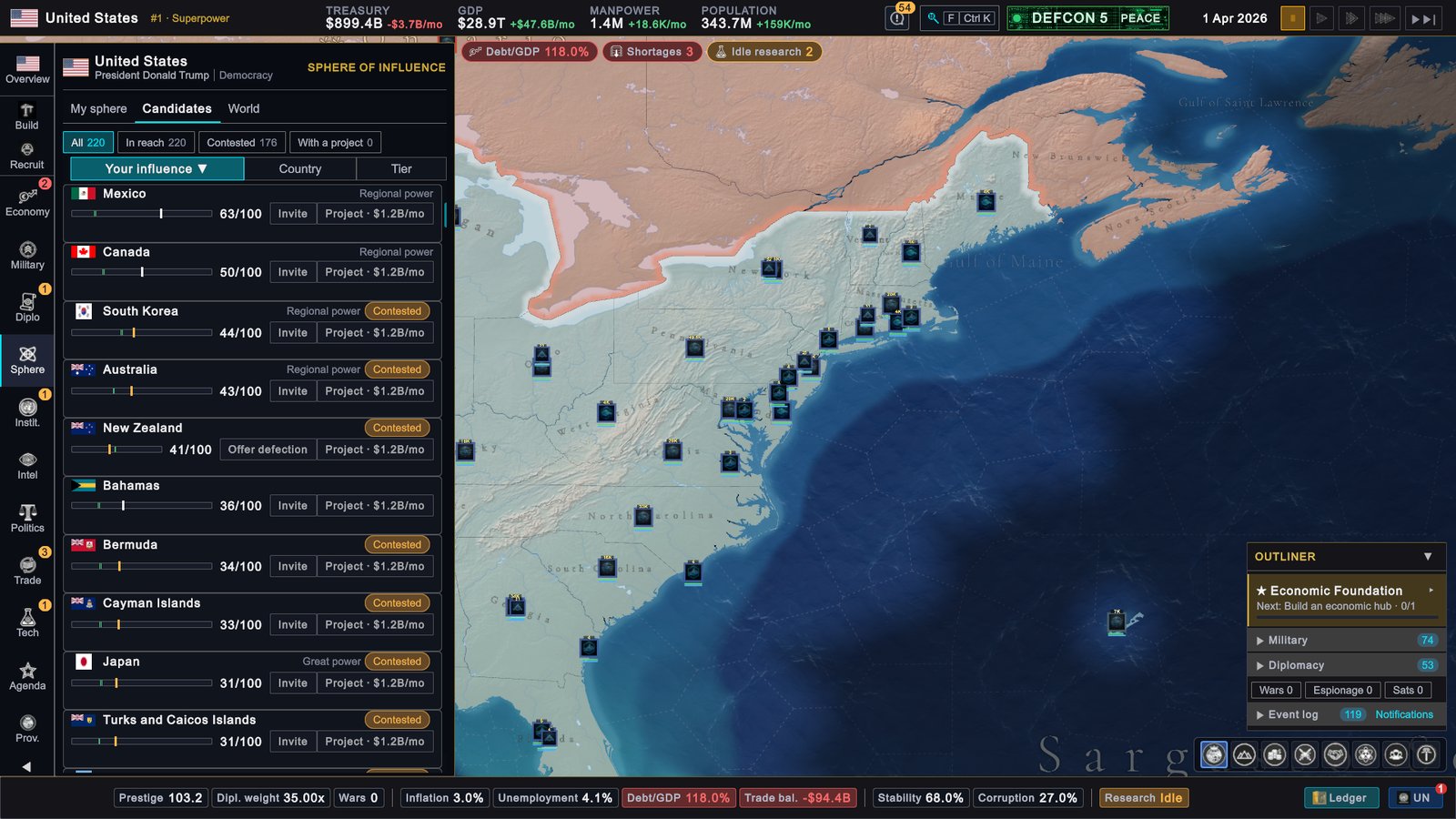
- Invite. You need a free slot, the country in reach, peace and no truce with it, influence of 35 or more, its relation toward you at 30 or more, and its score under 30% of yours. An AI country answers at once. The pill on its card predicts the answer (Likely accepts, Could go either way or Likely refuses) and its tooltip lists what counts for and against; your influence weighs most. A refusal costs no relations but blocks a new invitation for 360 days.
- Project. The button reads Project with its monthly cost. An influence project adds 2.6 points a month and uses a project slot. Each one costs 0.004% of your GDP a month, with a minimum of $2M, and stops by itself if the treasury cannot pay. The country must be in reach and under 30% of your score, but no minimum influence or relation is needed, so a project is the way to open a country where you have little. A project on another leader’s member gives that leader a Meddling in its sphere grudge of -20 toward you for as long as it runs.
- Offer defection. A member of another sphere shows this in place of Invite. It unlocks when your influence there has been 45 or more, and at least 15 ahead of its leader’s, for six months in a row. The member then weighs your offer against its loyalty to its leader. If it accepts, it pays the cost of leaving and joins you; the old leader is not asked.
A country with no tier can ask to join: Petition to join appears on each leader in World. The leader’s influence on you must be 20 or more.
Membership, leaving and release
A member gets the charter’s benefits and is shielded: other leaders cannot invite it, only offer a defection. Membership brings no duty in wars, trade or votes, but a member cannot lead a sphere or run projects. Under a Security charter the leader is asked to honour its guarantee when a member is attacked; refusing costs prestige and relations.
| Economic | Security | Political | |
|---|---|---|---|
| Opinion of the leader on leaving (fades over a year) | -25 | -35 | -30 |
| Leader’s influence on the country | -15 | -20 | -18 |
Leave sphere… on the Your leader card and Release… on a member’s card both apply these costs, and the country cannot rejoin that leader for 360 days. The game removes a member without penalty when the leader loses its tier, when the member grows past 40% of the leader’s score, or when the leader declares war on it. A member that declares war on its leader is removed and pays the leaving costs.
AI members review their place every month. A poor relation with the leader, a rival’s influence close to the leader’s and a distant ideology push them out; economic dependence on the leader holds them in.
Rival spheres
There is no automatic penalty between two leaders or between their members. Rivalry runs through influence: erosion, the Contested chip and defection offers.
The Sphere page, tab by tab
- My sphere. The header shows your tier and rank, then the tiles Slots, Influence projects and Charter. Below are Members, Influence projects, Charter and Requests. A member’s card shows its top rival and your influence. If you are a member yourself, the tab shows Your leader, What you get, What it costs and Rival influence.
- Candidates. Every other country as a card. Filters: All, In reach, Contested, With a project. It is unavailable without a power tier.
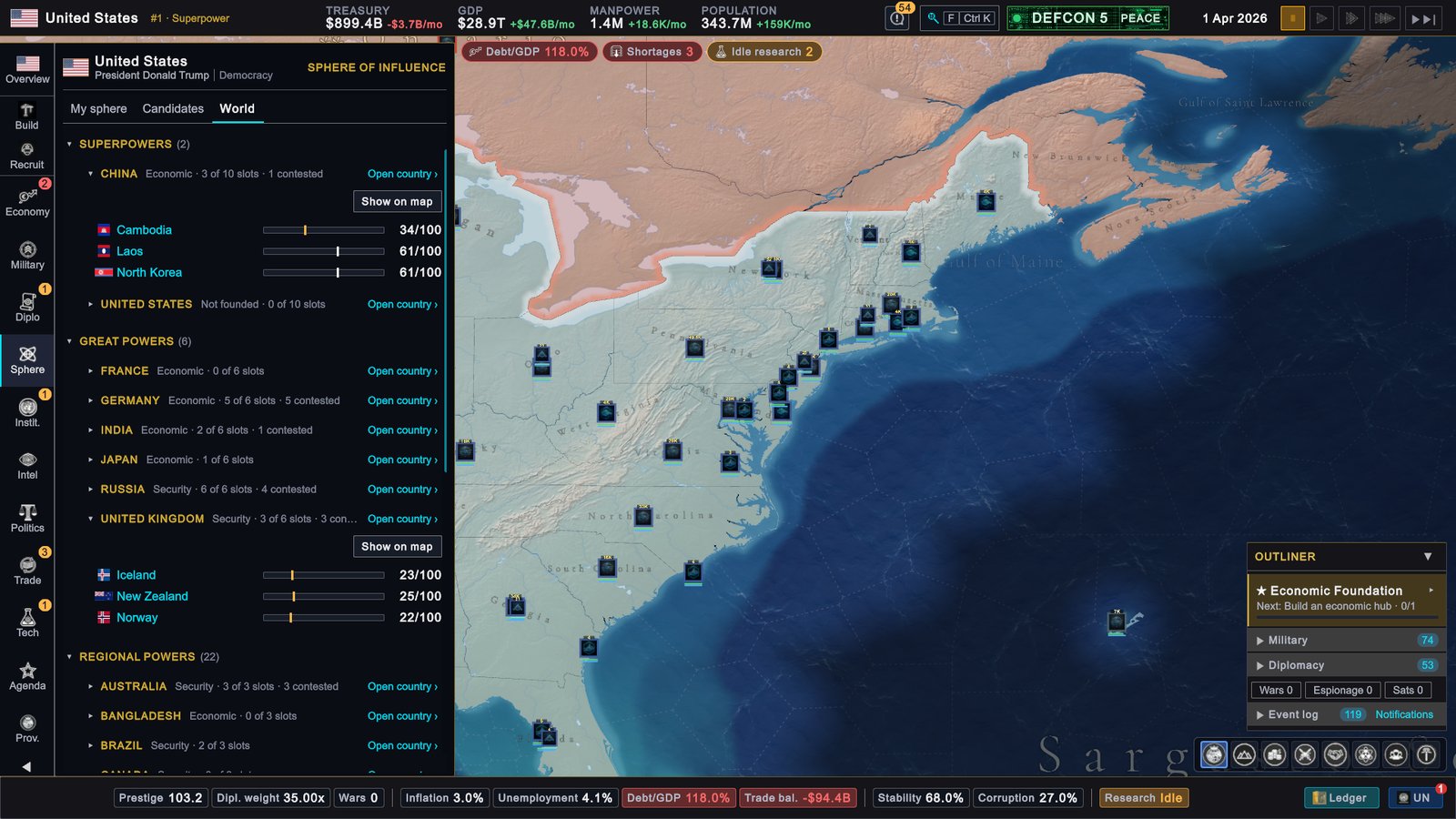
- World. Three folds, Superpowers, Great powers and Regional powers, listing every country with a tier, its charter and its members. Show on map frames a leader and its members.
What to do
- Pick the charter for the members you can reach. Economic suits trade partners, Security suits threatened countries, Political suits countries close to your ideology. The charter is fixed for two years.
- Build ties before inviting. A trade agreement, an embassy and good relations lift influence past 35 without a project. Use projects where you start with little.
- Check the pill before you invite. A refusal locks that country for a year.
- Watch the top rival on each member’s card. Once a rival holds 45 or more and leads you by 15, its six-month clock runs.