A war in Global Protocol is declared on one country, under a stated reason, and then spreads through alliances and guarantees. Before you commit, the game shows what the declaration will cost you with the rest of the world. Ending a war is covered in Peace and occupation.
Where to find it
- Declaring. Click a country on the map, open Relations on its card and press DECLARE WAR in the WAR & PEACE group. The button is disabled, with the reason shown, during a truce, against an ally, and against a country whose territory you have not explored.
- Your wars. Military › Wars (M opens Military by default) shows your war exhaustion and one card per active war. Click a card to open the war page in the right dock.
- Requests to join. A call to arms or a called guarantee opens as a window and also waits in Diplomacy › Inbox.
How it works
Reasons for war
Every war carries a casus belli: the reason the attacker gave. You pick it in the Declare War window, and it stays with the war until the peace.
| Reason | When you can pick it | What it changes |
|---|---|---|
| Territorial Claim | Any time | You may demand occupied provinces in the peace |
| Reconquest | Any time | You may demand occupied provinces in the peace |
| Ideological | Any time | Unlocks the Regime Change demand |
| Humiliation | Any time | The standard demands only |
| Honor Guarantee | The target is at war with a country you guarantee | The standard demands only |
| Coalition War | You are in a coalition against the target | The standard demands only; no diplomatic price |
A reason you cannot use is greyed out. The country you attack, and the partners that join to defend it, fight under Defensive. A mod’s story event can start a war under Story event.
The first four reasons need no preparation. What separates them is the peace: a side without a land reason can take provinces only after a decisive win.
The Declare War window
- CASUS BELLI. The list of reasons. DECLARE WAR stays disabled until you pick one.
- Enemy Allies. The countries that stand behind the target, each with its strength. When a collective defence organization would answer for the target, it appears as one row with its member count.
- Call Allies to War. Your allies, each with its chance of joining. Tick the ones you want to invite. Partners you have only through a collective defence organization are not listed, and neither is an ally that is also allied to the target.
- Force Comparison. Your side against theirs, with an Advantage or Disadvantage percentage.
- Price of this war. Appears once a reason is picked:
- Aggressive expansion, before and after. Declaring under any reason except Coalition War adds 10 points, scaled by your doctrines. Aggressive expansion is the alarm your conquests raise in other countries.
- Coalition line 100, and whether you stay below it, are close, or cross it. Above the line a coalition can form against you.
- Uninvolved countries think worse of you: 4 points of relations for a neutral, up to 8 for a close friend of the victim.
- UN. A forecast of the Security Council vote on a trade restriction against you, and who would veto it.
- Forces under allied command stationed in the target. They fight on its side while their own countries stay out of the war.
Coalition War shows “no aggressive expansion, no penalty with other countries”. If the target refused an ultimatum from you in the last 180 days, the header reads Justified by a refused ultimatum, and the aggressive expansion and the relations drop are halved for that one war.
Confirming also acts between the two of you: a guarantee is revoked, a non-aggression pact ends, embassies are suspended, and your trade agreement and supply contracts are suspended until the peace.
Who joins
- The defender’s allies are called at once. Countries tied to the defender by a military or mutual-defence alliance each decide from their relations with it. The Defense Pact treaty is a separate agreement and calls nobody. An ally that is also allied to the attacker stays out without blame. An ally that refuses loses prestige, and the country that called it thinks 40 points worse of it.
- Collective defence organizations take up an attack on a member as a decision of the organization. They do not answer when a member is the attacker.
- Guarantors of the defender must honour the guarantee or break it.
- Your allies join only if you ticked them, and each still decides by the chance shown.
- Coalitions do not attack at once. A coalition waits until its combined strength exceeds the target and the target’s allies, then all its members declare one war together.
When you are the ally, a CALL TO ARMS window names the attacker and the reason. HONOR ALLIANCE puts you in the war. REFUSE breaks the alliance and costs prestige and relations with that ally. You have 12 days to answer. A called guarantee offers HONOR GUARANTEE or BREAK GUARANTEE.
Each country in a war is Primary (one of the two the war began between) or Allied (a partner that joined). The difference matters when you make peace.
War score
War score runs from −100 to +100, shown from your side: your enemy sees the same number with the opposite sign. Each side earns points, and your score is your points minus theirs.
| What earns points | Up to |
|---|---|
| Battles won | 40 |
| Enemy provinces you occupy (full value after the first 60 days) | 40 |
| Outweighing the enemy side in strength (full value at three to one) | 15 |
| The enemy’s war exhaustion | 15 |
| Occupying every enemy province | 10 more |
If you hold ground but have fought almost no battles, the war page shows Score limited — low engagement and your points from occupation and strength count for less, down to about a third. An enemy that can no longer resist is exempt.
The status pill follows the score: Early War for the first 30 days whatever the number, then Stalemate, Winning from +25, Decisive from +60, Losing and Collapsing on the negative side, and Total victory once you hold every enemy province.
War exhaustion
War exhaustion is one percentage for your whole country, across all your wars. It grows every day you are at war: 2 points a month as a base, plus more for the battles you fight, lost battles most of all. That battle part counts up to three times as much when your enemies outweigh you and half as much when you outweigh them. Having your own provinces occupied adds up to 1.5 points a month, and a blockaded coast up to 1 more.
High exhaustion slows your GDP growth (by up to 4 points a year at 100%), pulls your stability target down by up to 20 points, pushes corruption up, and feeds your enemy’s war score. Every peace deal halves the exhaustion of both signers; once you are at peace it falls by 2 points a month.
When an AI country is attacked
Its allies and guarantors are called the same day, and a war of aggression against a UN member goes to the Security Council the day after. The country then fights until the pressure on it outweighs its will to continue, which is the judgement the peace view shows you. It can also send you a peace offer of its own.
The Wars tab and the war page
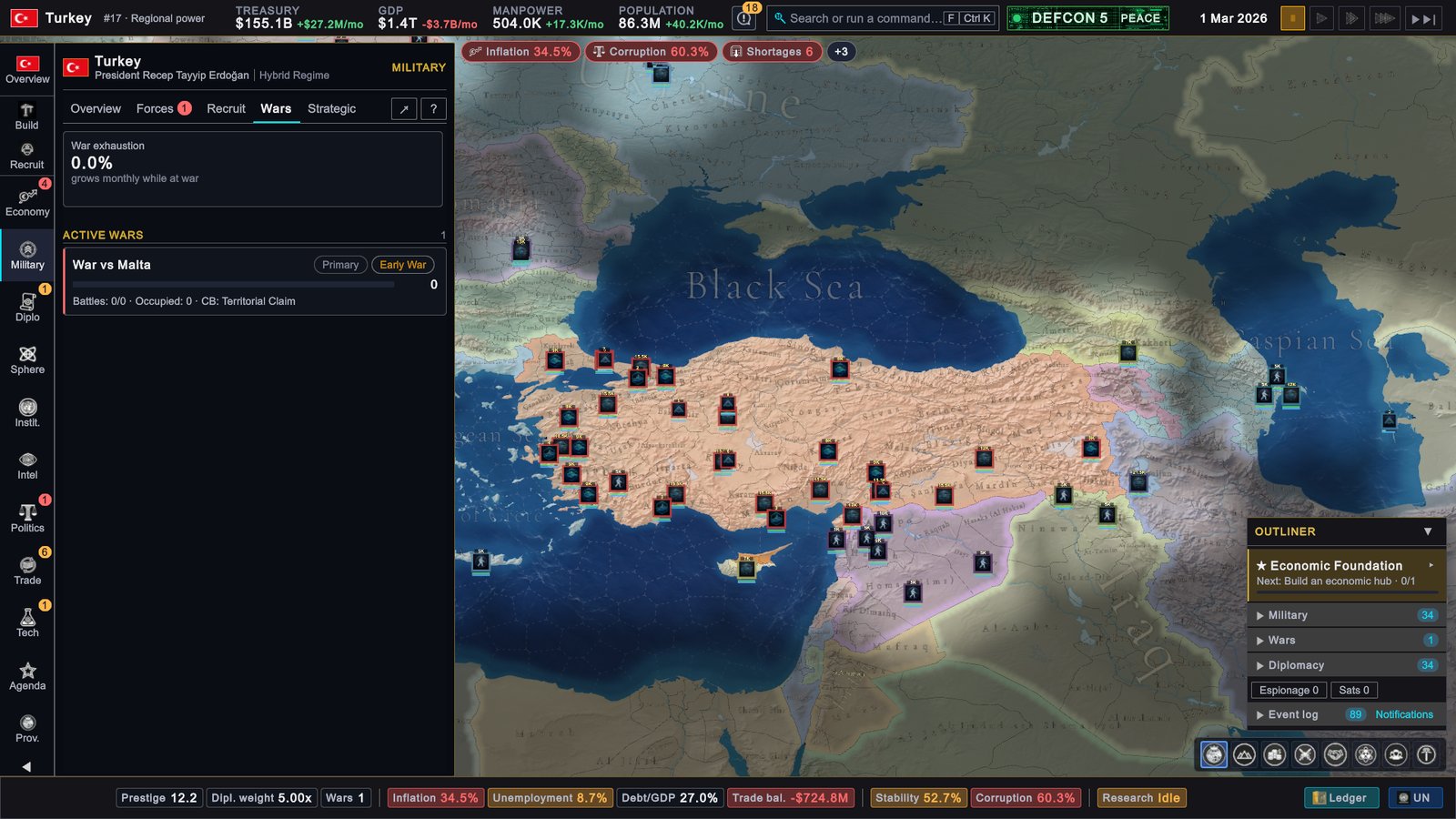
Each war card shows your role, the status pill, the score bar, battles won out of battles fought, provinces occupied, the reason, and the share of each side’s coast under blockade.
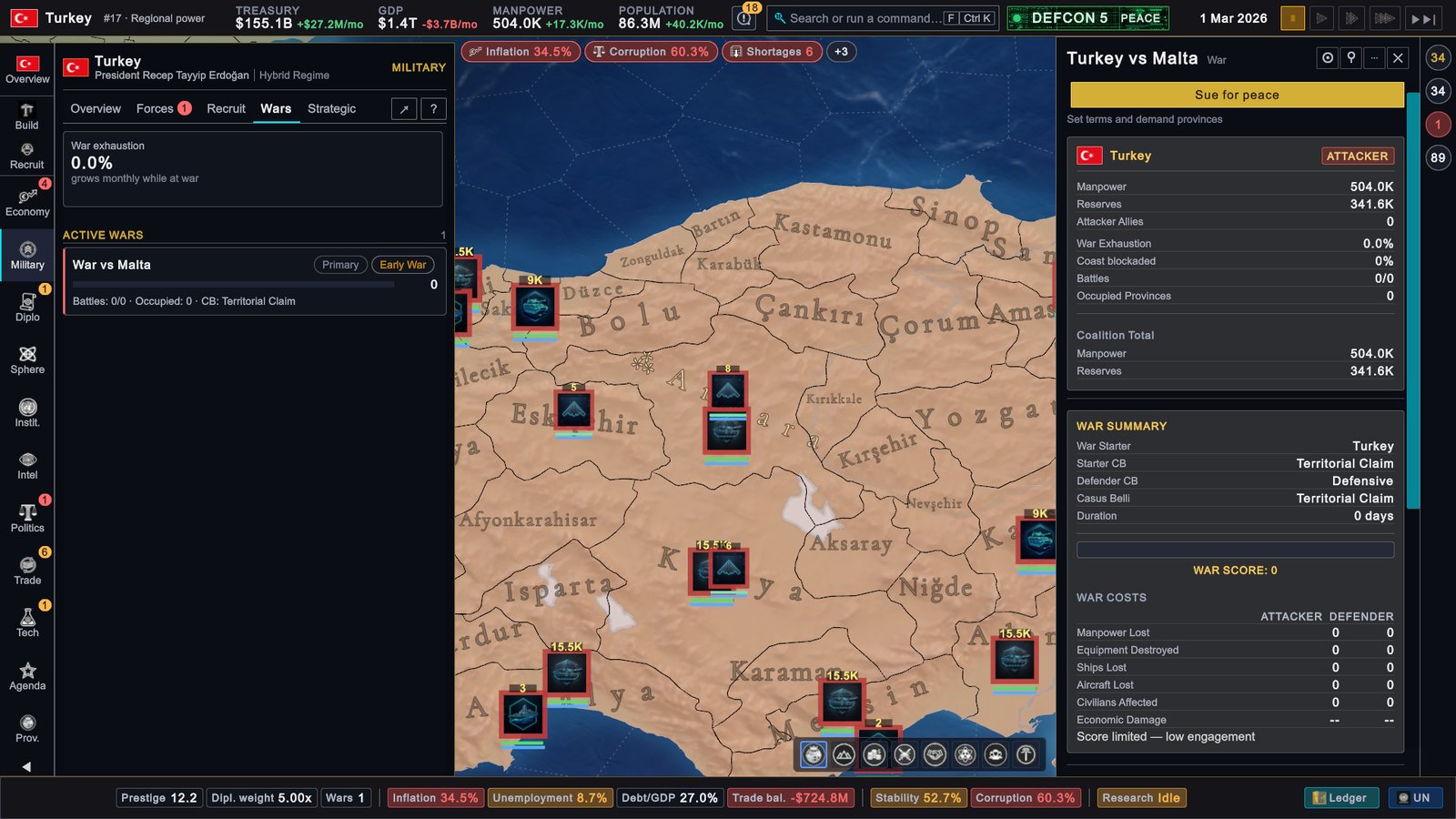
The war page adds each side’s reason, the duration, a WAR COSTS table, a card per country, the current battles and sieges, and the provinces that have changed hands. Sue for peace at the top opens the peace view.
What to do
- Pick the reason for the peace you want. Land needs Territorial Claim or Reconquest; a change of government needs Ideological.
- Send an ultimatum first if you can afford the delay. A refusal halves the price of the war that follows.
- Watch the coalition line. Each declaration and each province taken adds aggressive expansion.
- Fight early. Occupation counts fully only after two months and is limited without battles.
- Keep wars short and few. Exhaustion is shared by all your wars and costs growth and stability.