Missiles hit a province from far away without moving a single unit. Conventional missiles wear down buildings, infrastructure and armies. The same conventional stock is also your missile defence, because your batteries fire those missiles as interceptors. Nuclear missiles are built, based and launched through the same screens; what they do on arrival is covered in Nuclear weapons and DEFCON.
Where to find it
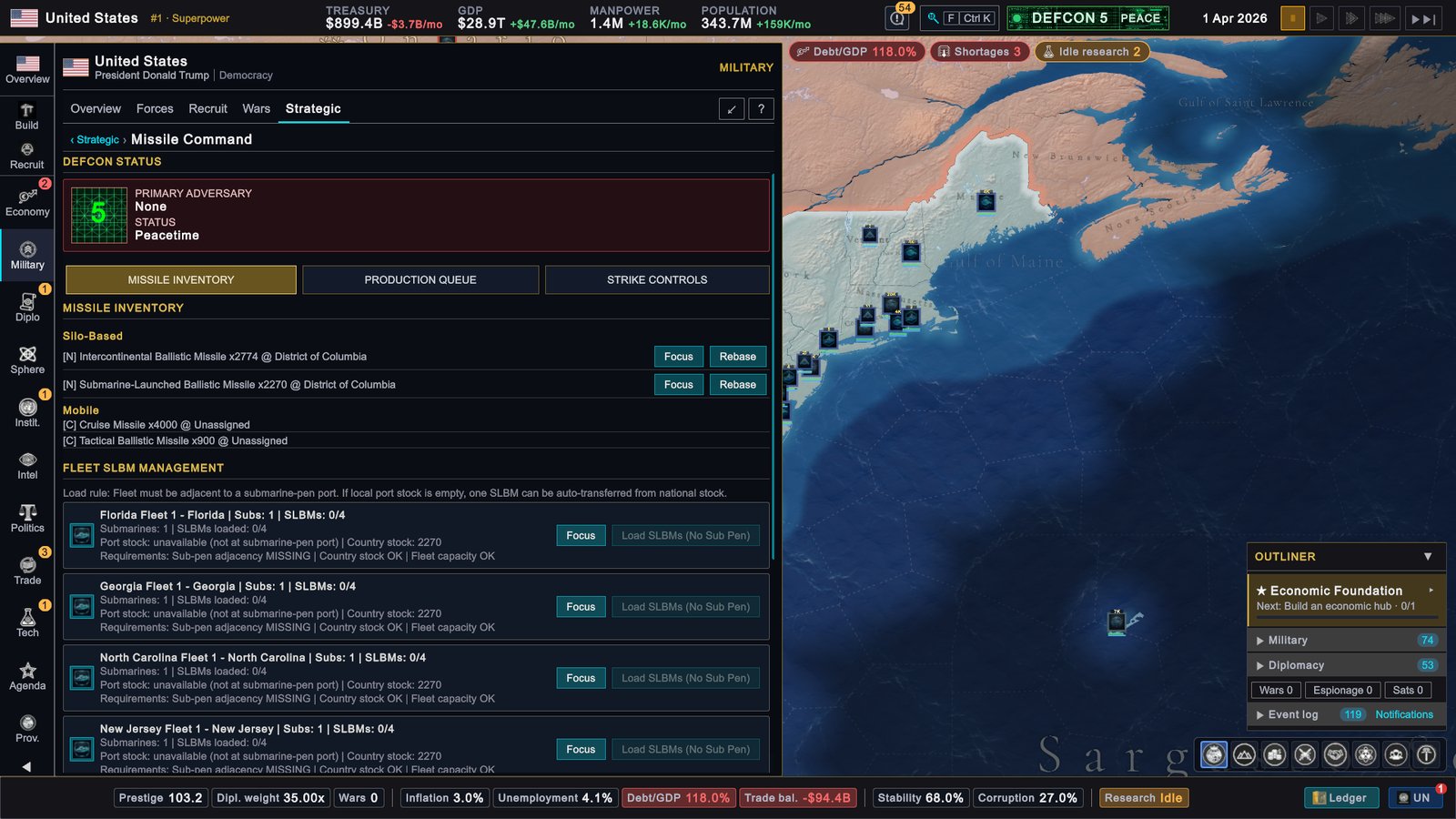
- Military › Strategic shows your stock under Missile inventory and your defences under MISSILE DEFENSE. Military opens with M by default.
- Missile Command › on that tab opens Missile Command. Clicking the DEFCON indicator in the top bar opens it too.
- Missile Command has three tabs: MISSILE INVENTORY, PRODUCTION QUEUE and STRIKE CONTROLS.
- A fleet with submarines has Load missiles and Launch missiles on its unit bar.
How it works
The missile types
| Missile | Warhead | Based on | Research needed |
|---|---|---|---|
| Short-Range Ballistic Missile | Nuclear | Mobile launcher | Military Tier 2 |
| Medium-Range Ballistic Missile | Nuclear | Mobile launcher | Military Tier 2 |
| Intermediate-Range Ballistic Missile | Nuclear | Silo | Military Tier 2 |
| Intercontinental Ballistic Missile | Nuclear | Silo | Military Tier 4 |
| Submarine-Launched Ballistic Missile | Nuclear | Submarine | Military Tier 3 |
| Cruise Missile | Conventional | Mobile launcher | Military Tier 2 |
| Tactical Ballistic Missile | Conventional | Mobile launcher | Military Tier 2 |
From short-range to intercontinental, each ballistic type reaches further, is harder to shoot down, costs more and takes longer to build. The submarine-launched missile is the hardest of all to intercept and reaches almost as far as the intercontinental one. Of the two conventional types, the Cruise Missile reaches further and the Tactical Ballistic Missile hits harder. Ranges and build times are in the Missiles reference; the tiers are unlocked in the Knowledge Network.
Building and basing
Some countries start with a stock of conventional missiles, held in a national pool that the inventory lists as Unassigned. To add more, open PRODUCTION QUEUE:
- Pick the Missile Type and Warhead, then a Destination (from the list or with Select on Map), and press Queue Production. The type list shows only what your research has unlocked.
- One order builds one missile. It is paid from the treasury when you queue it, and progress is counted in months. Cancelling an order gives no refund.
- The destination must be a province you control with a free slot of the right kind:
| Building | What it gives |
|---|---|
| Mobile Launcher Facility | Slots for mobile missiles |
| Missile Silo Complex | Slots for silo missiles |
| Submarine Pen | A home port for submarine missiles, and the place where submarines load |
On the MISSILE INVENTORY tab, Rebase moves one missile to another province you control that has a free slot. The move is instant and free. Missiles based in a province you no longer control cannot be fired.
Submarines
Each submarine carries four missiles: Submarine-Launched Ballistic Missiles or either conventional type. To load, stop the fleet in the sea zone next to a province with a Submarine Pen and press Load missiles on its unit bar, or use Load SLBMs under FLEET SLBM MANAGEMENT in Missile Command. To fire, select the fleet, press Launch missiles and pick the target. Range is measured from the sea zone the fleet is in, which is the point of putting missiles to sea.
Launching a strike
-
Open STRIKE CONTROLS and choose Conventional or Nuclear. The Nuclear side opens only at DEFCON 3 or lower.
-
Pick the missile and its source. Missile lists what you hold, with the count and range. Source is Auto (nearest) or one province that holds missiles.
-
Enter targeting. Choose Target on Map (or Launch Strike) puts the map into targeting mode. A pill at the top of the map shows the Salvo size: change it with the minus and plus buttons (Shift-click steps by 10) or Max.
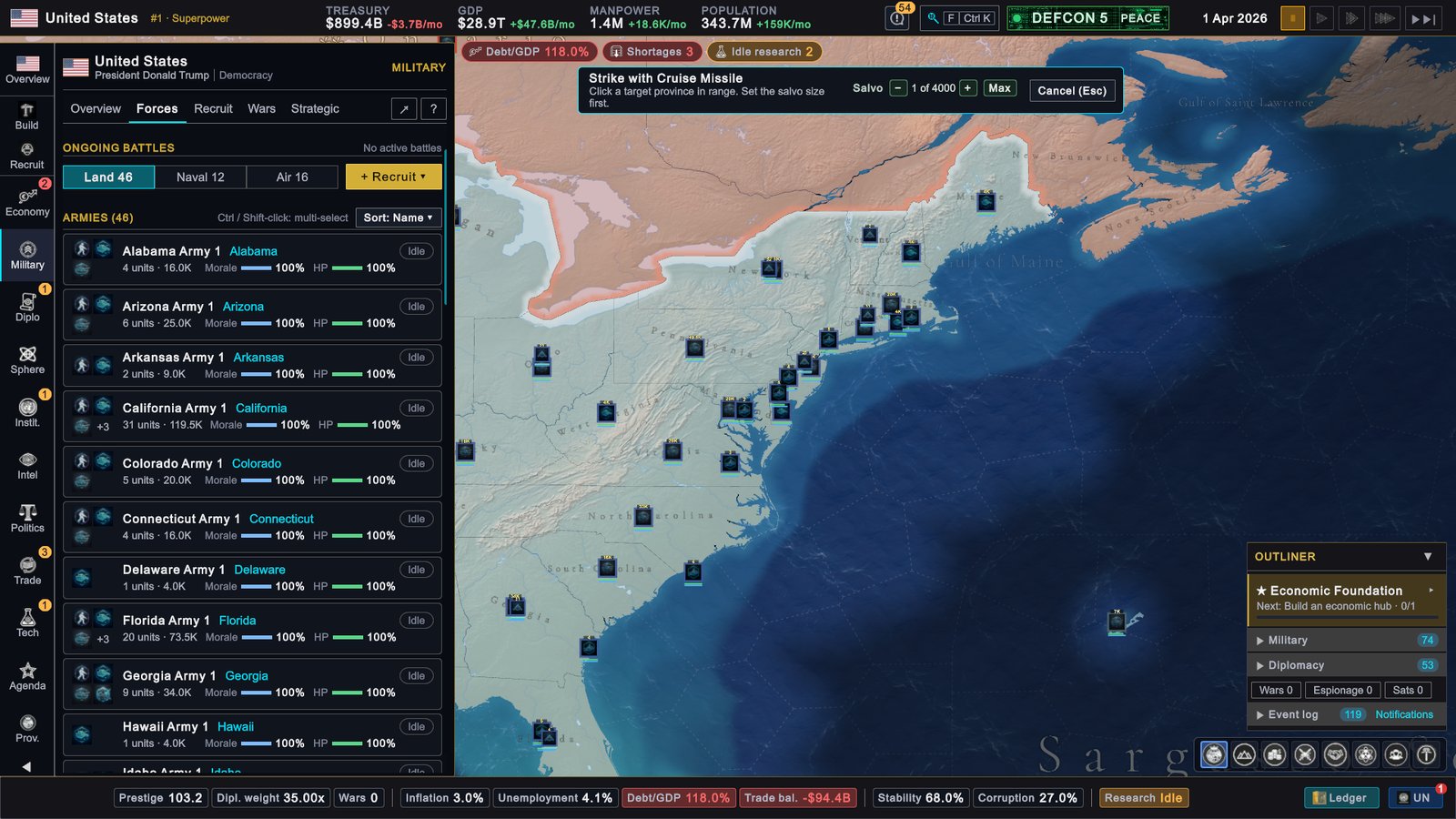
United States, 1 April 2026: targeting a strike. The pill at the top holds the salvo size. -
Left-click the target province. The strike is ordered at once: there is no confirmation step. A target that is refused keeps you in targeting mode with the reason in a toast, and Cancel (Esc) leaves without firing.
The rules for a target:
- Its owner must be a country you are at war with, and it cannot be your own province.
- It must be in range. Range is counted in provinces in a straight line from the launch site. Conventional missiles from the national pool can launch from any province you control, so the nearest one counts. Research can extend missile range.
- If only part of a salvo can reach, that part flies and the rest stays in stock.
Flight and arrival
A missile takes about one day per province of distance and lands the day after launch at the earliest. The map draws its flight. A missile in the air cannot be recalled. You get a toast when your strike hits or is met by defences, and the target gets an Incoming missiles warning.
Missile defence
Only Missile Defense Batteries shoot missiles down. A battery needs Military Tier 4 research and an Early Warning Radar needs Military Tier 3; some countries start with batteries already in place.
- Reach. A battery protects targets within about one province of itself, and only its owner’s provinces. A battery in an occupied province defends no one.
- Fire channels. A level-1 battery can engage six incoming missiles a day. The Strategic tab sums these as Intercept slots. Missiles beyond what the batteries in range can engage that day get through untouched.
- Interceptors. Each engagement fires two interceptors, and every interceptor is one conventional missile taken from your stock (Tactical Ballistic Missiles first, then Cruise Missiles). With none left, the batteries do not fire. The Strategic tab shows the count as Interceptors.
- Odds. Each shot starts from a 60% chance, lowered by how hard the incoming type is to intercept. Missile-defence research raises it, and so does every Early Warning Radar you own anywhere in the country: 10 points each, up to 30. No shot is better than 95%.
- One chance. Each missile is engaged once, on the day before it lands.
Military › Strategic turns this into estimates for a strike on your capital: the kill chance for one engagement and the share shot down for 1, 5, 10 and 20 missiles. The estimates are for an intercontinental missile: shorter-range missiles are easier to stop than the figures show, and submarine-launched ones are harder.
What a conventional strike does
Each conventional missile that lands does three things in the target province:
- It removes a share of the province’s infrastructure.
- It picks one building and may hit it. A level-1 building that is hit is destroyed; a higher-level one drops a level.
- It damages every army there except your own. Regiments worn down to nothing are destroyed.
There is no population loss and no radiation.
What to do
- Treat conventional stock as one magazine. Every missile you fire at the enemy is an interceptor you no longer have. Before a war with a missile-armed country, check Interceptors on the Strategic tab and keep production running.
- Put batteries where the targets are. A battery covers its own neighbourhood only. Start with the capital, then your silo provinces and biggest cities. Add a few Early Warning Radars; they help every battery at once.
- Saturate, or do not bother. A defended province stops small salvos. Raise the Salvo past what its batteries can engage in a day, or pick a target outside battery reach.
- Aim for effect. Strike the province an army is standing in before you attack it, or the province whose buildings you want gone. One missile is one building roll.
- Spread your arsenal. Rebase missiles so that losing one province does not take most of your stock out of play.
- Use submarines for reach. A loaded submarine fleet off the enemy coast brings Cruise and Tactical Ballistic Missiles within range of targets your land provinces cannot reach.