Hello, world leaders.
Update 0.6.0, Conquest & Clauses, is almost here. It changes how wars end. Land now costs what it is worth, and it gets cheaper the longer you hold it. A small country can be taken whole; a large one only a slice at a time. A country whose enemies hold a valuable enough part of its land for three months gives in. And a peace can bring payments, deliveries of goods or a Subject Agreement instead of new borders.
It is also a turning point in how we build the game. At the end of this post you’ll find what comes next, and why the next updates put stability first.
Every screenshot below comes from the 0.6.0 build that is about to ship. To show these moments without fighting a two-year war for each one, our test tools set up the wars, the occupied land and the sample agreements. Everything you see on screen is the game’s own.
Wars that end
Until now, a won war could take almost anything, almost at once. In 0.6.0, land has a price and a clock.
What land is worth, and how long you have held it
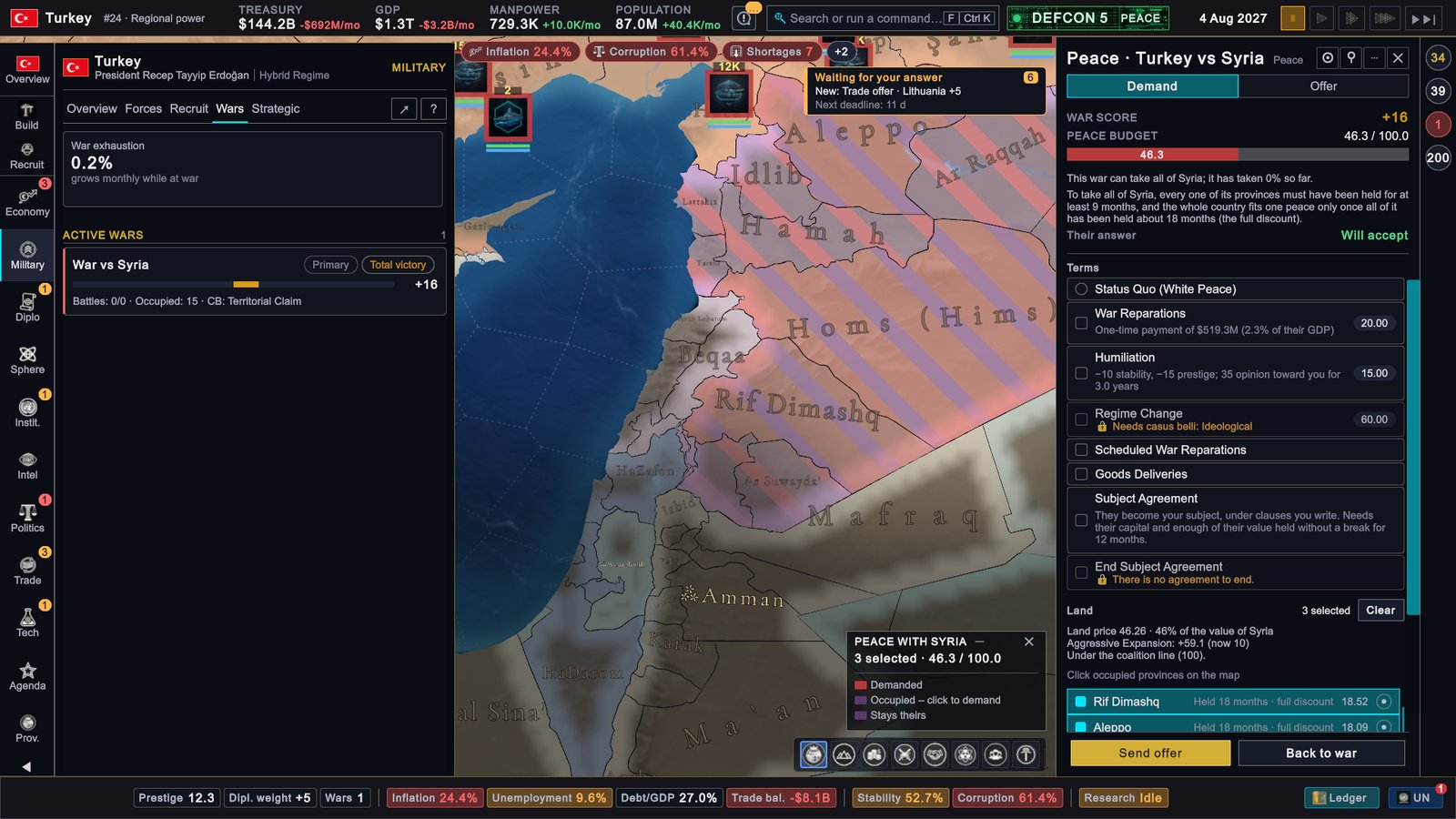
Each province’s base price is its share of its country’s value: population (40%), economy (40%) and area (20%), with the capital counting one and a half times. Land you have only just occupied costs about five times its base price. After a month’s grace it gets cheaper every month. After 18 months held, the occupation surcharge is gone and the province costs its base price. The peace view shows each province’s months held and its discount.
One war can only take so much
A small country can be taken whole, once every one of its provinces has been held for at least nine months. A bigger country can only lose part of itself in one war, and the bigger it is, the smaller that part. The peace view tells you how much of the country this war can take and how much it has taken so far. Every separate peace in the same war counts against that cap.
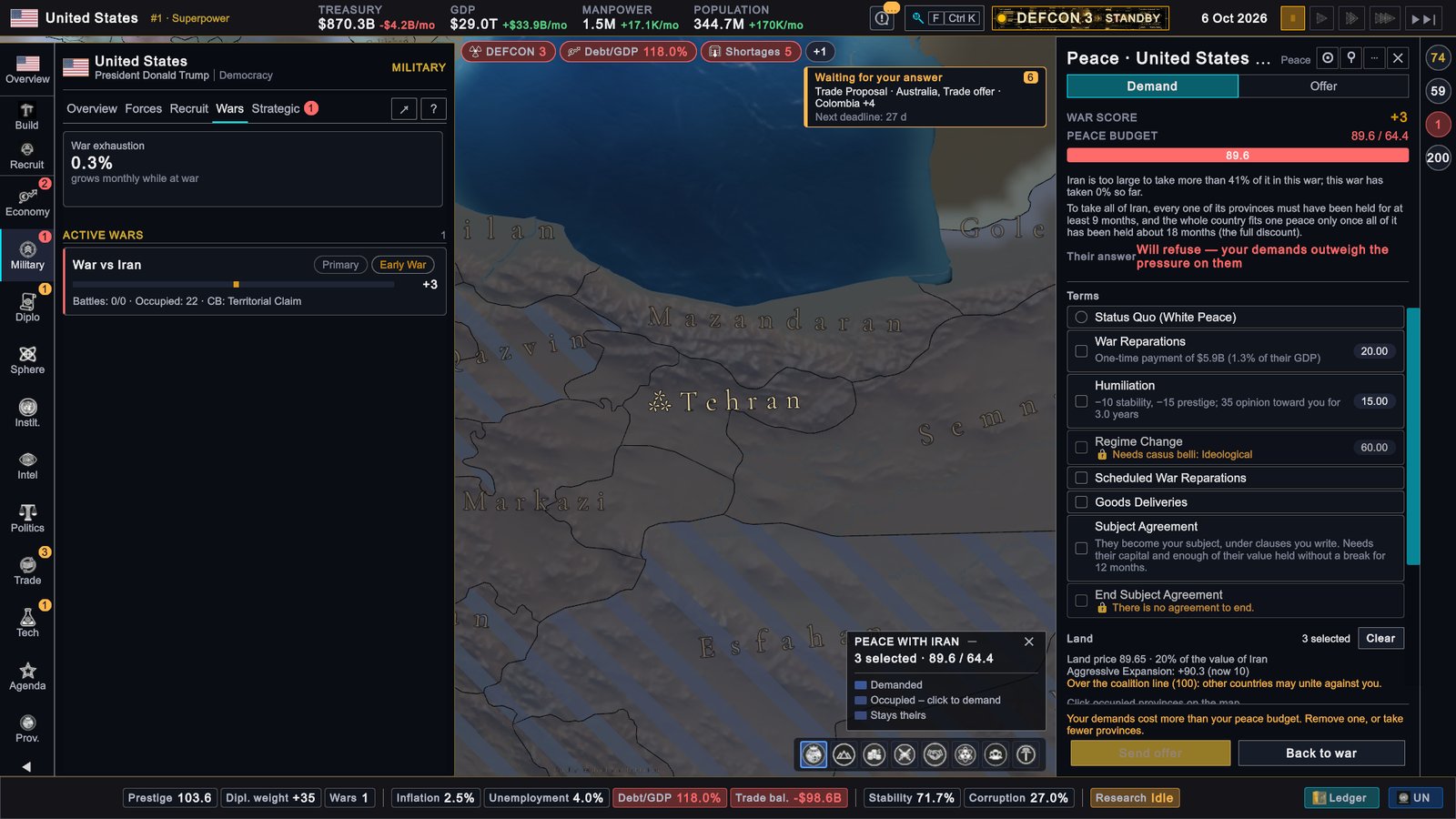
Taking land also alarms the world. Aggressive expansion now counts the land’s full value, not its discounted price. The victim’s neighbours and allies feel it one and a half times as much, and its sphere leader twice as much. Land annexed in a peace starts with resistance that fades over five years: until it settles, it produces less and stays restless.
Capitulation, pockets and the Occupy area order
A country whose enemies hold enough of its value for three months in a row capitulates; it is measured once a month, and a month below the line starts the count again. The line it must cross rises with its size, and with a calm government, allies still fighting and a nuclear force that can strike back. Its land armies stand down and half their manpower goes home. It can’t recruit land units or order missile strikes, and the rest of its land is yours to take by occupation. If the share you hold falls back far enough, the capitulation lifts. A capitulated AI country accepts terms within the war’s cap, but a human player is never signed into a peace: in single player and multiplayer alike, you can refuse every offer, and a Subject Agreement needs your acceptance.
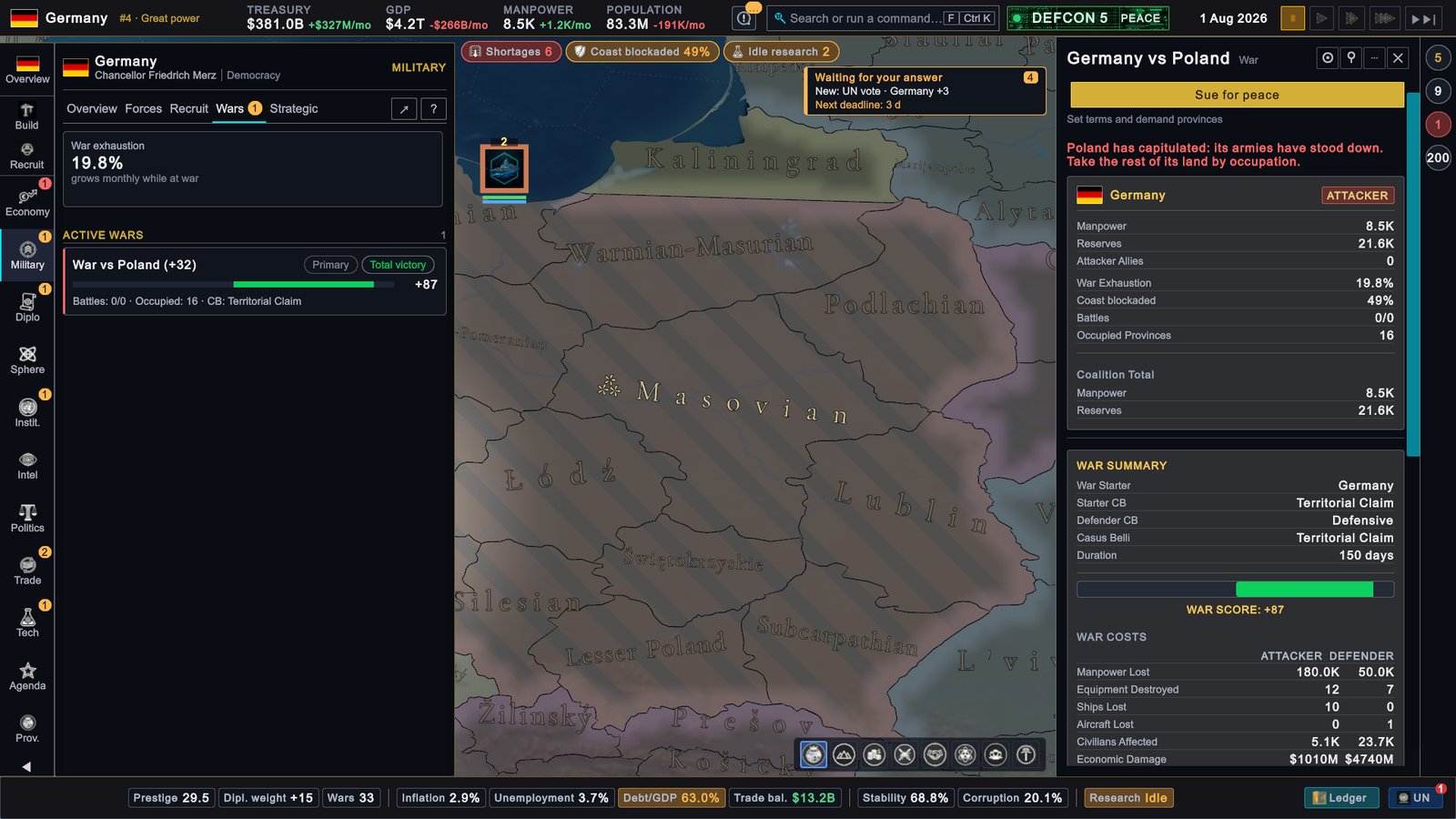
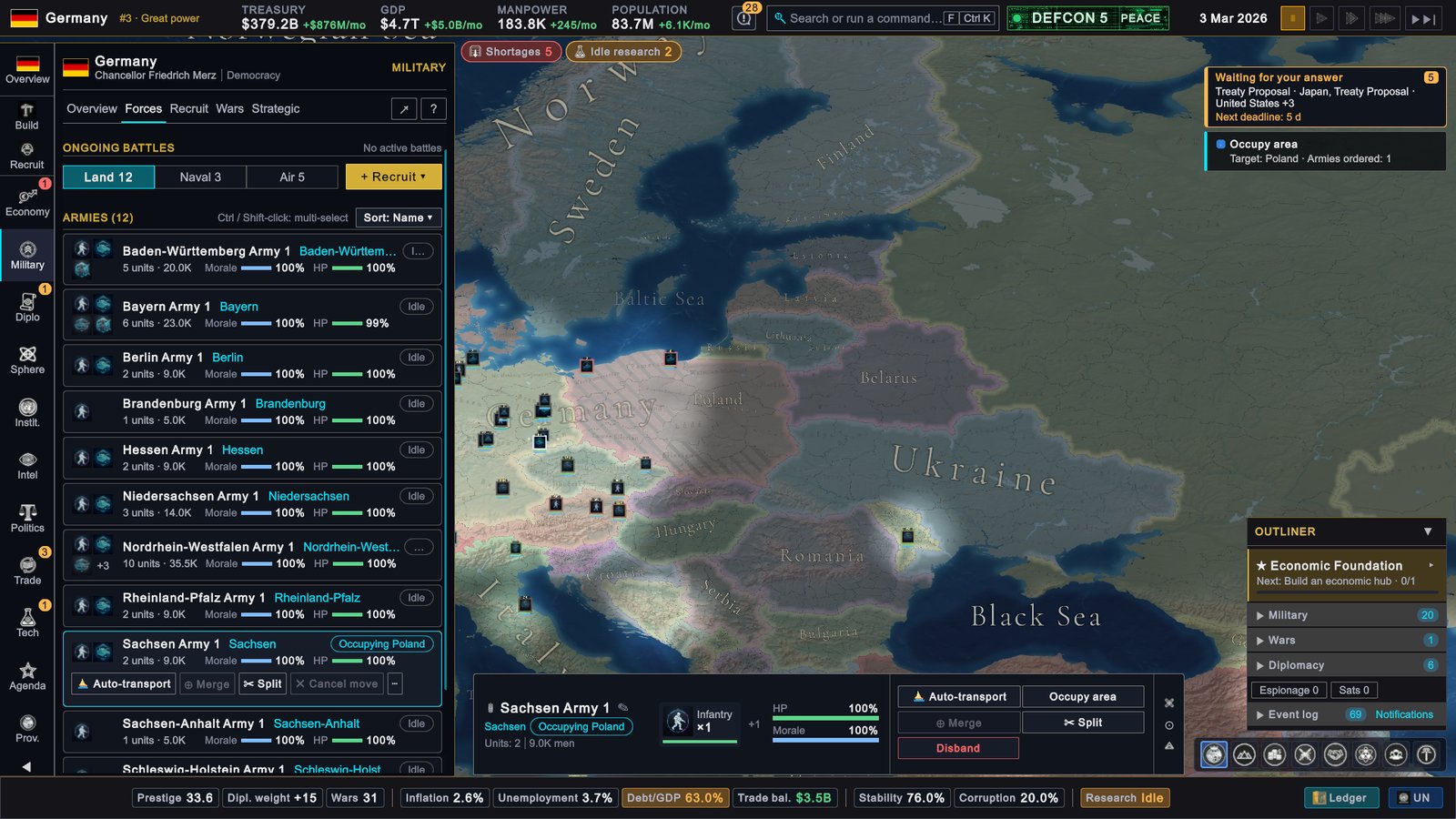
A part of a country that is cut off from the rest, with no army to defend it, surrenders to the occupier on its border after 30 days. The capital’s part, islands and exclaves are the exceptions. And the new Occupy area order sends the armies you select across a country you name, province by province.
Payments instead of borders
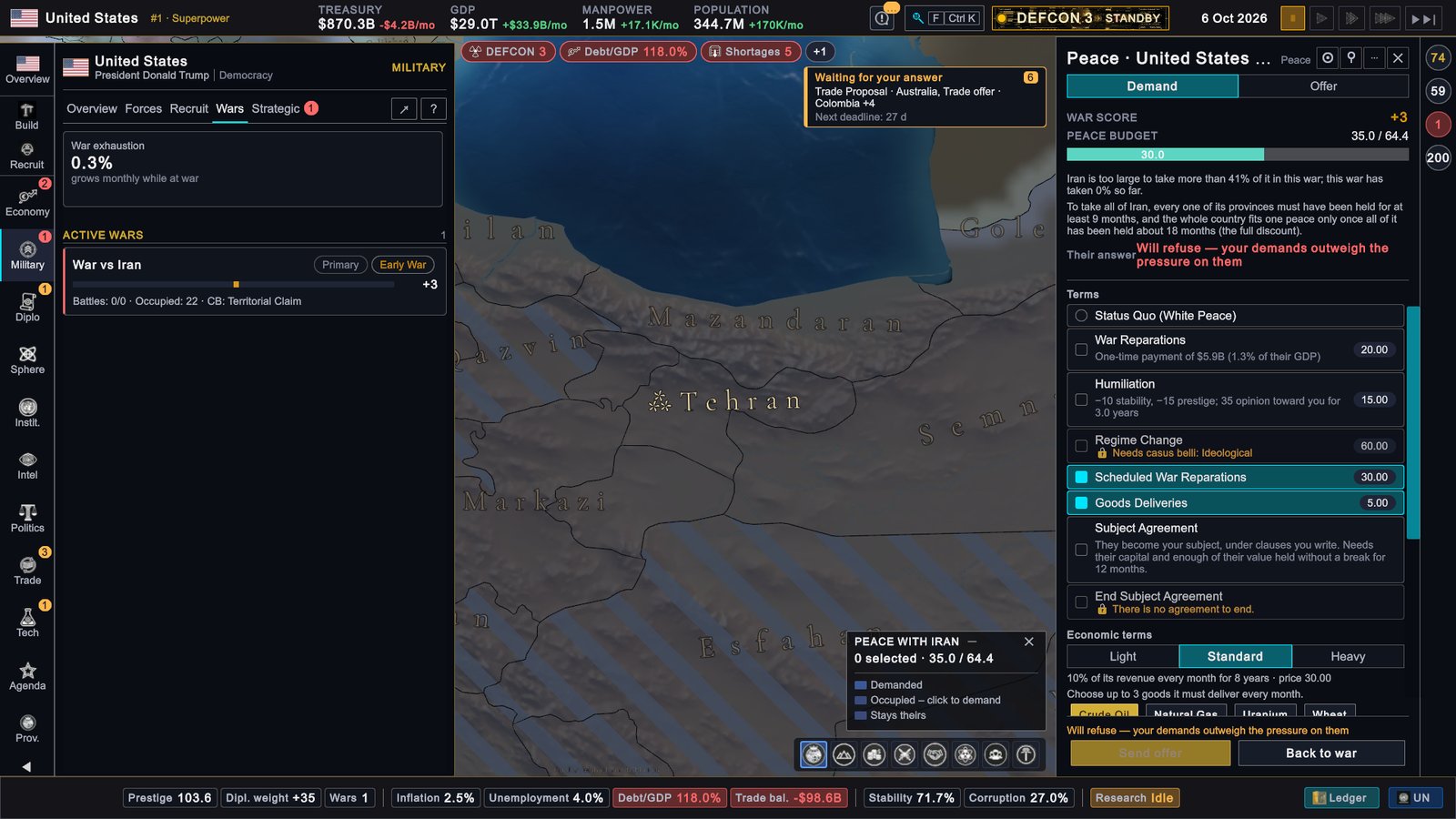
Not every war has to end with new borders. There are two new peace terms:
- Scheduled war reparations: a share of the loser’s monthly revenue. Light is 5% for 5 years, Standard 10% for 8 years, and Heavy 15% for 10 years.
- Goods deliveries: up to three goods. Each month the loser delivers a quarter of its surplus of each one, at a quarter of the world price, for five years.
Missed payments pile up as arrears. A payer who walks away with Repudiate defaults: the truce ends and the other side gains a reason for war. The receiver can Forgive the rest instead. And when you are the one losing, switch the peace view from Demand to Offer to concede land the enemy holds, reparations or a humiliation, and see the answer before you send it.
The AI plays by the same rules. AI winners pick a war aim: a clearly weaker small country whole, a bigger one in slices, now and then the loser as a subject, or payments when the loser has nuclear weapons. They wait for held land to get cheaper before they sue for peace, and after about four years of war they settle for what they can get.
Subject States
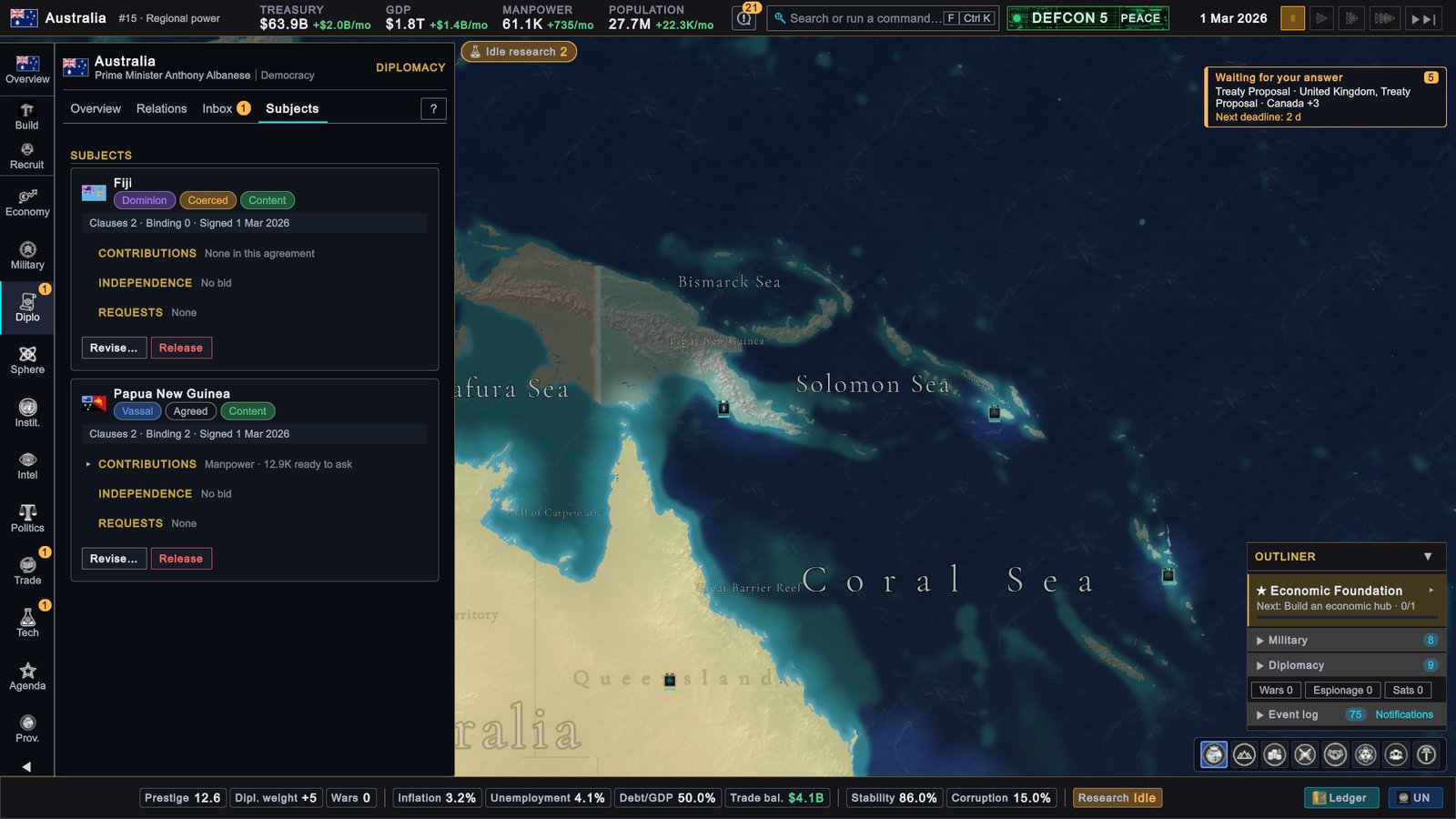
This is the biggest new system in 0.6.0. A Subject Agreement binds one country to another through clauses in five areas: foreign policy, military, economy, domestic politics and security. The clauses that bind decide what the relationship is: a Dominion, a Vassal or a Comprehensive Central Authority.
Built clause by clause
One clause editor serves every way an agreement can begin: revising your own, proposing a new one, answering an offer with a counter-proposal, or writing the terms of a peace. Tick a clause and the editor tells you what it does and what the relationship would become.
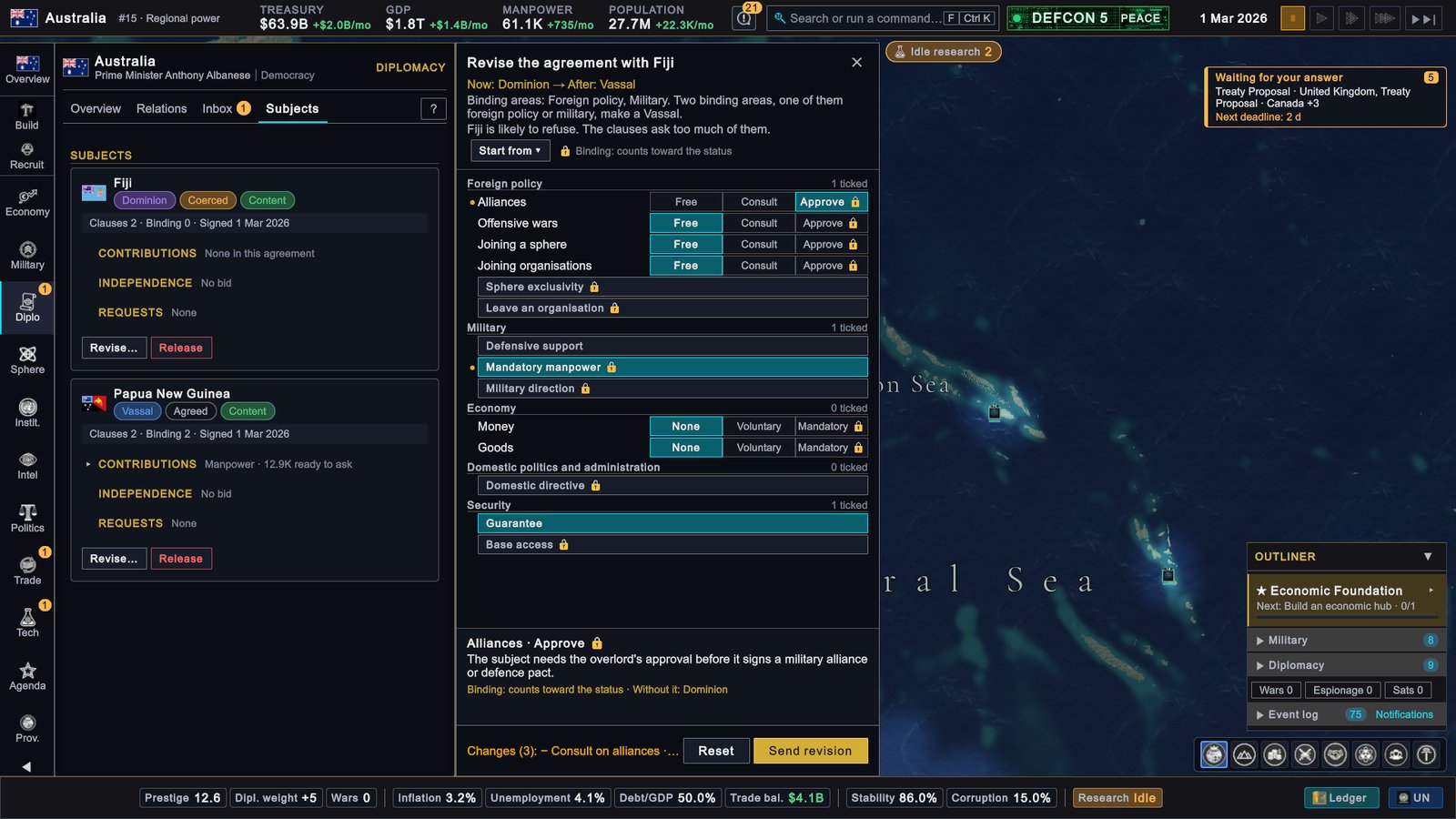
An agreement can begin in peacetime. A Dominion needs the country in your sphere and enough leverage over it overall (economy, trade and military count together, and the page shows each part), and the other country still has to accept. Or it can be imposed in a peace, as a Dominion or a Vassal, once you have held the loser’s capital and enough of its land for 12 months. Imposing one alarms the world too: it adds aggressive expansion, though always less than annexing the whole country. A proposal that gets no answer lapses after 30 days.
What an overlord can ask for
Depending on the clauses, an overlord can ask for:
- Contributions of money, goods or manpower, drawn in two stages over an eight-year cycle;
- Approval before the subject joins an alliance, signs a treaty, starts an offensive war, or joins a sphere, an organisation or a trade bloc. Anything that needs approval is greyed out, with the reason;
- Calls to war, base access and guarantees;
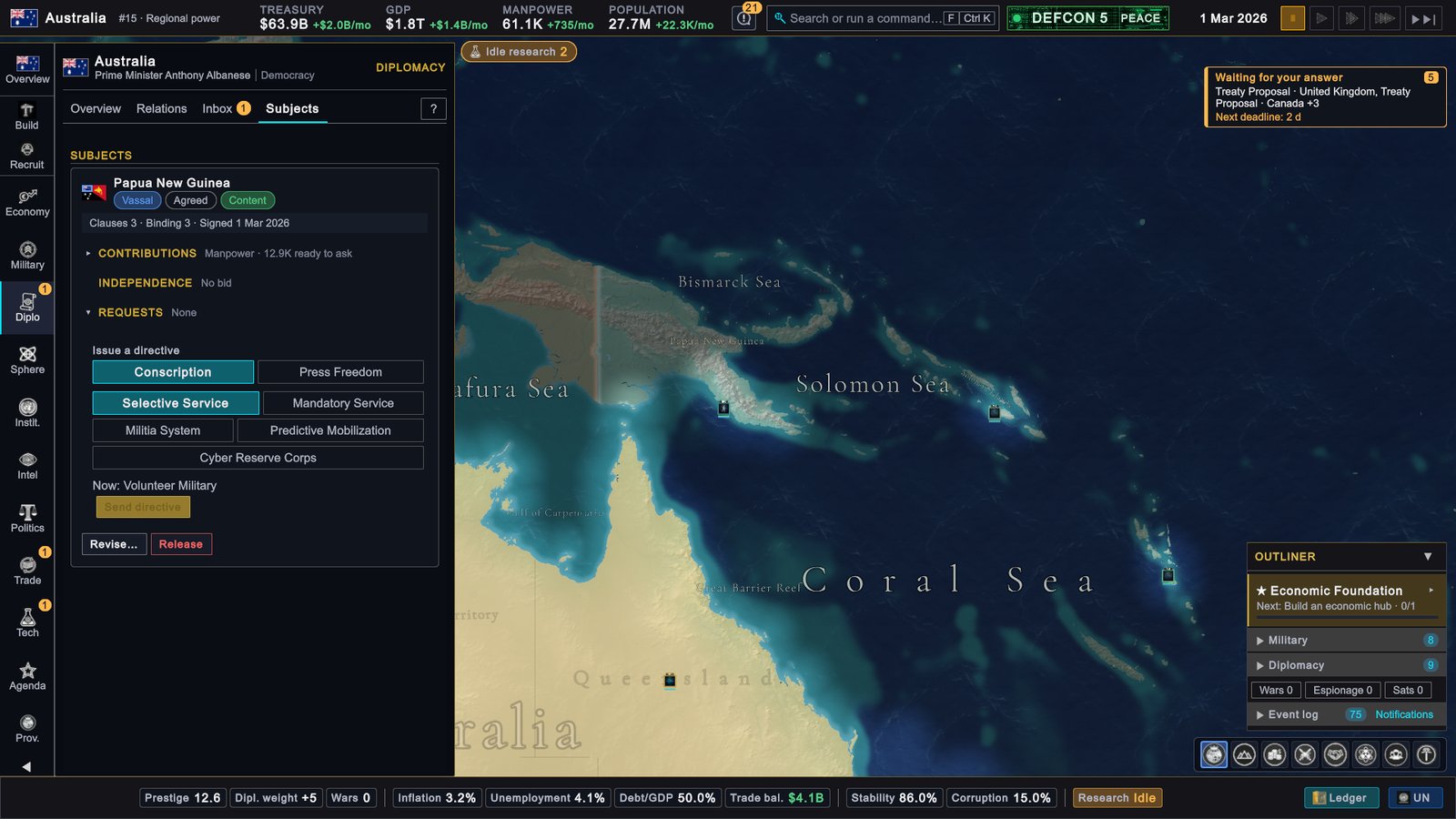
- Directives: a change to one of the subject’s laws, in the areas the agreement covers. The overlord pays for the change. The subject takes it through its own law process. A deliberate refusal is a breach of the agreement; a law its own parliament votes down is not.
What a subject can do
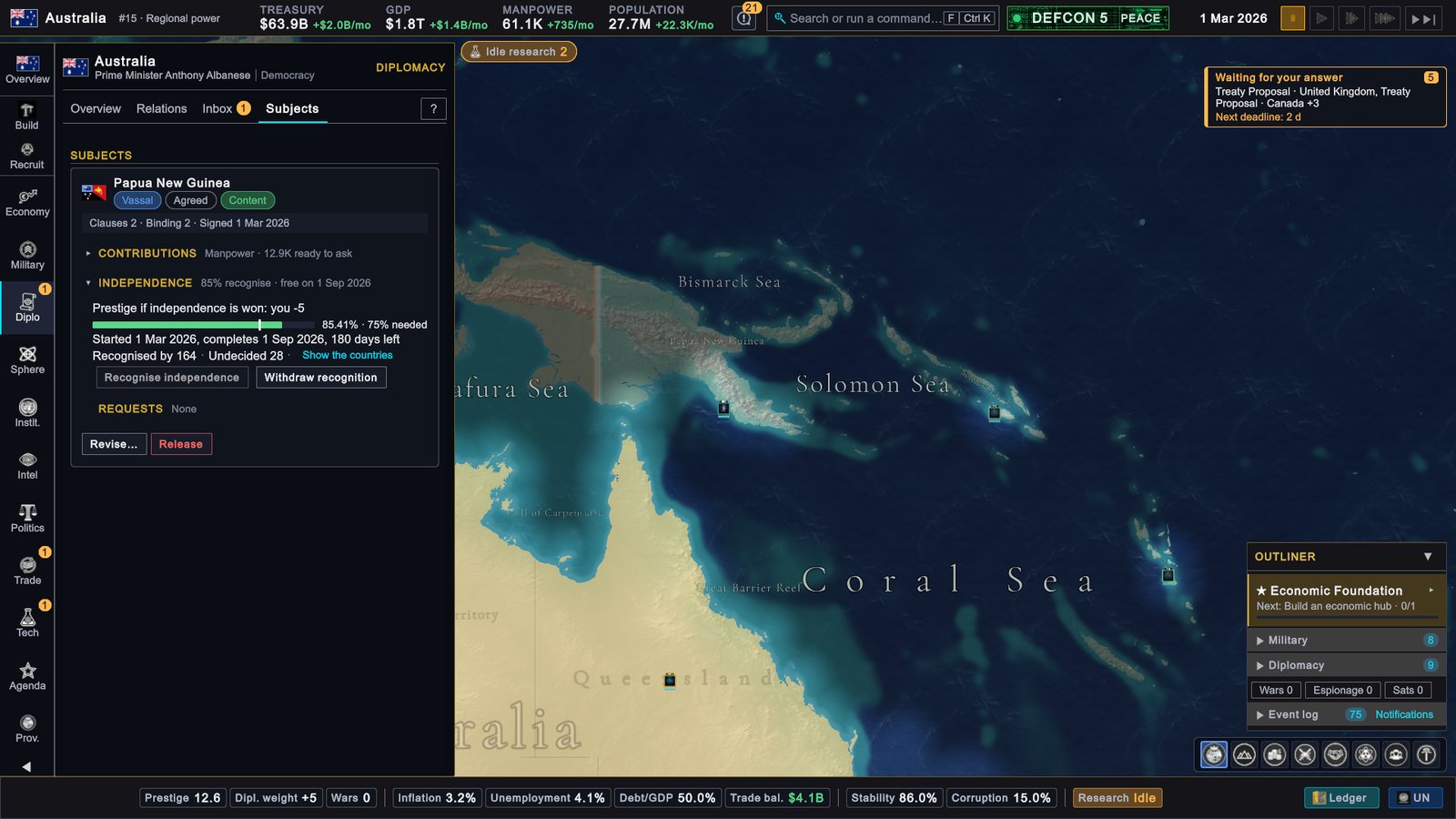
A subject has a mood (content, uneasy, restless, or looking for a way out) and the reasons for it. There are six ways out: the overlord releases it; 75% of the UN members who can vote recognise its independence and keep recognising it for six months; it wins a War of Independence; both sides agree to end the agreement; a third country frees it in a peace; or the overlord disappears. Other countries recognise a subject more readily when its agreement was forced on it. While the two are at war, in a War of Independence or any other, the whole agreement is suspended: neither side can use it until the war ends.
Flags and prestige
A subject’s flag now carries its overlord’s flag in the corner, with a border in the colour of its status: violet for a Dominion, blue for a Vassal, rose for a Central Authority. Being a subject costs prestige: 3, 6 or 10 points, depending on the status. An overlord gains 1 to 3 per subject, up to 8. The Prestige tooltip lists every line.
Human players always answer for themselves, in single player and multiplayer. In multiplayer, the AI never accepts a proposal for a player who has dropped out: if they don’t come back to answer it, it lapses.
Also in 0.6.0
- No more freeze when a world war ends. Accepting the peace that ends a world-spanning coalition war took about three minutes on one player’s save. In our profiling it now takes under half a second.
- Conquest cleans up after itself. An annexed country no longer gets its GDP back a month later, and it leaves every organisation, seat and trade arrangement. A permanent Security Council seat it held goes to a special General Assembly election. Land area follows territory, so population density stays right.
- UN admission now goes through Institutions: a Security Council recommendation, then a two-thirds vote in the General Assembly.
- Air and navy. Close air support hurts enemy armies outside battles too. Air wings at a captured airbase move to a free airfield, or are lost. Idle AI fleets go home.
- Map. Small provinces’ names read straight, and the borders of tiny places such as Hong Kong, Malta and St Kitts follow their real outlines.
- Suspend industry in a province to stop its processed goods and the inputs they use.
- Flags fill their box on cards and in lists.
- Achievements. Unlocks recorded under the earlier rules no longer arrive on Steam all at once, and using the admin panel now stops achievements in that campaign.
- Modding. Subject States, war pacing, peace payments and close air support can all be modded, the Mod Builder has an Institutions page, and the Old World Order 1450 mod updates to 0.11.0.
The patch notes will have the full list when the update goes out.
What comes next
Since Early Access began in June, the game has grown fast: a commodity economy with physical trade, multiplayer, a new interface, spheres of influence, international institutions, 97 achievements, and now conquest and Subject States.
Growing that fast has a cost, and you have told us about it. Some systems don’t hear about each other’s changes. Some numbers move without telling you why. Some decisions ask for your attention every month, when one standing order would do.
So for the next few updates, we are prioritising stability, clarity and fewer clicks before adding another major system:
- Solid ground. Conquest, peace and annexation update everything they should, and long sessions stay stable.
- Know why. Every headline number tells you why it moved, and which of your decisions moved it.
- Fewer clicks. Set a policy once, instead of answering the same question every month.
- A connected world. Deeper links between the systems you already know: your choices ripple across the economy, politics and diplomacy, and the world reacts for reasons you can see.
This doesn’t mean the game is finished. It doesn’t mean we’ve dropped the bigger ideas on our roadmap either: they stay on it, and some of them may come once we leave Early Access. For now, stability and clarity come first, so that whatever we build next stands on solid ground. We’ll keep releasing often, and each release carries fixes from your reports.
Thank you
Thank you for every review, bug report and long message, and for every save file you sent us. Several of the fixes in this update started with one of them. If you’re enjoying the game, a Steam review helps a small team like ours more than you know.
See you at the peace table.
— Ozan Kanık, founder, Dorlion Interactive