Hello, world leaders.
The next update changes how countries act together. The United Nations is already in the game: its resolutions are proposed and voted on in a screen of their own, the UN Command Center. A trade bloc, meanwhile, is a bonus: join one, and your trade grows with the whole world. In the next update both are rebuilt. The General Assembly and the Security Council vote by their own rules, a Council measure decides exactly which trade stops, and how you vote reaches your trade and your politics at home. Trade blocs become the real agreements in force on 1 January 2026, and they shape who trades with whom. And the European Union decides together, in two stages.
This preview is about the UN, the trade blocs and the EU. The other institutions are on the new page with their members.
One honest note before we start: this is a preview. Every screenshot below comes from the current development build, taken from games we played three months forward as the United States, Germany and Australia. To show each step in one game, our test tools tabled some of the items and cast some of the votes on cue, through the same commands the AI uses, and skipped the waiting between stages. Numbers and details can still change before the update ships.
One page for every institution
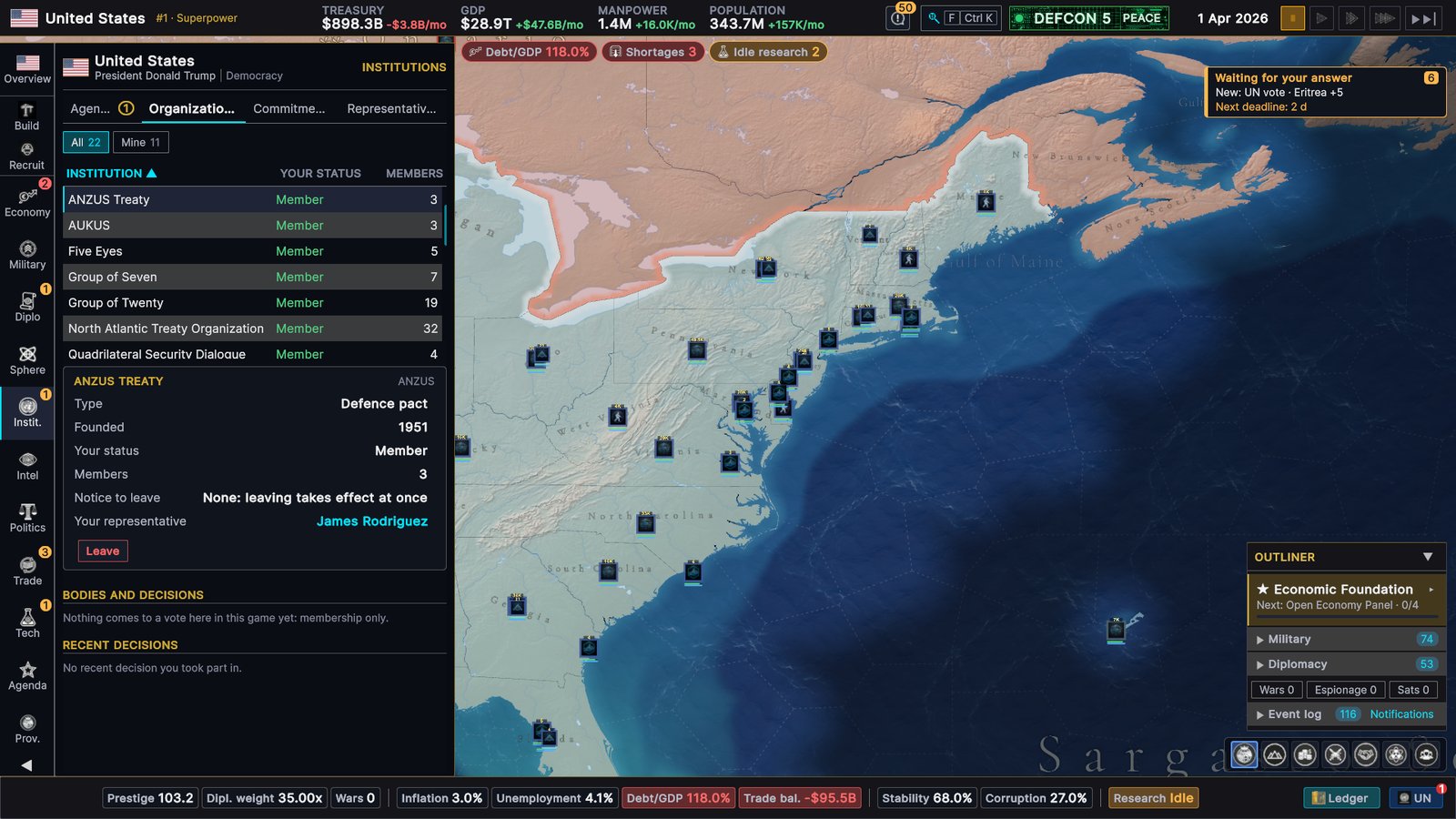
The new Institutions page has four tabs:
- Agenda: every item open in your institutions, with the ones waiting for you first.
- Organizations: every institution in the game, what it is and who belongs to it.
- Commitments: what your memberships oblige you to do.
- Representatives: who speaks for you, and on what instructions.
There are 22 institutions: the UN, NATO, the EU, the CSTO, BRICS, the G7 and G20, the African Union, ASEAN, the Gulf Cooperation Council and more, each with its members as of 1 January 2026.
The United Nations
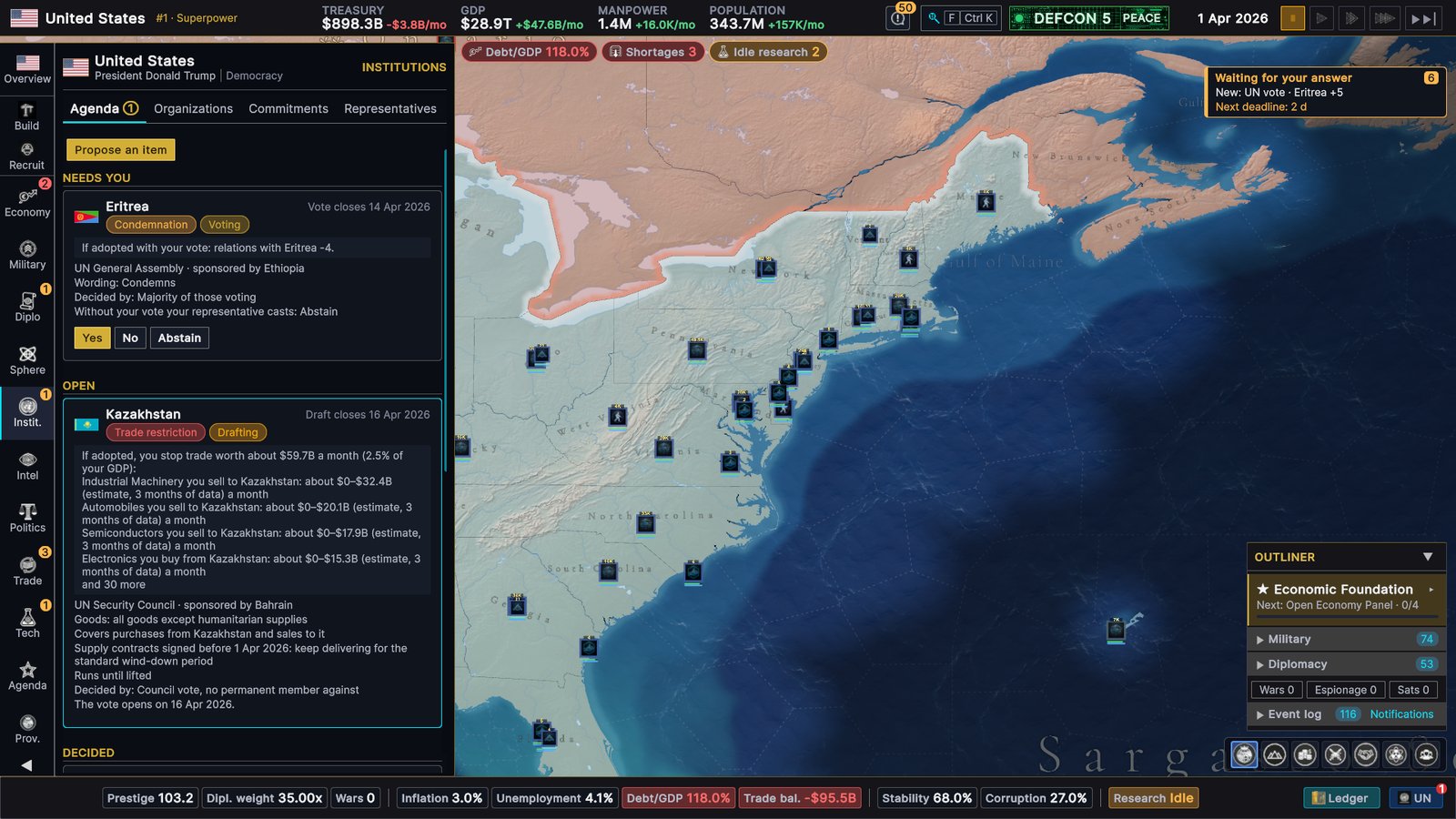
Every UN member has one vote in the General Assembly. The Assembly can:
- condemn a country, by a majority of those voting;
- call for a ceasefire, by two-thirds;
- support mediation, by a majority;
- recommend measures when the Security Council is blocked, by two-thirds;
- elect the Security Council’s non-permanent members.
Items aren’t decided the moment they’re tabled. Each one is drafted, then voted on: fifteen days for each, five each when it’s urgent. Countries take positions while it’s drafted, and a sponsor can soften the wording to win votes. Every country casts its own ballot, the AI included, and the card shows the tally.
The Security Council
The Security Council has fifteen seats: five permanent members — China, France, Russia, the United Kingdom and the United States — and ten elected members, chosen by region for two years. The Council decides by nine votes, with no permanent member against. A permanent member that abstains doesn’t block a decision; one that votes no does.
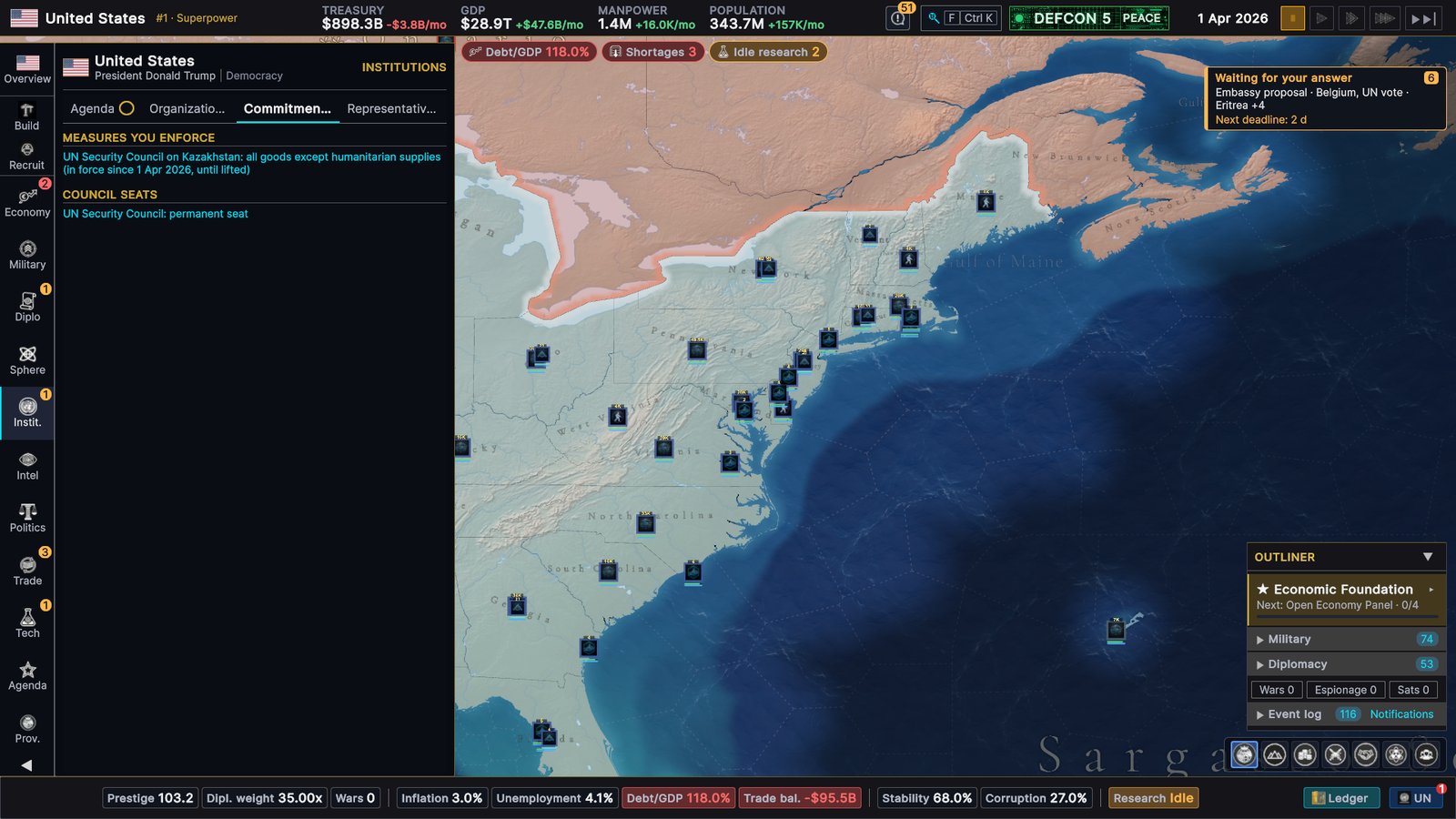
Only the Council’s measures bind every member. It can restrict trade with a country, lift or renew the restriction later, and help countries that a measure hurts. It can also condemn a country and call for mediation.
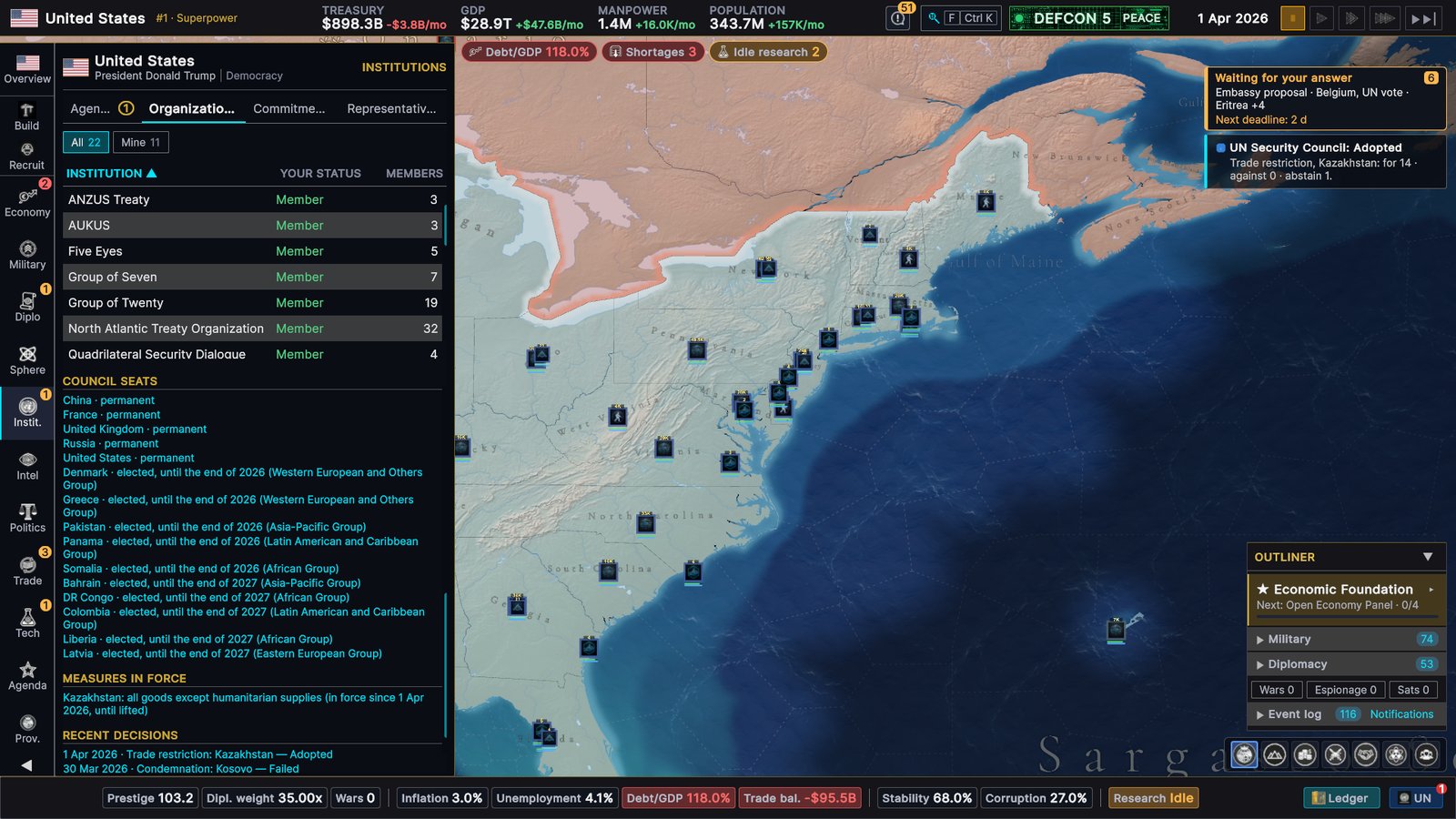
What a trade measure does
A trade measure names its target, the goods it covers and the direction: buying from the target, selling to it, or both. Under a measure on all goods, food, medicine and fertilizer stay open. It also says what happens to the contracts it catches: they stop at once, wind down for 90 days, or run to the end of their term.
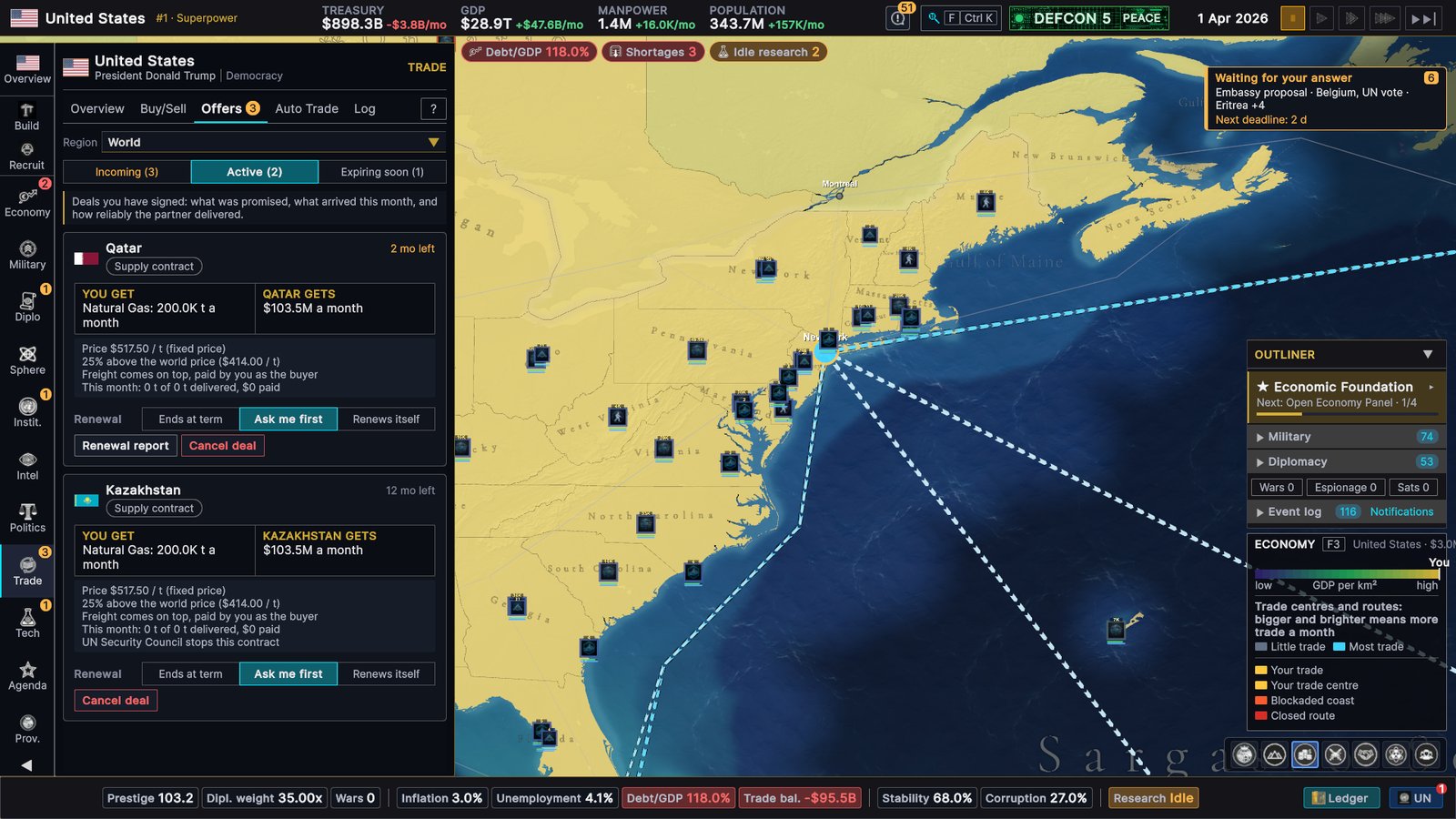
Once a measure is in force, three things happen in every country it binds. The target drops out of the state’s suppliers (or buyers) for those goods. The state’s supply contracts with it end as the measure says. And the private sector’s trade with the target in those goods falls to a tenth of what it was. You see it wherever you trade: under Commitments, on the cards of the contracts it ends, and on the supplier rows it closes.
When a permanent member says no
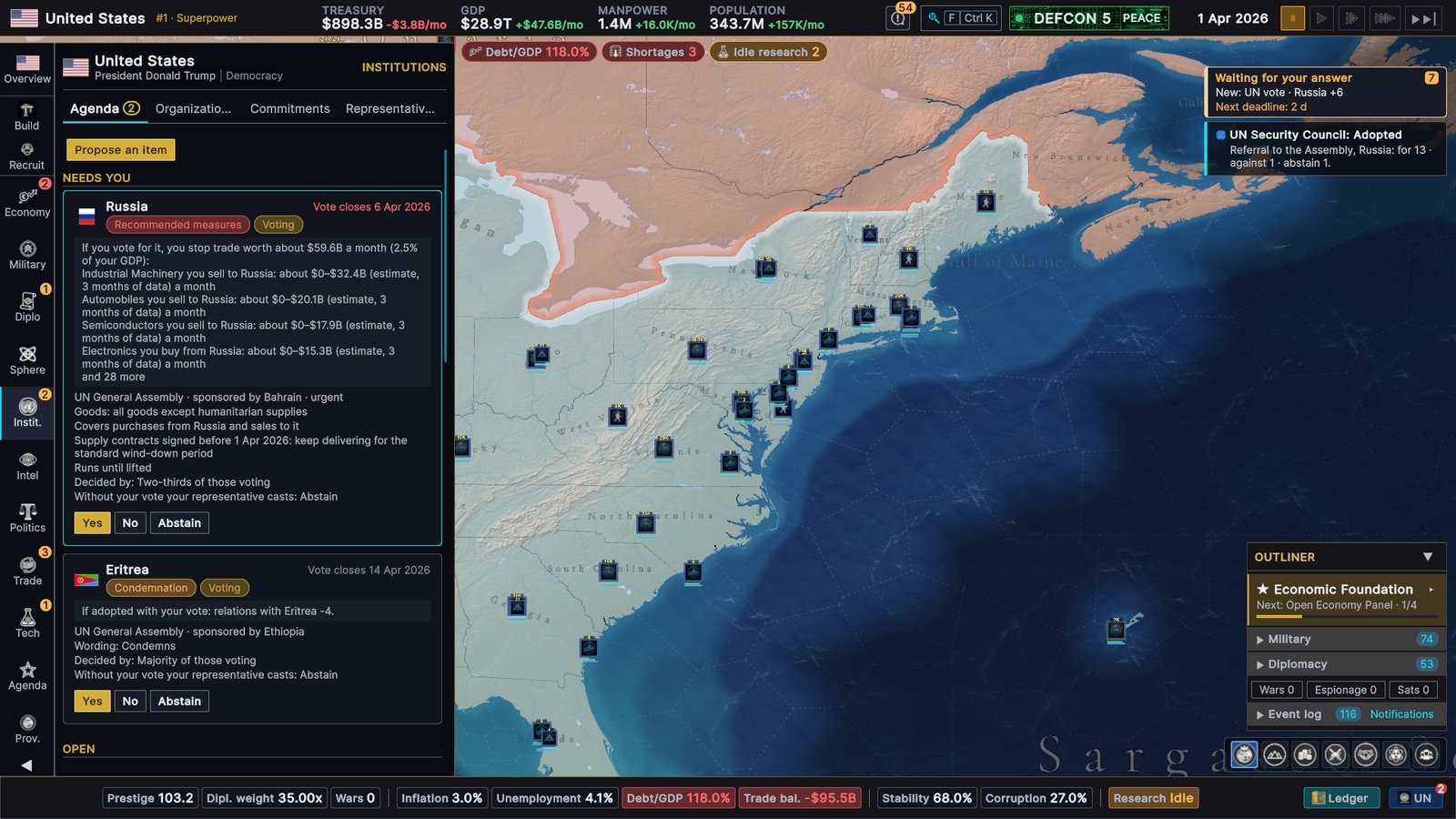
A veto doesn’t have to be the end. The sponsor can refer the draft to the General Assembly under Uniting for Peace: a procedural vote in the Council, where no veto applies. The Assembly then votes on recommended measures, by two-thirds. In the real UN, such a recommendation binds no one. In the game, voting for it commits your country to applying the measures; the countries that vote against or abstain stay free.
Your representatives
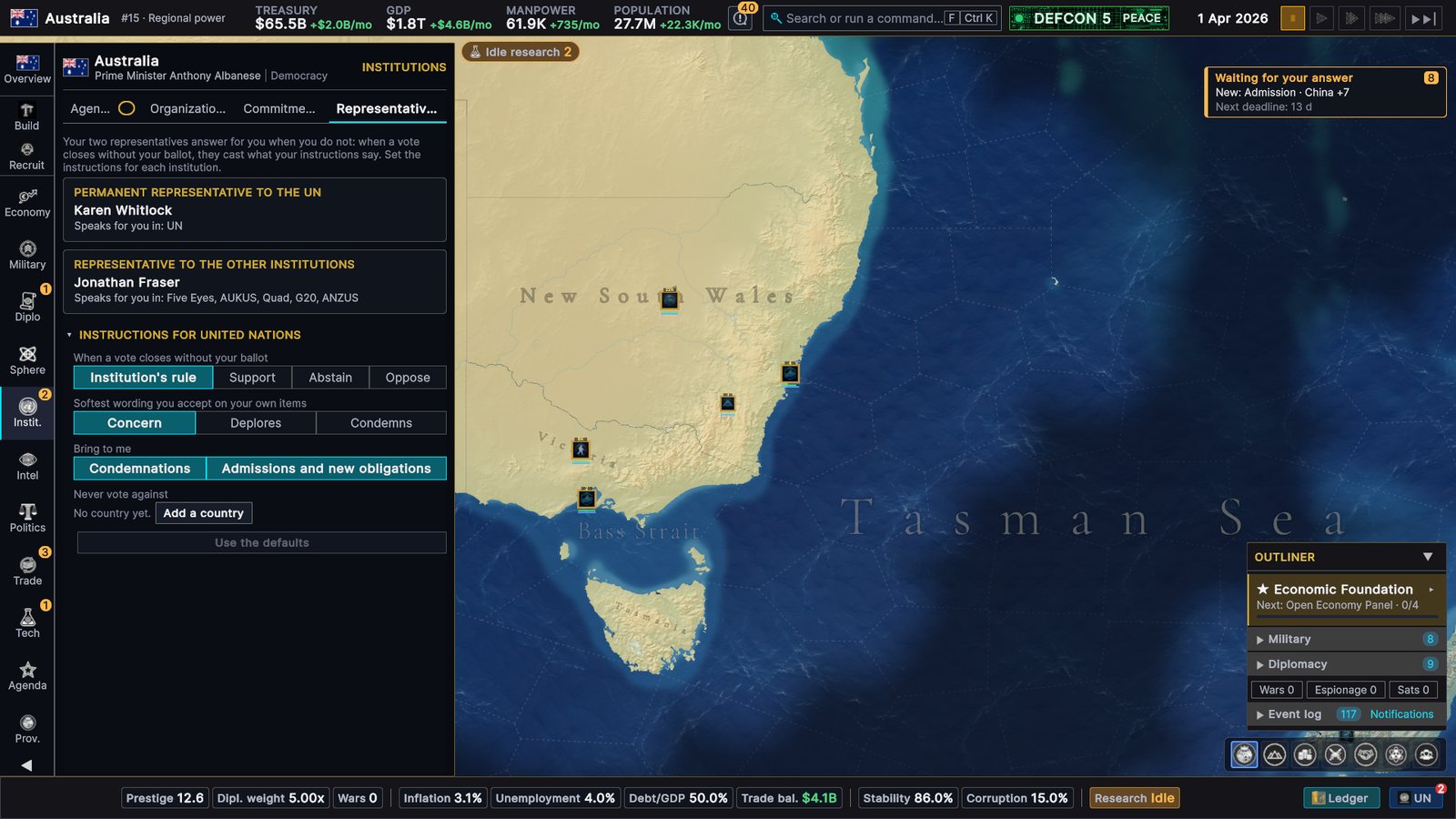
Every country has two representatives: a permanent representative to the UN, and a representative to the other institutions. They have names, but no salary or skills. What they do is what you tell them.
When a vote closes without your ballot, your representative casts one for you. For each institution, you decide:
- what they cast when you don’t vote: the institution’s own rule, or yes, no or abstain;
- the softest wording you’ll accept on your own items, so a condemnation you sponsor can pass in a milder form;
- what is brought to you: condemnations, and admissions or new obligations, are listed under Needs you and counted on the rail; the rest is left to your representative;
- who they never vote against: up to four countries your representative will never condemn, sanction or keep out.
How you vote matters at home too. Condemning a partner, or sanctioning a rival, moves your interest groups’ approval: business, the military and the others each react in their own way.
Security Council elections
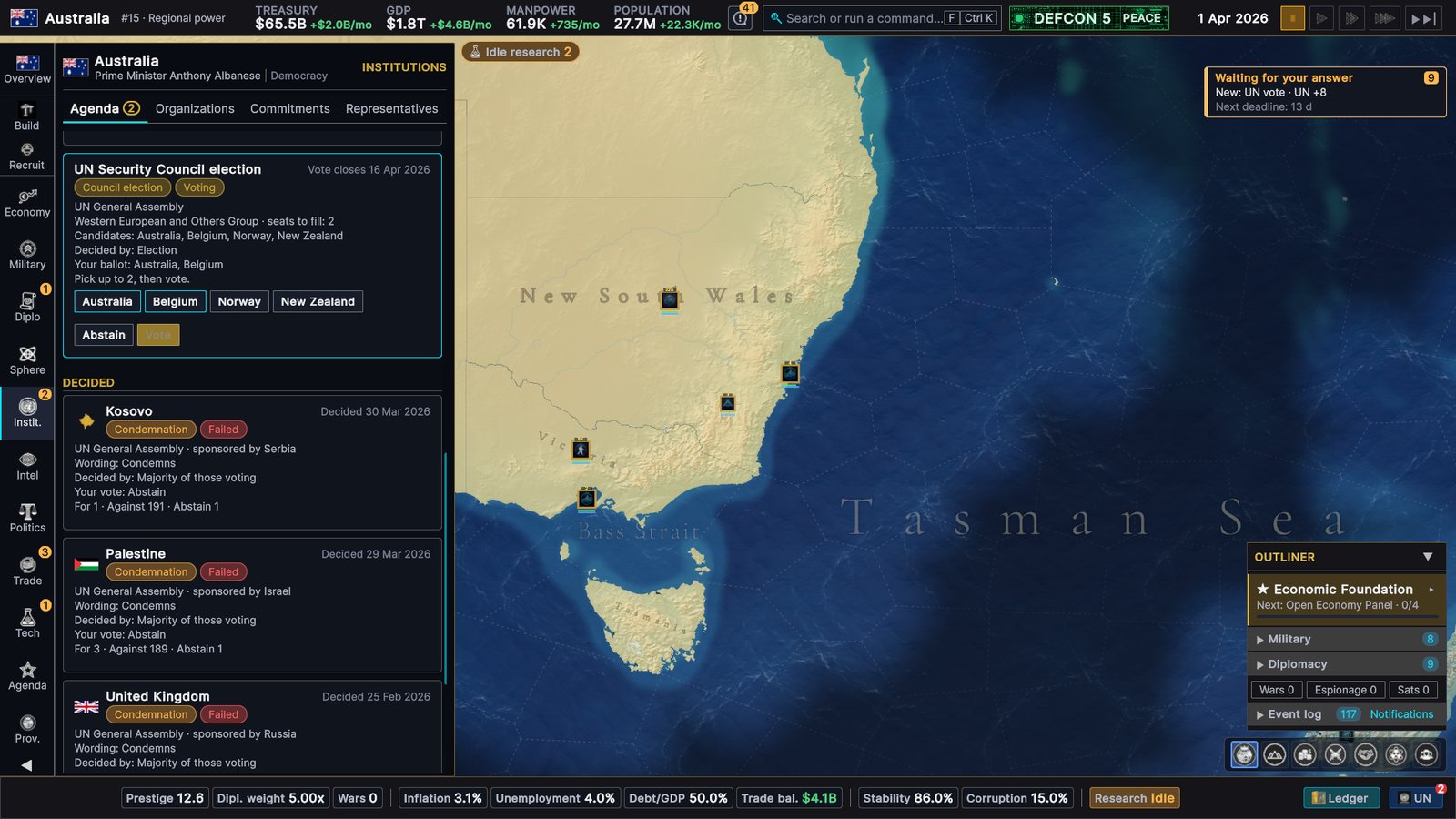
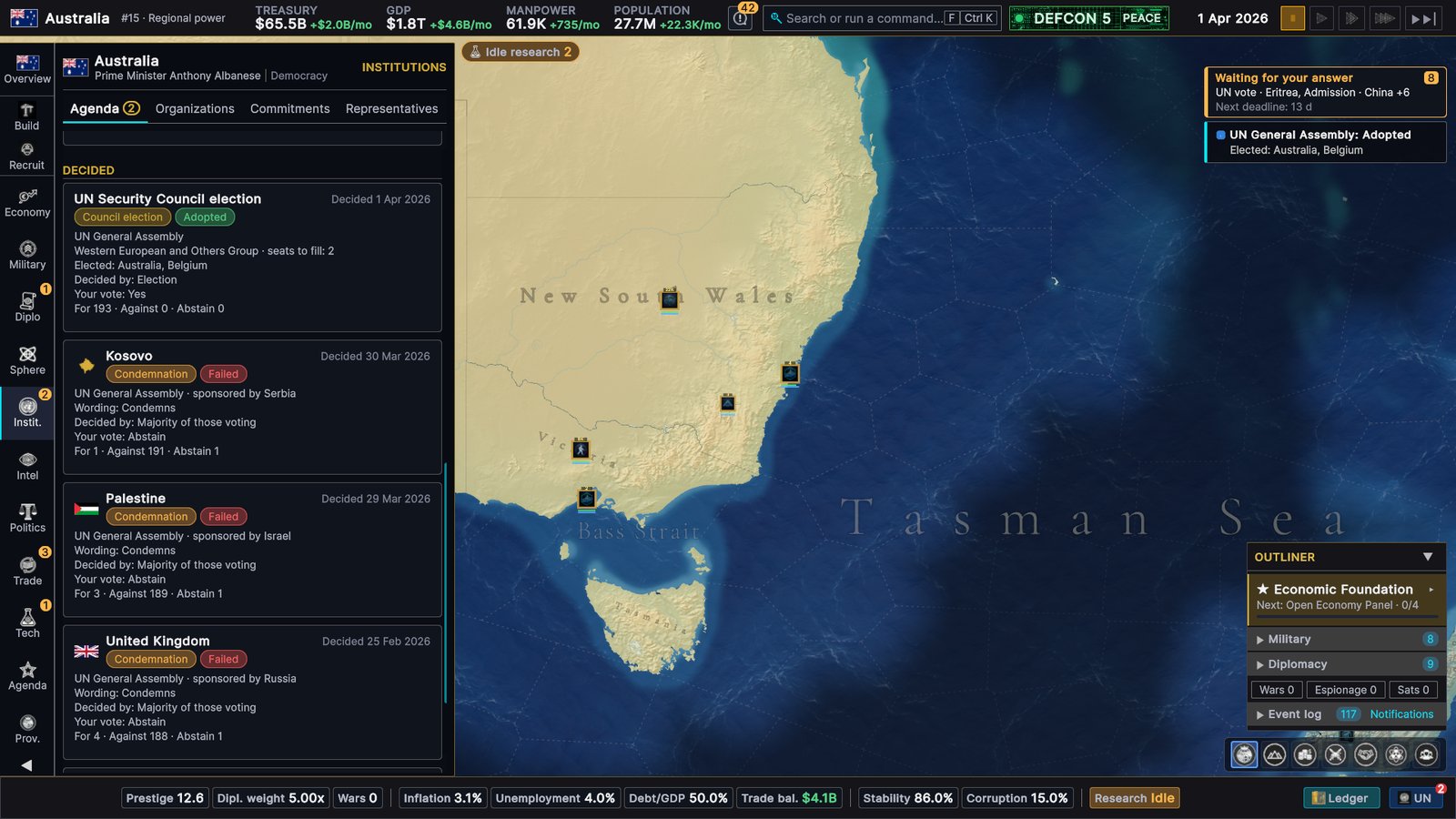
Every year, on 20 May, the Assembly opens elections for the Council seats whose terms end that year. There is one election per regional group. You can stand as a candidate, and you vote for up to as many candidates as there are seats. A seat takes two-thirds of the votes. So that an election always ends, the game adds a shortcut the real UN doesn’t have: after three more rounds among the best placed, the most votes fill the seats still free.
Trade blocs, as of 1 January 2026
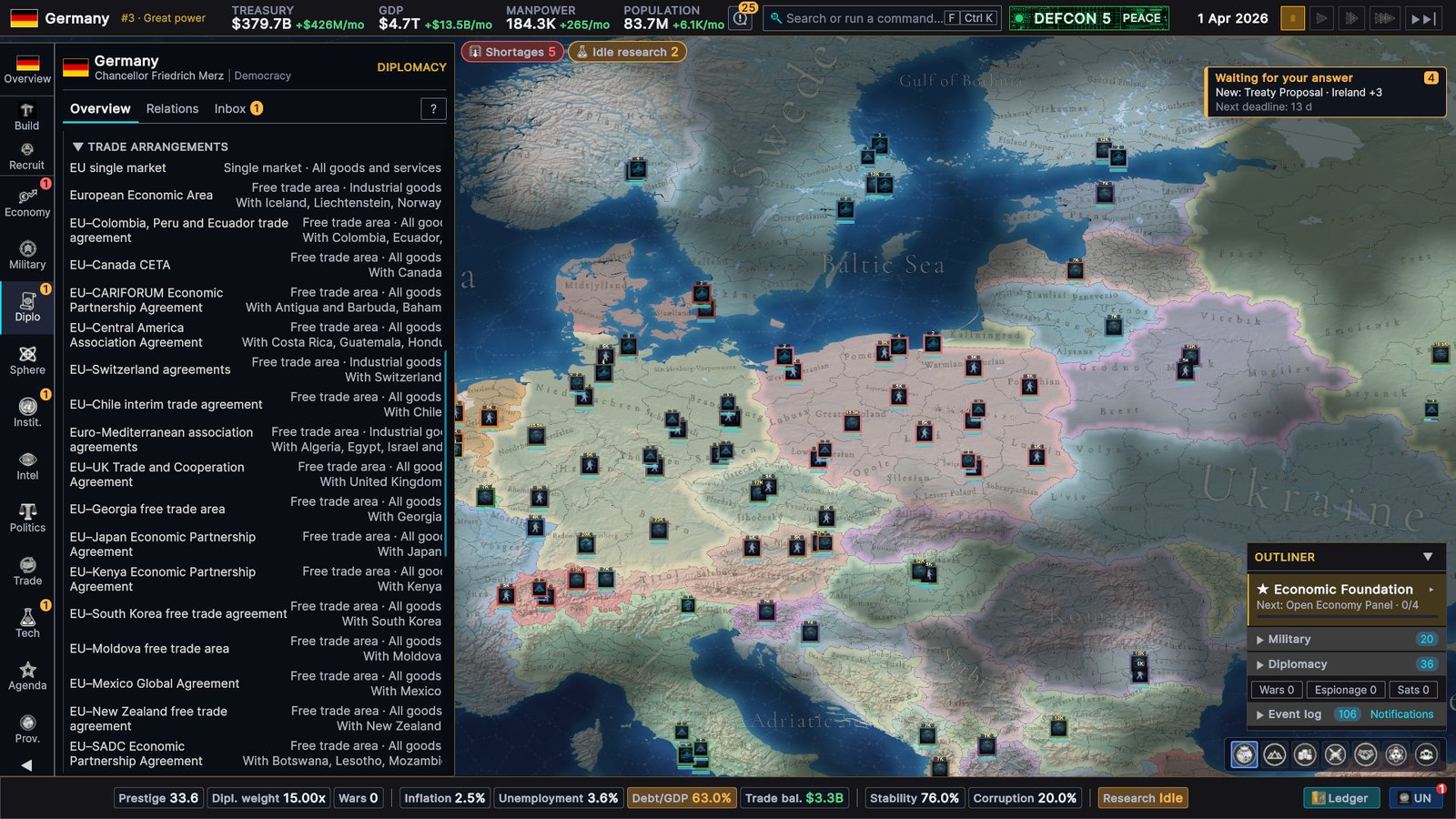
Trade blocs are now the real agreements in force on 1 January 2026: 13 blocs and the 23 agreements the EU has with its partners.
| Bloc | What it is | Who admits new members |
|---|---|---|
| EU single market | single market | the EU |
| EAEU, SACU | customs unions | every member |
| EFTA, Andean Community | free trade areas | every member |
| CPTPP, RCEP | free trade areas | no member objects |
| MERCOSUR, GCC, ECOWAS | customs unions | closed |
| ASEAN (ATIGA), AfCFTA, USMCA | free trade areas | closed |
“Closed” means the bloc takes no new members in this version.
The EU’s agreements run from the customs union with Turkey and the agreement with the United Kingdom to Japan, South Korea, Canada, Mexico, Vietnam, New Zealand, Ukraine and more.
A bloc now works between pairs of countries. Two members trade the goods it covers at a lower tariff — or none — so deals follow tariffs, and the bonus on all your trade is gone. Who may apply is a game rule, drawn from each bloc’s real accessions and applicants: CPTPP takes the Pacific Rim economies and the countries that have applied, EFTA European states.
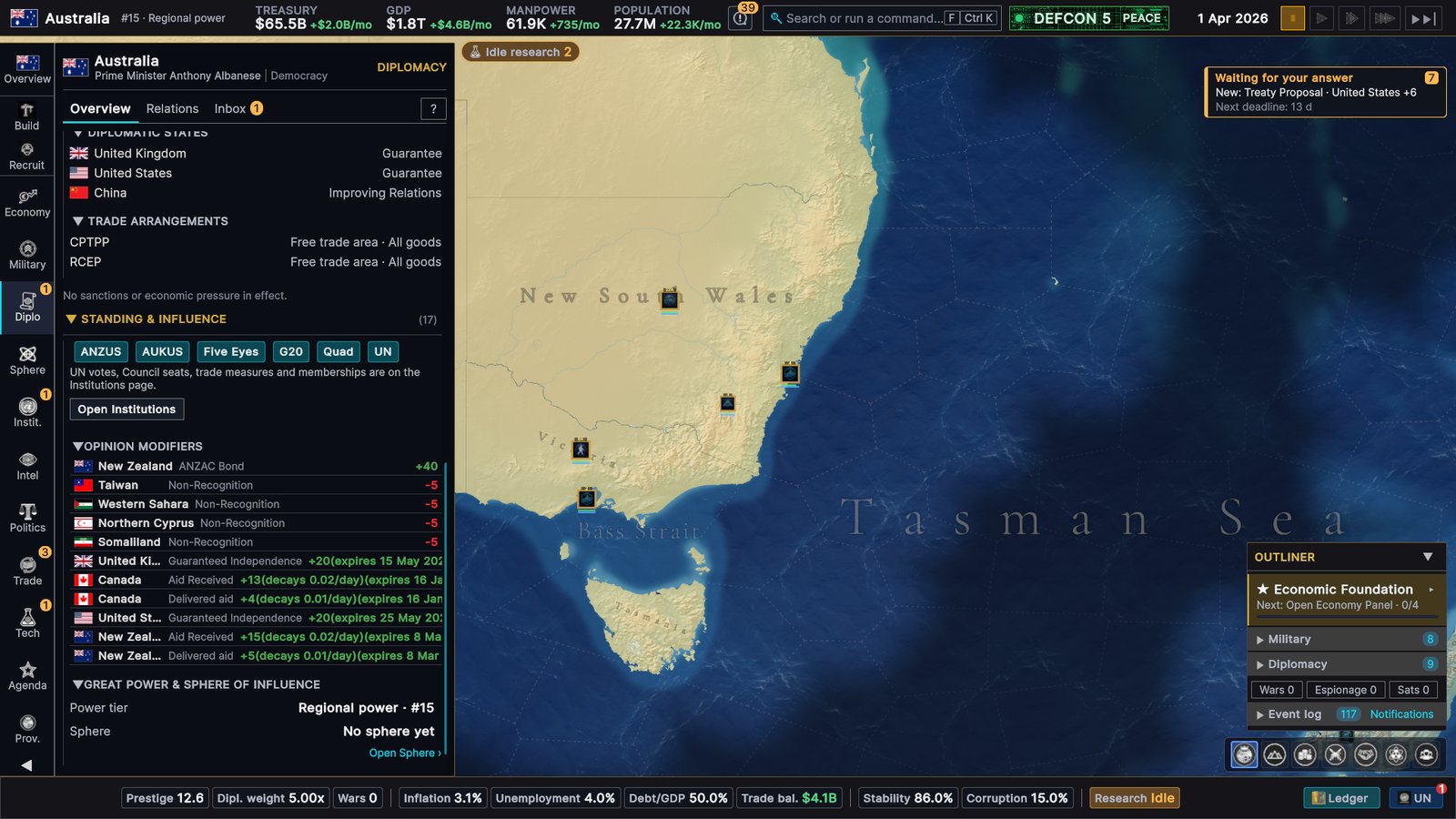
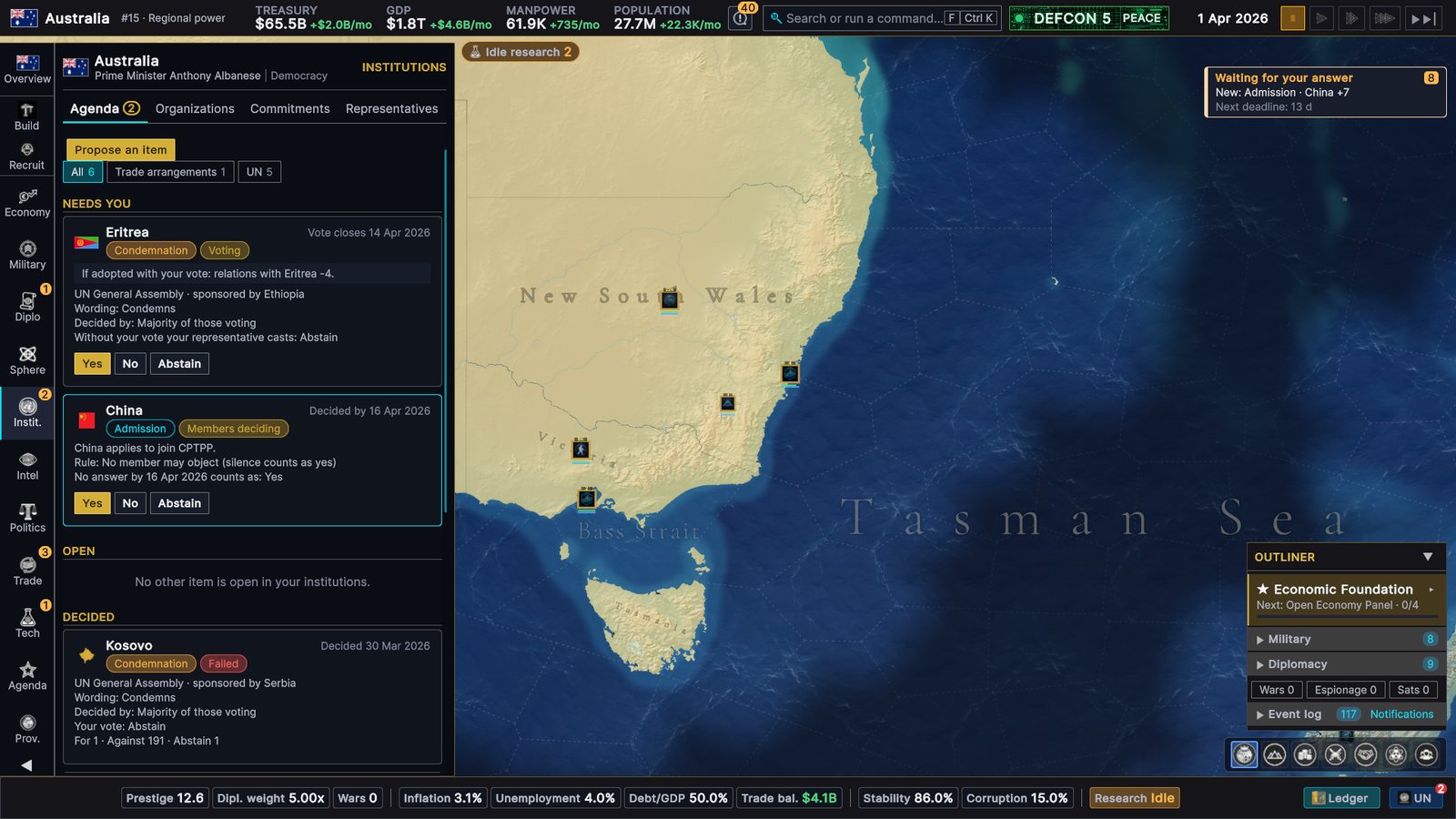
You can apply to a bloc that will have you, and its members decide. You can found a free trade area with a partner, and leave a bloc with notice: six months for CPTPP, two years for the EU. When someone applies to a bloc you’re in, you get a vote.
The European Union
The EU’s members decide together in the Council of the EU, and the next update gives it its own procedures.
A sanction takes two stages. First, a decision by unanimity. In the game, every abstention is a constructive abstention: it doesn’t block the decision, unless the members abstaining make up a third of the members and a third of the EU’s population. Then a regulation on the same text, by qualified majority: 55% of the members, representing 65% of the people. Once adopted, it binds every member, including the ones that voted no.
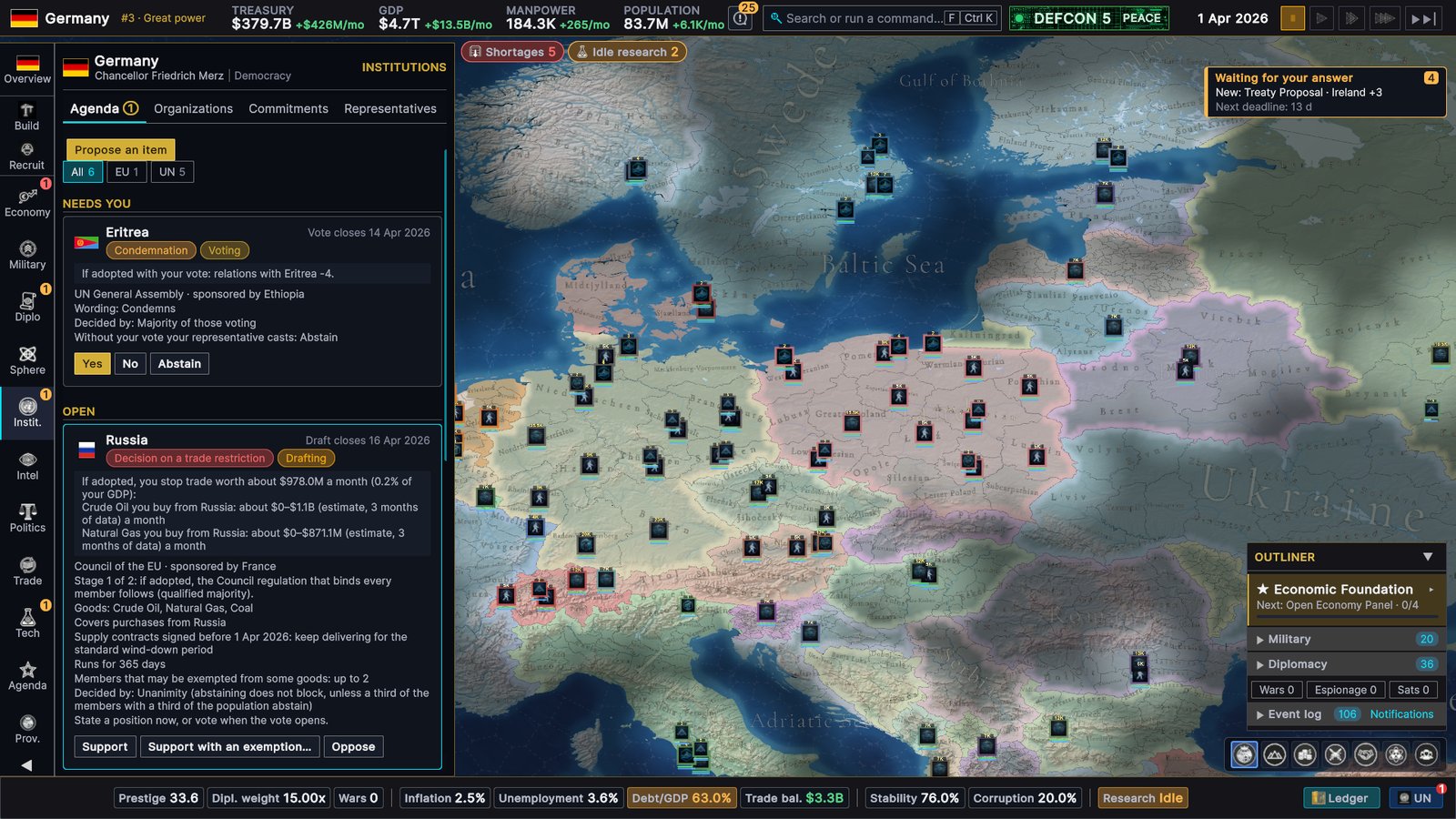
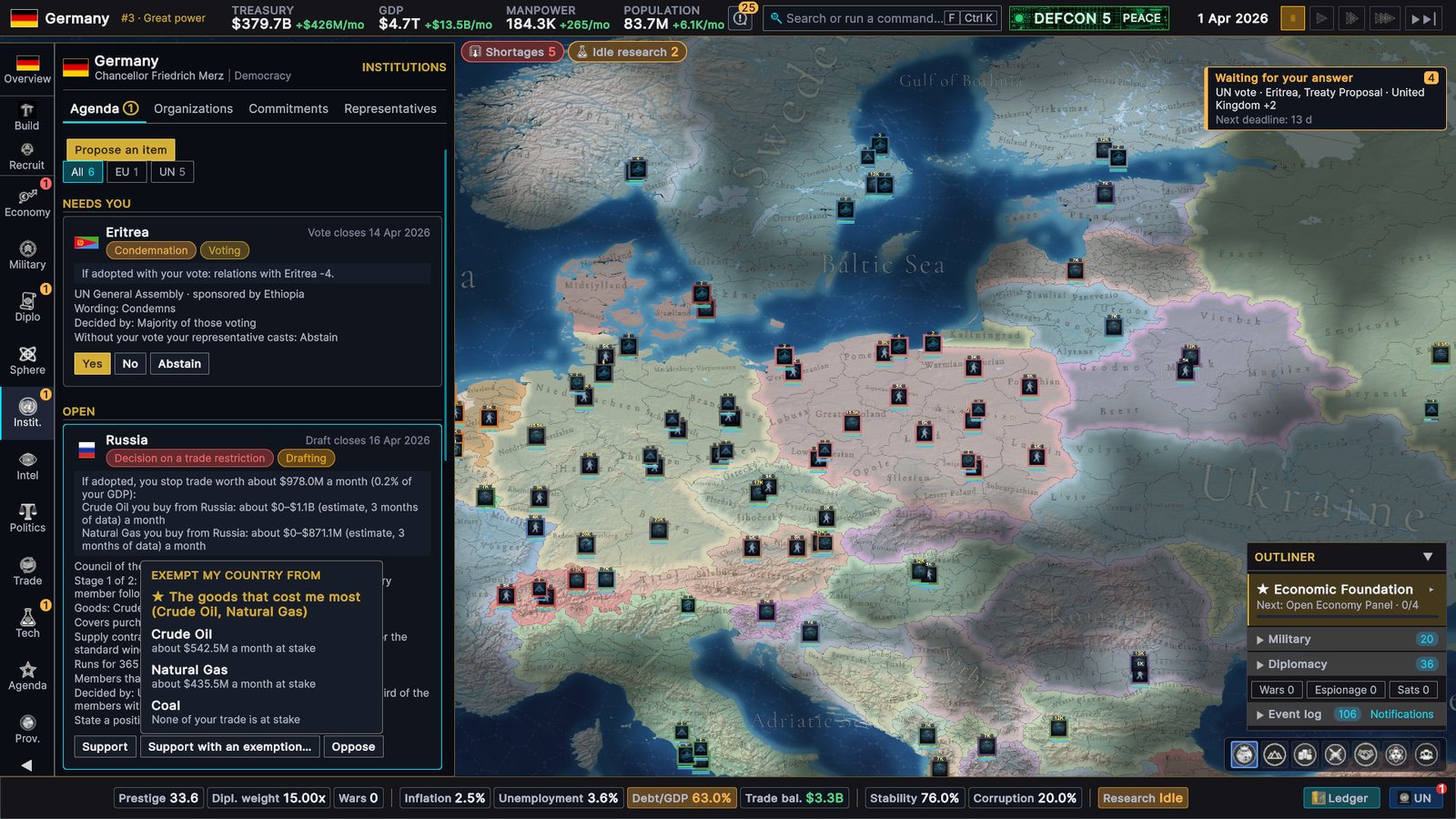
You can ask for an exemption. If a decision hurts you in a few goods, support it on condition that you’re exempted from them. The menu shows what each good puts at stake for you. In our model, if the decision needs their votes and no more than two members ask, they get their exemptions. The members that backed the decision without conditions, and are hardest on its target, think less of the ones exempted.
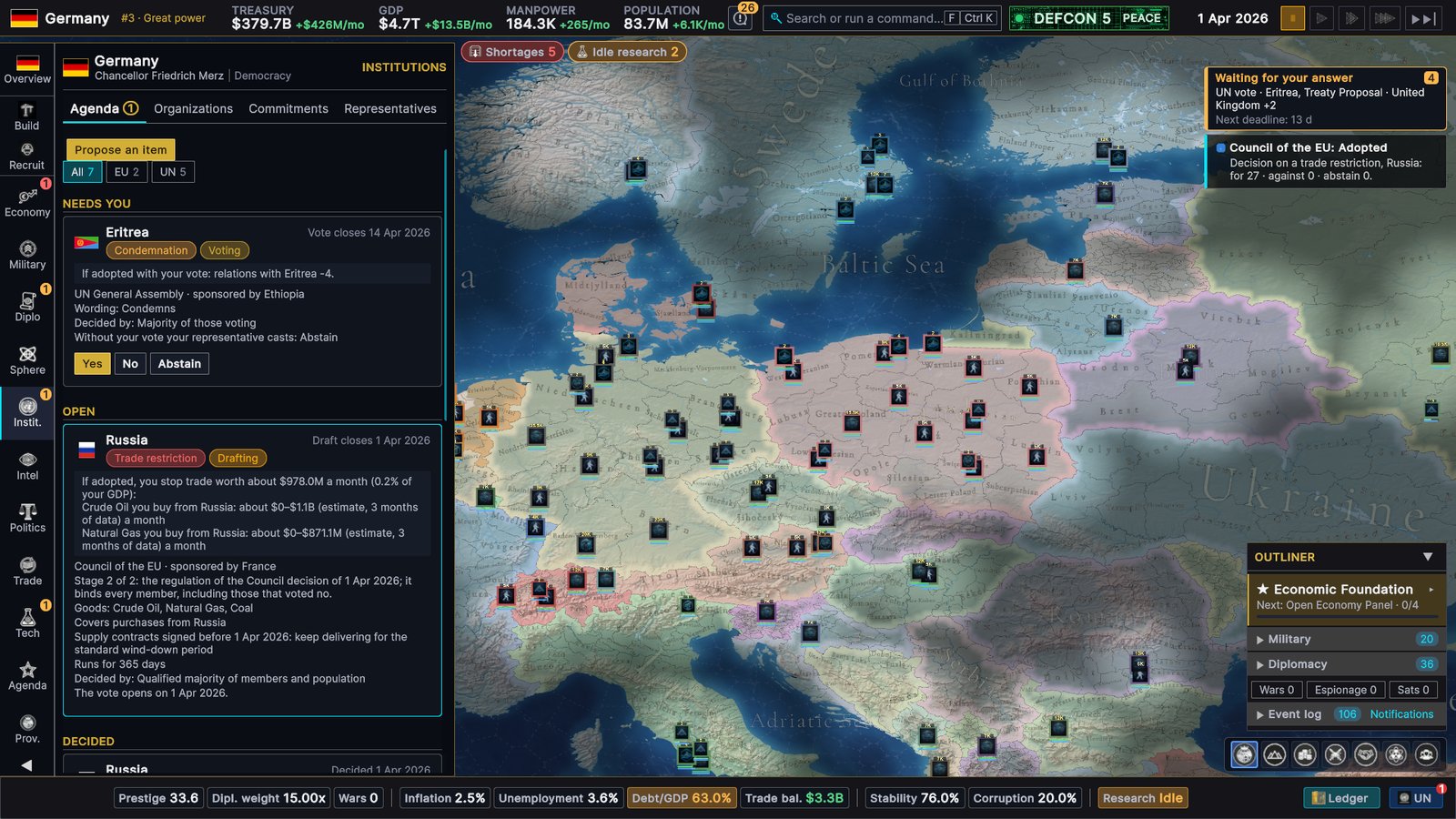
In the game, EU measures run for a year. Their renewal comes up on its own before then, and a single member’s no lets them lapse.
The EU trades as one. Its members can’t sign trade agreements of their own: the Union negotiates for all of them. A trade mandate, by qualified majority, offers a partner an agreement. If the partner accepts, the members vote on the deal, and the whole single market then trades with it at a fraction of the normal tariff.
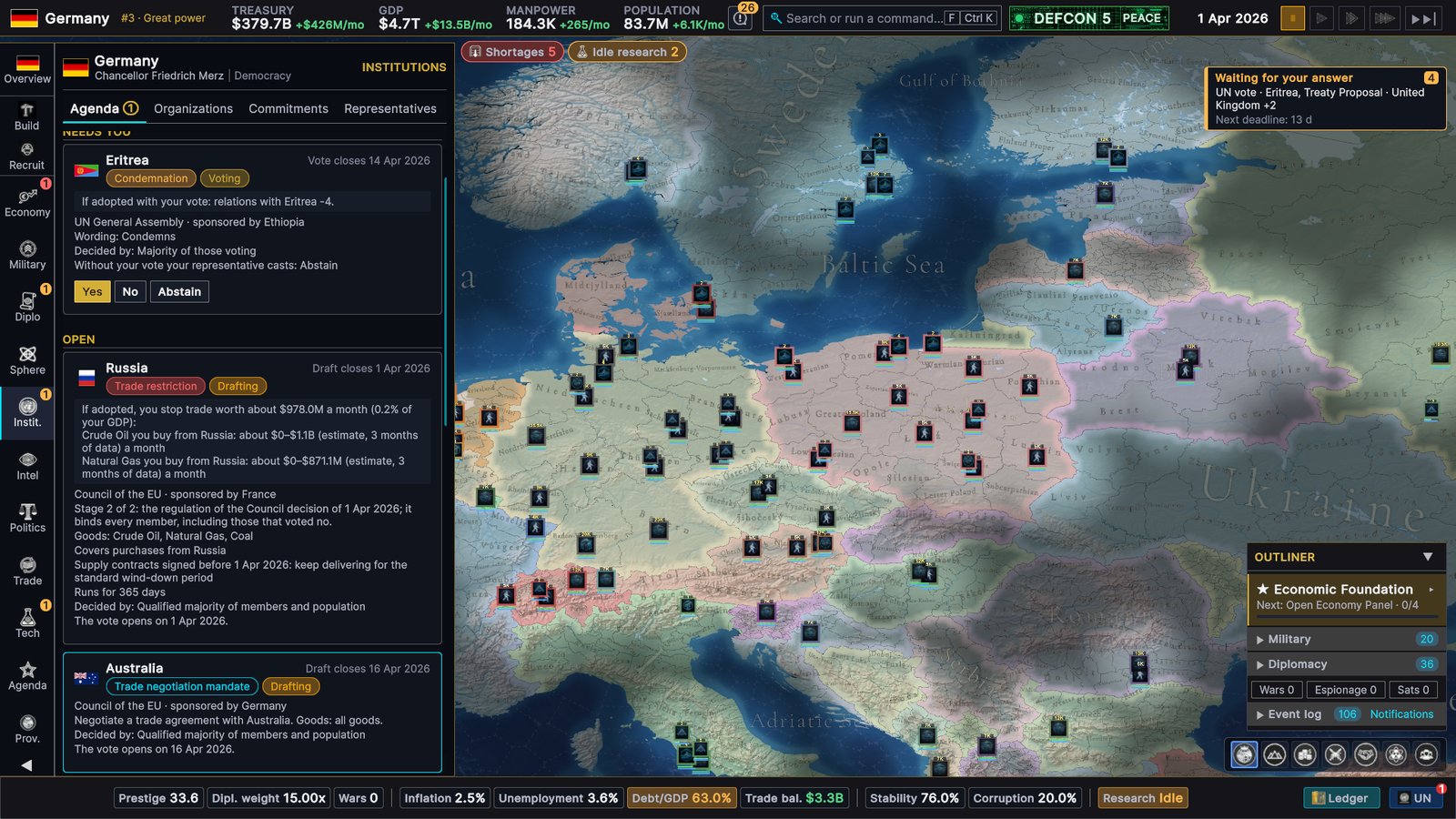
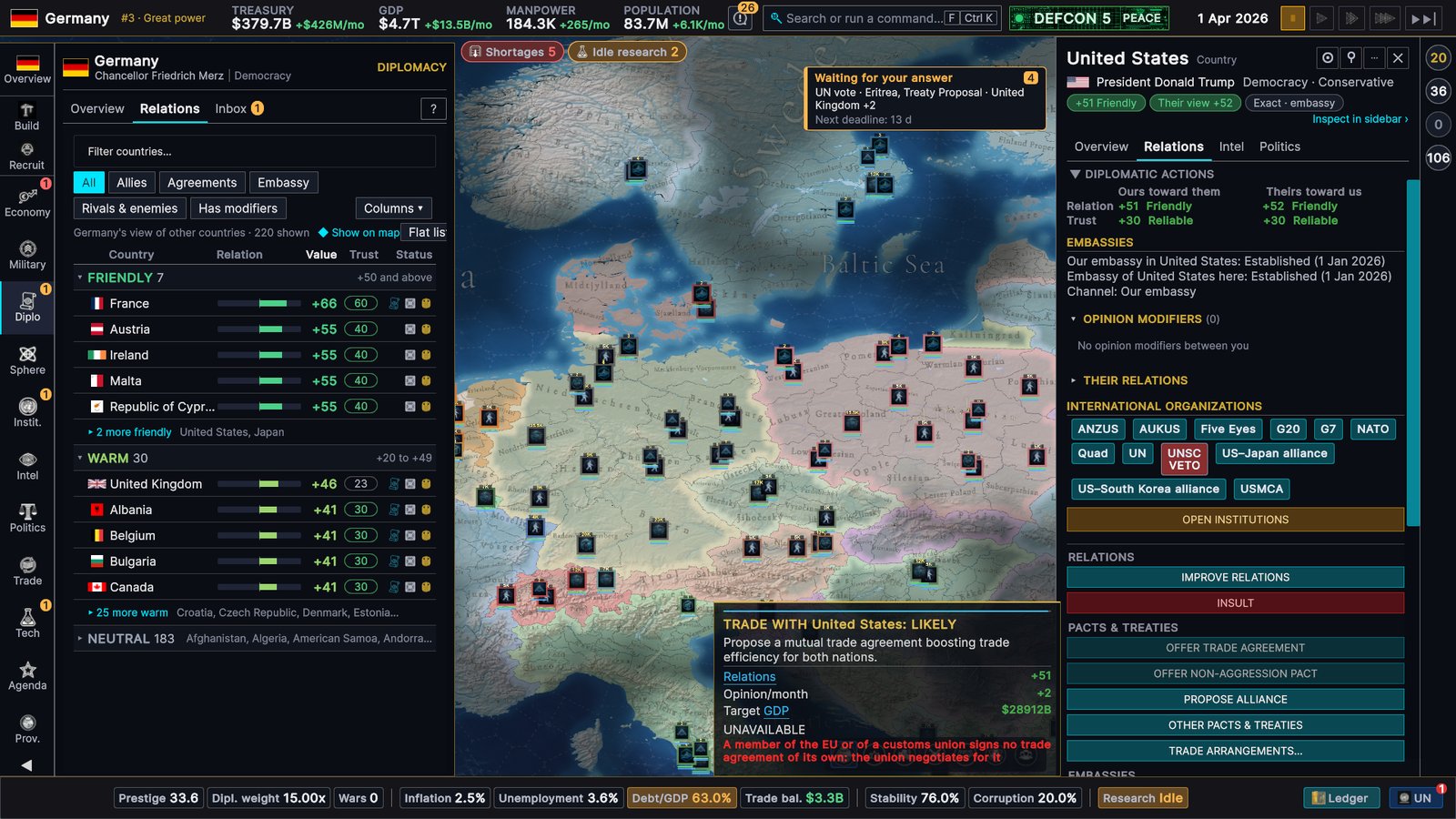
The same goes for sanctions. A sanction Germany imposes alone is a statement, not a trade measure: to stop trade, it seeks an EU or a UN measure.
Same orders, same world
Global Protocol is built to be deterministic: its randomness is seeded, so the same start and the same orders play out the same way. Institutions put that to a hard test. A single Assembly vote involves every member’s ballot, the sponsor’s compromises and the deadlines, and every player’s computer has to reach the same result on its own.
Orders, not the world
Multiplayer runs in deterministic lockstep. Only your orders travel between players; every computer simulates the whole planet itself, the AI included. The next update adds six new orders, one for each thing you can do in an institution:
- table an item;
- cast a ballot;
- state your position while an item is drafted;
- join or leave;
- instruct your representatives;
- make a trade bloc move: apply, found, invite, answer or leave.
Everything else is worked out on each computer by itself, and has to come out the same: every AI ballot in the Assembly, every compromise a sponsor makes, every exemption the EU grants, every bloc’s answer to an applicant.
Small details, the same everywhere
Lockstep lives and dies on small details. Two from this update:
- Votes are counted in fractions. The voting rules are stored as exact fractions: a two-thirds majority is 2/3, not 0.6667. With a decimal, two votes out of three failed a two-thirds rule. Now a tally is whole-number arithmetic: exact, and the same on every computer.
- Armies in a fixed order. The AI used to go through a country’s armies in the order the engine happened to store them, and that order can differ between two computers. Now it goes by each unit’s permanent ID.
Every computer keeps checking that it agrees with the others through a fingerprint of the world. The next update adds everything the institutions hold to it: every membership and Council seat, every agenda item, ballot and public position, your representatives’ instructions, every trade measure and who enforces it, and every trade bloc, link, application and answer. If two computers ever disagree on any of it, the game notices, and the host resyncs everyone.
Everything in this devlog works in multiplayer, exactly as in single player.
How we prove it
- Two worlds, one vote. A test builds two copies of the world, laid out differently in memory on purpose, and runs the UN on both, day by day: the AI tabling and voting, the agenda and the deadlines. The human player’s orders are sent as real network messages and applied on each copy, and every day both copies must produce the same fingerprint. A third copy joins in the middle of a vote, from a snapshot of the first, and stays in step to the end. To prove the test can fail, one copy is denied a single ballot, and it falls out of step at once.
- Every fix, broken on purpose. For the fixes in this update we broke the code again, one change at a time, and checked that a test turned red each time.
- Close to 27,000 automated tests now cover the game.
- It stays cheap. In our profiling, the institutions and the new trade blocs add about 2% to the cost of a game day.
Claude Plays: one session, replayed in one take
Determinism is also how we make our Claude Plays videos. Claude first plays an original session on a fresh game, writing down its orders turn by turn. Then we start the same game again, replay the orders from that original session, and record the replay in one take. Because the game is deterministic, the replay is the same game as the original session.
Our 30-minute take covered 20 in-game months, from January 2026 to September 2027, and every month matched the original session. We did need two retakes. Both times, our recording script had clicked in the wrong place on a screen; the world never played out differently. What you watch is the game itself, move by move.
The screenshots in this devlog show the same thing. We captured them three times while we fixed our capture tool, and each time the same world came back. Ethiopia tabled the same condemnation of Eritrea, Serbia’s condemnation of Kosovo failed by the same vote, and the treasuries, tallies and costs on screen matched.
This one takes a little longer
The next update is bigger than the last ones, and it’s taking longer. Institutions touch almost every part of the game — trade, war, diplomacy, politics, the AI — and we’d rather ship it when each part works with the rest than rush it out. Thank you for your patience.
We’re working on NATO and CSTO now: allies will decide together how to defend a threatened member.
What’s next
We’re still in Early Access, and your feedback decides what comes next. Our development roadmap is public: see what we’re working on at our roadmap page.
Thank you
Thank you for every review, bug report, screenshot and long message. If you’re enjoying the game, a Steam review helps a small team like ours more than you know.
See you on the world stage.
— Ozan Kanık, founder, Dorlion Interactive