Hello, world leaders.
In our first devlog we showed you how Global Protocol simulates the whole planet every in-game day — and how multiplayer lets your friends share it. Version 0.5.10 is now live, and it rebuilds the part of that planet that matters most: its people.
Some of the questions we hear most often are versions of “why is my population shrinking?”, “where did these refugees come from?” and “why did the socialists just win?” We’ve never properly explained how any of that works. So this devlog does: where the 2026 population comes from, how it is born, ages, moves and votes — and, most importantly, what you can do to change it for the better.
After that we’ll cover the other big pillar of this update, missile defence and mutually assured destruction, give modders a short tour of the three ways to change the game, and finish with everything else that shipped.
Where the 2026 population comes from
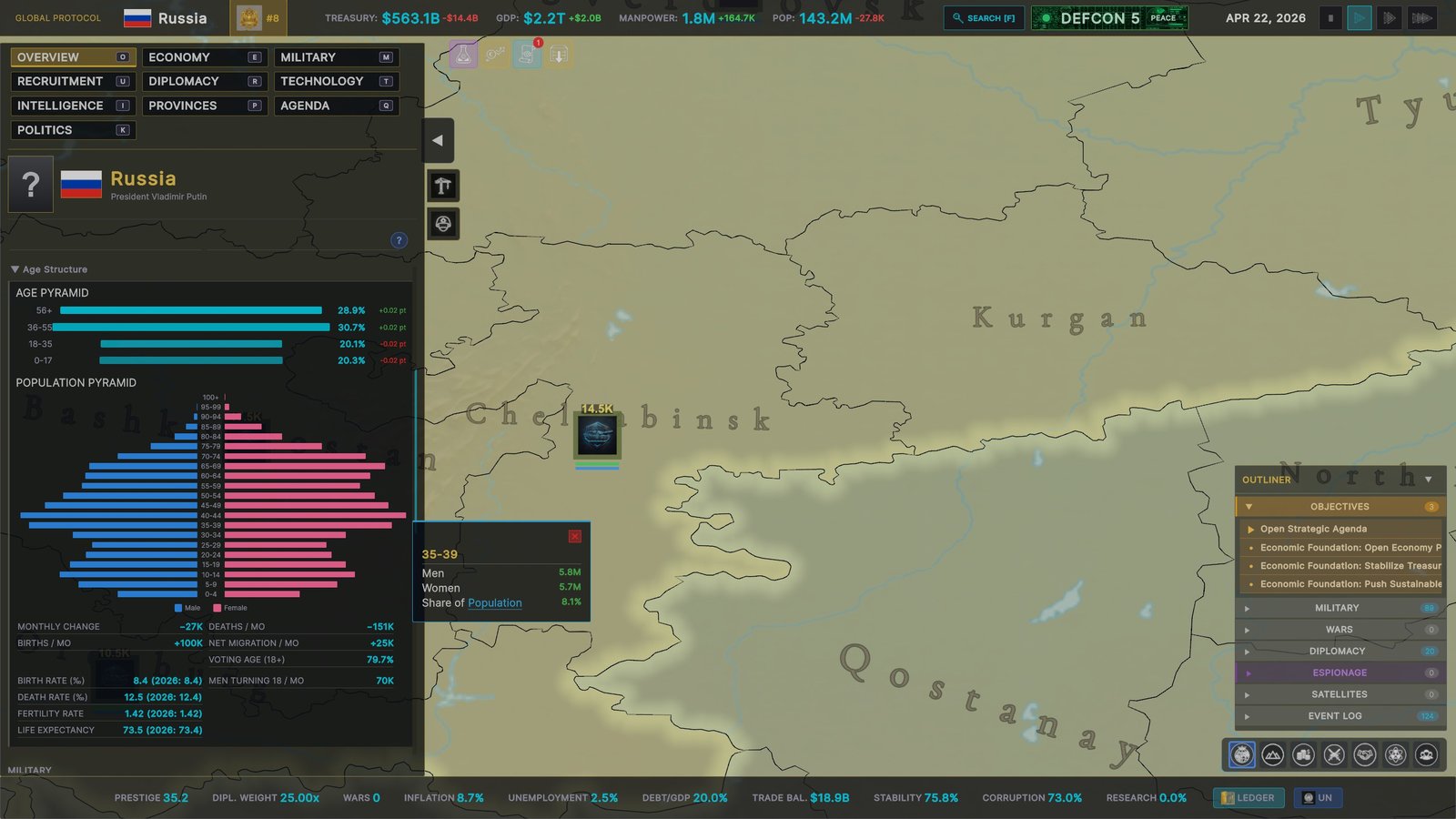
Every country in Global Protocol now carries a full population pyramid: the number of men and women at every single age, from newborns to 100 and over. And every one of those numbers starts from real data.
Here’s how the starting world is built:
- Real data. The World Bank publishes population by age and sex, birth and death rates, fertility, life expectancy and child mortality for nearly every country. We curated every playable country’s starting population from it; where a country has no official figures, it borrows its region’s age profile.
- From five-year groups to single years. Statistics come in five-year age groups. Our data pipeline smooths them into single years, so a country with a baby boom 35 years ago really does have more 35-year-olds than 30-year-olds.
- Moved forward to 1 January 2026. The 2024 data is run forward with the same rules the game uses, so the world you start in is the world of today.
- Calibrated country by country. Death rates come from the United Nations’ model life tables. For each country we solve three small correction factors — for child deaths, adult deaths and births — so that its first year in the game matches its real birth and death rates.
- Sanity-checked. Where one year’s figure is a one-off shock rather than the trend, we start from the underlying level instead. Examples are China’s 2024 Dragon Year baby bump and Monaco’s death rate inflated by wealthy retirees. War-shock years are handled the same way: the game’s own war devastation adds those deaths once fighting starts.
The result is a world that grows by about 0.86 % in its first year, close to the UN’s own projection, with each country within a few tenths of a percentage point of it.
How a population lives
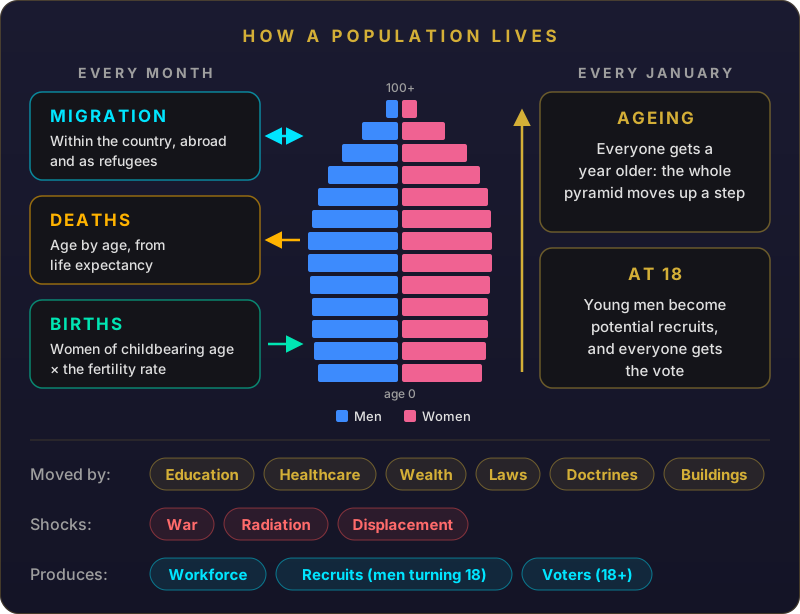
Once the game starts, your population’s future doesn’t follow a predetermined curve. Nothing tells Japan to shrink or Nigeria to grow: every change comes out of the simulation.
Every month:
- Deaths are worked out age by age from each province’s life expectancy. A newborn, a 40-year-old and an 85-year-old each face their own, very different risk.
- Births come from the number of women of childbearing age and the province’s fertility rate. That’s why a young country grows quickly and an ageing one struggles even at the same fertility: what matters is who is there to have children.
- Migration moves people in and out (more on that below).
Every January, everyone gets a year older: the whole pyramid moves up a step.
What moves life expectancy and fertility
Each province starts from its country’s calibrated 2026 values. From there, every province moves on its own as things change:
- Education raises life expectancy — and lowers fertility, just as it did in every country that went through the demographic transition.
- Healthcare raises life expectancy.
- Wealth (GDP per person) raises life expectancy along the well-known Preston curve, and nudges fertility slightly down.
- Laws, doctrines and buildings add bonuses of their own (see How to change it for the better).
These changes are gradual on purpose. Life expectancy can rise by at most about 0.6 years a year, and fertility changes by at most 0.12 children per woman a year. A generation of good policy shows; a single budget tweak doesn’t. Fertility also has a soft floor of around 1.3 children per woman: a country can drift towards it, but gently.
When things go wrong
- War devastates provinces, and devastation raises death rates — hitting young children and the elderly hardest.
- Radiation from a nuclear strike does the same, for decades: it fades by just two points a year. The blast itself kills outright.
- Displacement: people flee devastated provinces as refugees. Children and women are the most likely to flee; men of fighting age the least.
Young men turning 18 fill the ranks
Your manpower now comes from real people. Every month, the young men turning 18 become potential recruits, and a share of them joins your reserve. That share grows with a bigger defence budget and a stricter conscription law. A birth-rate collapse 18 years ago shows up in your barracks today. In the Russia screenshot above, about 70,000 young men come of age every month.
Migration
People move for two very different reasons.
Within your country, they drift towards provinces that are more developed and calmer — up to 2 % of a province’s population a month. Neglected, restless regions empty out; thriving ones grow.
Across borders, everyday migration follows each country’s real long-term migration rate, which your immigration law can raise or lower. And when a province’s unrest climbs above 60, its people start fleeing to neighbouring countries as refugees.
Two rules keep this honest:
- The world’s books balance. Worldwide, arrivals are scaled every month to match departures, so over a long campaign migration can’t quietly inflate the world’s population.
- Migrants have ages too. Economic migrants are mostly young adults, so a country that attracts them gets younger. Refugees are more often children and women.
Youth, jobs and unrest
A country with many young adults and too few jobs gets restless. When the share of 18–35-year-olds among your adults is above the world average and unemployment is above 8 %, unrest creeps up every month — by up to half a point. Poverty adds more. Social spending, especially in an educated country, brings it back down.
Inside politics
Your people don’t just work and fight. They vote.
Everyone aged 18 and over is part of the electorate. In the simulation, age groups use different baseline turnout rates and political tendencies:
| Age | Turnout | Leans towards |
|---|---|---|
| 18–35 | 55 % | liberal and socialist parties |
| 36–55 | 70 % | the national average |
| 56 and over | 80 % | nationalist and authoritarian parties |
So in the game, an ageing country’s politics shift over the decades: older voters turn out more, and each year there are more of them.
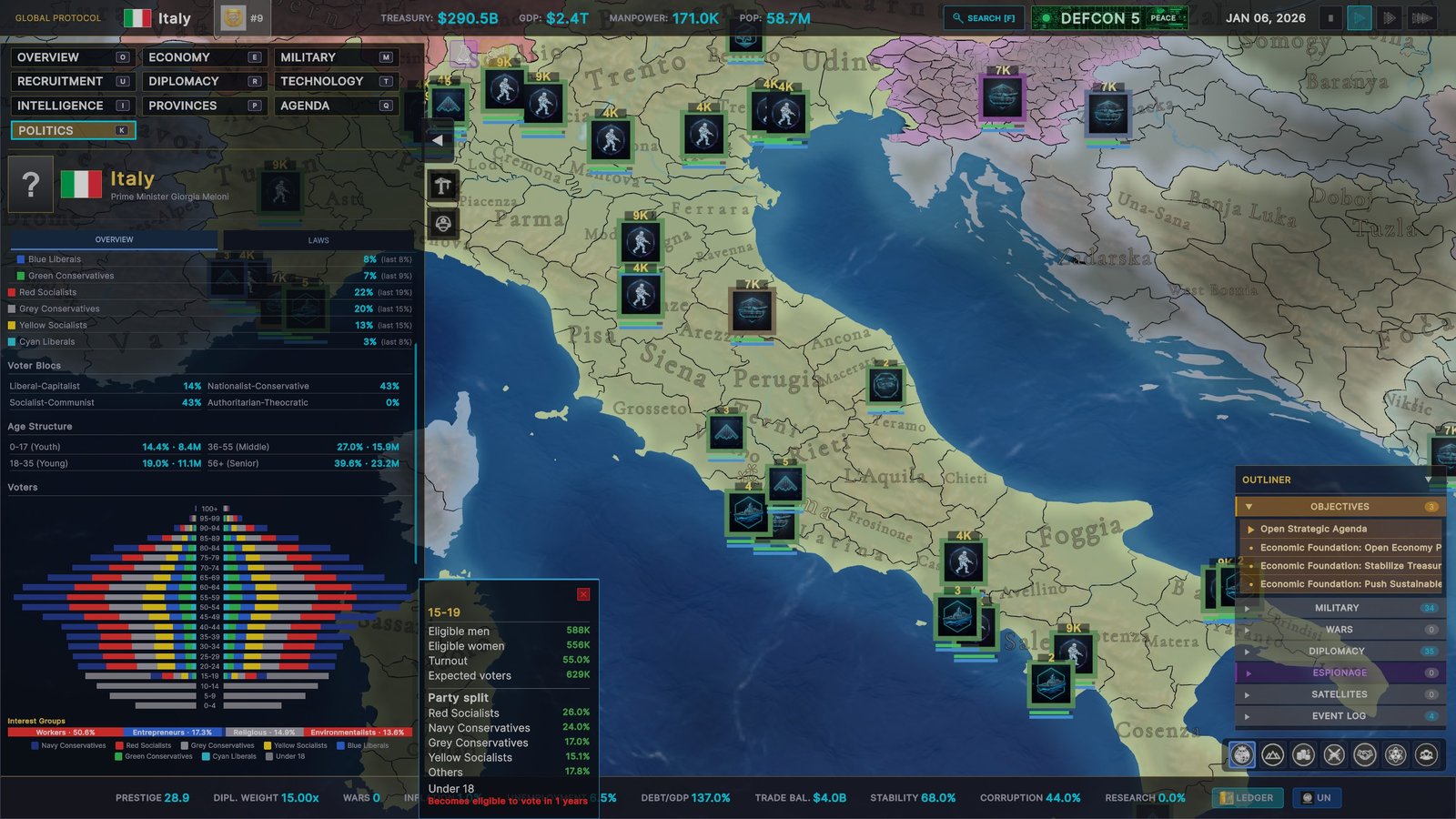
On top of age, four voter blocs — liberal-capitalist, socialist-communist, nationalist-conservative and authoritarian-theocratic — react to how the country is doing:
- Unemployment pushes voters towards socialists.
- Inflation pushes them towards nationalists.
- Unrest pushes them towards authoritarians.
- Growth rewards liberals — and the government in power.
Five interest groups — workers, entrepreneurs, the military, the religious and environmentalists — grow or shrink with your laws, education, cities, armed forces and doctrines, and they shift the national vote as they do. 104 countries feature hand-curated real-world party lineups, while every remaining country receives a four-bloc lineup tailored to its political system.
How to change it for the better
This is the part many of you asked about. Here’s what actually moves the numbers.
Help people live longer
- Fund social programmes. Your social budget share steadily raises healthcare access, which adds years of life.
- Fund research and build Public Schools. Your research budget raises education, and schools speed it up by 10 %. Education has the biggest effect of all — especially in countries that start with low life expectancy.
- Grow the economy. Richer countries live longer.
- Pick your Welfare State law: Targeted Programs (+0.3 years), Universal Services (+0.8), Comprehensive Welfare (+1.2) or Algorithmic Welfare (+0.8).
- Build Hospitals (+0.8 years) and Water Treatment (+0.5 years).
- Research health doctrines such as Public Health and Human Development (+1 year).
Laws, doctrines and buildings together add at most three years. The big, lasting gains — up to eight years above where a province started — come from education, healthcare and wealth.
More children
- Welfare: Universal Services (+2 % births), Comprehensive Welfare (+4 %), Algorithmic Welfare (+2 %).
- Reduced Workweek labour law: +1 %.
- Housing Projects: +2 % (buildings add at most 5 % in total).
- The trade-off: education and wealth lower fertility, just as they do in the real world. A rich, educated country has to work for its birth rate.
Attract people — and keep them
- Immigration law: Closed Borders (×0.9 immigration), Points-Based System (×1.01), Guest Worker Program (×1.08), Open Borders (×1.15) or Digital Visa Corridors (×1.3).
- Keep unrest below 60 in your border provinces, or people will flee as refugees.
- Develop your regions so people move within your country instead of leaving it.
Keep the peace at home
- Jobs for the young: keeping unemployment under 8 % switches off the youth-bulge pressure.
- Social spending and education bring unrest down faster; Hospitals, Public Schools and Public Libraries reduce it too.
- Mind the voters: unemployment, inflation and unrest each feed a different bloc.
See it for yourself
Open the Overview and expand Age Structure to see your pyramid, monthly births and deaths, migration and the young men coming of age, each shown next to its 2026 starting value. In any province, hover life expectancy or fertility: the tooltip breaks down exactly what is moving it.
Missile defence and mutually assured destruction
Global Protocol has always had nuclear weapons. v0.5.10 makes deterrence work the way it does in reality: you can shoot some missiles down, but never all of them — and if you launch, expect to be launched at.
Seven missiles, very different odds
Here’s how often a single defence battery stops each missile when it fires its two interceptors, before any technology or radar bonus. Ranges are in provinces.
| Missile | Range | Stopped |
|---|---|---|
| Tactical ballistic missile (conventional) | 6 | ~76 % |
| Short-range ballistic missile (nuclear) | 8 | ~73 % |
| Cruise missile (conventional) | 12 | ~70 % |
| Medium-range ballistic missile (nuclear) | 22 | ~63 % |
| Intermediate-range ballistic missile (nuclear) | 40 | ~51 % |
| Intercontinental ballistic missile (nuclear) | 52 | ~33 % |
| Submarine-launched ballistic missile (nuclear) | 46 | ~17 % |
How missile defence works
- 43 batteries across 41 sites start the game, including sites in the United States, Russia, China, India, the United Kingdom, France, Japan, South Korea, Israel and Taiwan. They cover anywhere from about 43 % of India’s population to all of Israel’s and South Korea’s, and you can build more.
- Each battery protects its own province and its neighbours.
- It engages the day before impact, firing two interceptors at each missile. Missile-defence technology improves every shot, and early-warning radars add up to +30 %. With a full radar network, even an ICBM is stopped about 73 % of the time — but no shot ever beats 95 %.
- Saturation is real. A battery has a limited number of fire channels per day and a finite magazine. Launch more than it can engage, and the rest get through.
Launch on warning
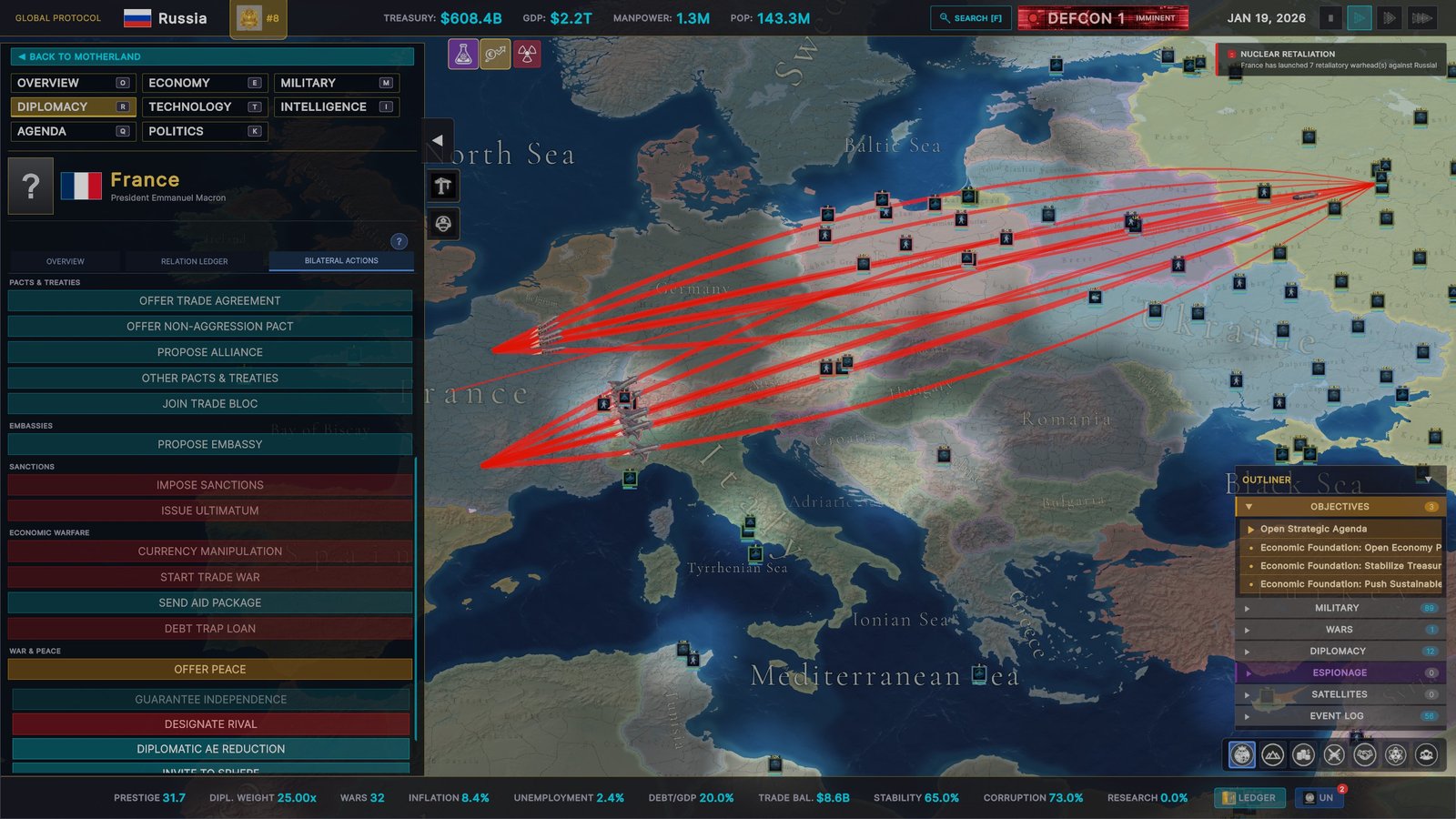
Attack a nuclear power and it won’t wait to be hit — whether it’s run by the AI or by you. The moment your missiles are in the air, it fires back:
- in proportion to what you launched, topped up to overwhelm your defences — up to 50 warheads;
- aimed first at where your missiles came from, then at your remaining launch sites;
- without the diplomatic penalty of a first strike. The world knows who started it.
Silos can only stand in fully controlled home territory, and ground zero now destroys the units and missile stacks it hits. So a first strike can blunt the reply. But missile submarines at sea are out of its reach, and their missiles are the hardest of all to intercept.
The price
A nuclear strike is never free:
- Relations collapse. The attacker loses 100 points of relations with every country except its allies — and even allies lose 10, enough over repeated use for them to walk away.
- Both economies take a massive hit: the attacker’s and the target’s.
- Fallout spreads in rings around ground zero, and radiation raises death rates for decades.
How the AI thinks about the bomb
AI nations treat a first strike as a last resort. They only consider it when they are exhausted by war and losing badly, or after losing two wars. Even then, they fire no more than a dozen warheads and keep half their interceptors in reserve. They weigh deterrence from both arsenals, and submarines count extra.
The DEFCON ladder tracks it all, from 5 — Peace through 4 — Elevated, 3 — Standby and 2 — Mobilized to 1 — Imminent and 0 — Exchange. In multiplayer, every interception and every retaliation is part of the world fingerprint that every player’s game checks.
Modding: JSON, WASM and .NET
There are three ways to change Global Protocol, from no code at all to full C#.
JSON — change the data. Units, buildings, resources, laws, doctrines, events, game settings — and whole scenarios with their own countries, borders, armies and currencies. No programming needed: the in-game Mod Builder writes it for you, and v0.5.10 adds an Events tab for branching, localised events. Publish to the Steam Workshop from the Mod Builder.
WASM — script it safely. Write logic in any language that compiles to WebAssembly (AssemblyScript, Rust, C…) and react to 13 game hooks: wars, peace, captured provinces, alliances, trade deals, every economy tick. Scripts run in a sandbox and can only do what their declared permissions allow. With v0.5.10’s new runtime, they now also run in the Windows and Linux release builds.
.NET — the whole toolbox. C# mods are loaded at runtime (on release builds through an interpreter), listen to the same game hooks, can add their own UI and do almost anything the game can. A C# mod is far less sandboxed than a script, so you’re trusting its author. A mod uses either WASM or C# for its logic, not both.
Rule of thumb: start with JSON, reach for WASM when you need logic, and use .NET when you need everything.
In multiplayer, everyone must run the same mods — and if they don’t, the lobby now tells you exactly which player and which mod differ.
And many more changes
- AI nations think twice before attacking their biggest trading partners and trade-bloc allies.
- Peace deals now price territory by what it’s really worth.
- A conqueror who crushes all resistance now reaches a full +100 decisive war score.
- In multiplayer, a peace offer from another player now waits for your answer.
- AI grudges fade over time after a war, and calls to arms never ask you to fight your own ally.
- Nuclear detonations wipe out units at ground zero, with fallout in concentric rings.
- Troops lost on sunken transports and carriers are now counted and reported.
- Destroyed armies, sunken fleets and downed air wings disappear from the map straight away.
- Modders can give each country its own military unit roster.
- Story events, like the Ukraine peace talks, now only involve the countries they’re about.
- Smoother camera panning across the map.
What’s next
We’re still in Early Access, and your feedback decides what comes next. Our development roadmap is public: see what we’re working on at our roadmap page.
Thank you
A country is its people — and now every one of them is born, grows up, moves, votes and grows old in the simulation. Thank you for every question that pushed us to build it properly, for every bug report, and for playing. If you’re enjoying the game, a Steam review helps a small team like ours more than you know.
See you on the world stage.
— Ozan Kanık, founder, Dorlion Interactive